Department of Orthopaedics and Traumatology, Kantonsspital St. Gallen, Rorschacherstrasse 95, 9007, St. Gallen, Switzerland.
Innsbruck Institute of Patient-Centered Outcome Research (IIPCOR), Innsbruck, Austria.
BMC Musculoskelet Disord. 2021 Jul 24;22(1):635. doi: 10.1186/s12891-021-04512-1.
Total knee arthroplasty is known to successfully alleviate pain and improve function in endstage knee osteoarthritis. However, there is some controversy with regard to the influence of obesity on clinical benefits after TKA. The aim of this study was to investigate the impact of body mass index (BMI) on improvement in pain, function and general health status following total knee arthroplasty (TKA).
A single-centre retrospective analysis of primary TKAs performed between 2006 and 2016 was performed. Data were collected preoperatively and 12-month postoperatively using WOMAC score and EQ-5D. Longitudinal score change was compared across the BMI categories identified by the World Health Organization.
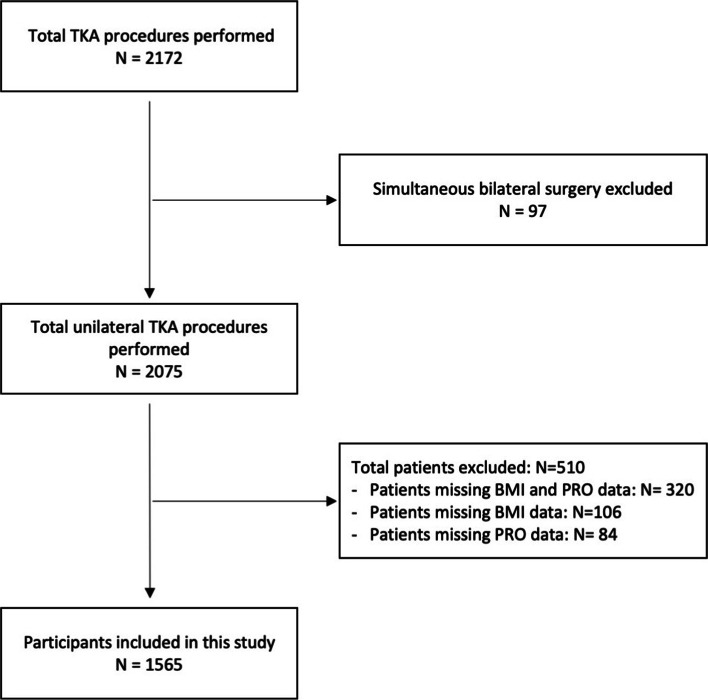
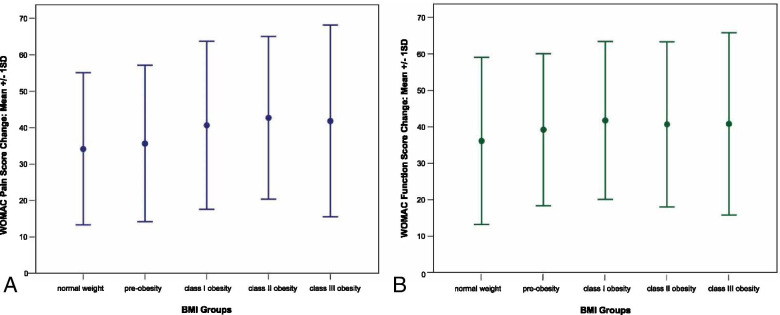
Data from 1565 patients [mean age 69.1, 62.2% women] were accessed. Weight distribution was: 21.2% BMI < 25.0 kg/m, 36.9% BMI 25.0-29.9 kg/m, 27.0% BMI 30.0-34.9 kg/m, 10.2% BMI 35.0-39.9 kg/m, and 4.6% BMI ≥ 40.0 kg/m. All outcome measures improved between preoperative and 12-month follow-up (p < 0.001). In pairwise comparisons against normal weight patients, patients with class I-II obesity showed larger improvement on the WOMAC function and total score. For WOMAC pain improvements were larger for all three obesity classes.
Post-operative improvement in joint-specific outcomes was larger in obese patients compared to normal weight patients. These findings suggest that obese patients may have the greatest benefits from TKA with regard to function and pain relief one year post-op. Well balanced treatment decisions should fully account for both: Higher benefits in terms of pain relief and function as well as increased potential risks and complications. Trial registration This trial has been registered with the ethics committee of Eastern Switzerland (EKOS; Project-ID: EKOS 2020-00,879).
全膝关节置换术已被证实可成功缓解终末期膝骨关节炎的疼痛并改善膝关节功能。然而,肥胖对全膝关节置换术后临床获益的影响仍存在争议。本研究旨在探讨体重指数(BMI)对全膝关节置换术后(TKA)疼痛、功能和总体健康状况改善的影响。
对 2006 年至 2016 年期间进行的单中心初次 TKA 进行回顾性分析。使用 WOMAC 评分和 EQ-5D 在术前和术后 12 个月收集数据。根据世界卫生组织(WHO)确定的 BMI 类别比较纵向评分变化。
共纳入 1565 例患者(平均年龄 69.1 岁,62.2%为女性)的数据。体重分布为:BMI<25.0kg/m2的占 21.2%,BMI 25.0-29.9kg/m2的占 36.9%,BMI 30.0-34.9kg/m2的占 27.0%,BMI 35.0-39.9kg/m2的占 10.2%,BMI≥40.0kg/m2的占 4.6%。所有结局指标均在术前和 12 个月随访时得到改善(p<0.001)。与正常体重患者相比,I-II 度肥胖患者在 WOMAC 功能和总分方面的改善更大。对于 WOMAC 疼痛,所有三种肥胖程度的改善都更大。
与正常体重患者相比,肥胖患者术后关节特异性结局的改善更大。这些发现表明,肥胖患者在术后 1 年可能从 TKA 中获得更大的功能和疼痛缓解获益。在进行治疗决策时,应充分考虑到这一点:疼痛缓解和功能改善方面的更高获益以及增加的潜在风险和并发症。
本试验已在瑞士东部伦理委员会(EKOS;项目-ID:EKOS 2020-00,879)注册。