Ishimoto Ryu, Mutsuzaki Hirotaka, Shimizu Yukiyo, Yoshikawa Kenichi, Koseki Kazunori, Takeuchi Ryoko, Matsumoto Shuji, Hada Yasushi
Graduate School of Comprehensive Human Sciences, University of Tsukuba, Tsukuba 305-8575, Japan.
Department of Rehabilitation Medicine, Ibaraki Prefectural University of Health Sciences Hospital, Ami 300-0331, Japan.
J Clin Med. 2024 Feb 24;13(5):1291. doi: 10.3390/jcm13051291.
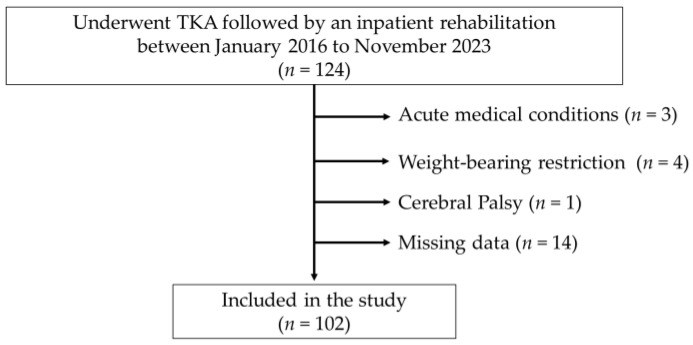
This study investigated the association between obesity and short-term patient-reported outcomes after total knee arthroplasty (TKA). The primary outcomes were the Western Ontario and McMaster Universities Osteoarthritis Index's (WOMAC) pain and function scores. Data were collected preoperatively and 2 and 4 weeks after surgery. Patients were stratified into three groups based on body mass index (BMI): normal weight (BMI < 24.99 kg/m), overweight (25 ≤ BMI < 29.99 kg/m), and obese (BMI ≥ 30 kg/m). The associations between BMI and the WOMAC pain and function scores were assessed using generalized linear mixed models. Among the 102 patients (median age: 75.0, women [85.3%]), 29.4%, 48.0%, and 22.5% were normal weight, overweight, and obese, respectively. The mean pain and function scores at baseline were similar across the BMI-stratified groups ( = 0.727 and 0.277, respectively). The pain score significantly improved 2 weeks post-surgery ( = 0.001). The function score improved significantly 4 weeks post-surgery ( < 0.001). The group and group-by-time interaction effects lacked statistical significance. All patients statistically and clinically showed relevant pain reduction and functional improvement shortly after TKA, irrespective of their obesity status. These data may help healthcare professionals discuss the expectations of pain amelioration and functional improvement with TKA candidates.
本研究调查了全膝关节置换术(TKA)后肥胖与患者报告的短期结局之间的关联。主要结局指标为西安大略和麦克马斯特大学骨关节炎指数(WOMAC)的疼痛和功能评分。在术前以及术后2周和4周收集数据。根据体重指数(BMI)将患者分为三组:正常体重(BMI < 24.99 kg/m²)、超重(25 ≤ BMI < 29.99 kg/m²)和肥胖(BMI ≥ 30 kg/m²)。使用广义线性混合模型评估BMI与WOMAC疼痛和功能评分之间的关联。在102例患者(中位年龄:75.0岁,女性占[85.3%])中,正常体重、超重和肥胖患者分别占29.4%、48.0%和22.5%。BMI分层组之间基线时的平均疼痛和功能评分相似(分别为P = 0.727和P = 0.277)。术后2周疼痛评分显著改善(P = 0.001)。术后4周功能评分显著改善(P < 0.001)。组间及组与时间的交互作用无统计学意义。无论肥胖状态如何,所有患者在TKA后短期内均在统计学和临床上显示出相关的疼痛减轻和功能改善。这些数据可能有助于医护人员与TKA候选患者讨论疼痛缓解和功能改善的预期情况。