
GR24,一种合成独脚金内酯类似物,以及光照影响拟南芥下胚轴细胞中皮层微管的组织。
GR24, A Synthetic Strigolactone Analog, and Light Affect the Organization of Cortical Microtubules in Arabidopsis Hypocotyl Cells.
作者信息
Krasylenko Yuliya, Komis George, Hlynska Sofiia, Vavrdová Tereza, Ovečka Miroslav, Pospíšil Tomáš, Šamaj Jozef
机构信息
Department of Cell Biology, Centre of the Region Haná for Biotechnological and Agricultural Research, Faculty of Science, Palacký University Olomouc, Olomouc, Czechia.
Department of Chemical Biology and Genetics, Centre of the Region Haná for Biotechnological and Agricultural Research, Faculty of Science, Palacký University Olomouc, Olomouc, Czechia.
出版信息
Front Plant Sci. 2021 Jul 7;12:675981. doi: 10.3389/fpls.2021.675981. eCollection 2021.
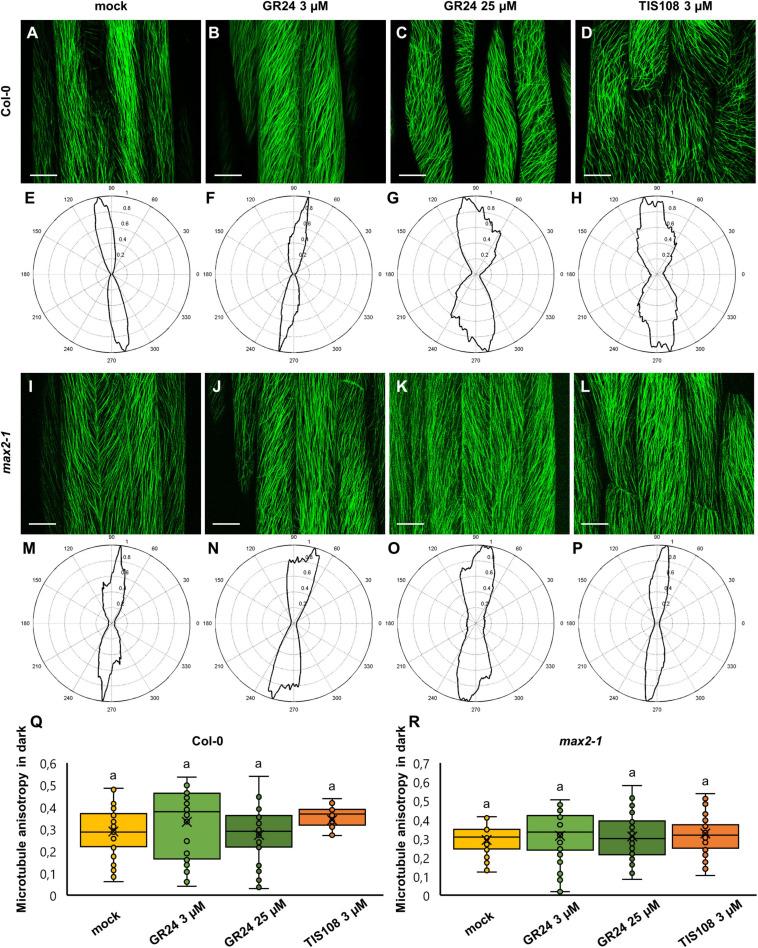
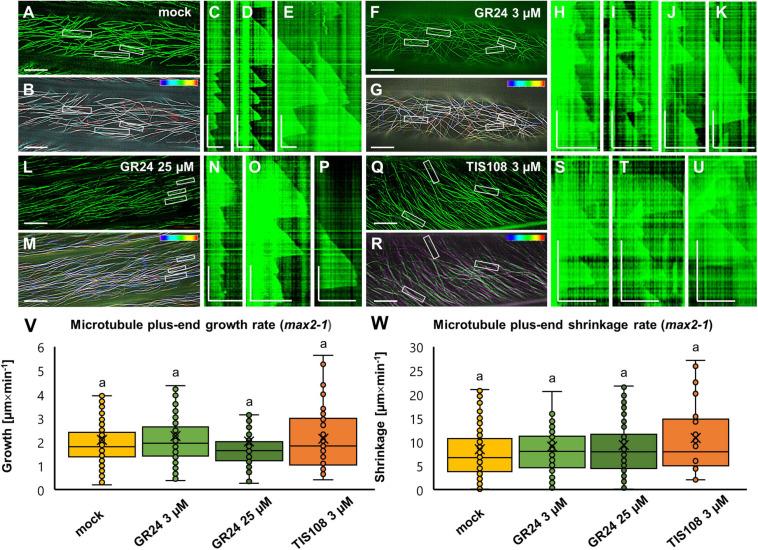
Strigolactones are plant hormones regulating cytoskeleton-mediated developmental events in roots, such as lateral root formation and elongation of root hairs and hypocotyls. The latter process was addressed herein by the exogenous application of a synthetic strigolactone, GR24, and an inhibitor of strigolactone biosynthesis, TIS108, on hypocotyls of wild-type Arabidopsis and a strigolactone signaling mutant . Owing to the interdependence between light and strigolactone signaling, the present work was extended to seedlings grown under a standard light/dark regime, or under continuous darkness. Given the essential role of the cortical microtubules in cell elongation, their organization and dynamics were characterized under the conditions of altered strigolactone signaling using fluorescence microscopy methods with different spatiotemporal capacities, such as confocal laser scanning microscopy (CLSM) and structured illumination microscopy (SIM). It was found that GR24-dependent inhibition of hypocotyl elongation correlated with changes in cortical microtubule organization and dynamics, observed in living wild-type and seedlings stably expressing genetically encoded fluorescent molecular markers for microtubules. Quantitative assessment of microscopic datasets revealed that chemical and/or genetic manipulation of strigolactone signaling affected microtubule remodeling, especially under light conditions. The application of GR24 in dark conditions partially alleviated cytoskeletal rearrangement, suggesting a new mechanistic connection between cytoskeletal behavior and the light-dependence of strigolactone signaling.
独脚金内酯是一类植物激素,可调节根部由细胞骨架介导的发育过程,如侧根形成以及根毛和下胚轴的伸长。本文通过在野生型拟南芥和独脚金内酯信号突变体的下胚轴上外源施加合成独脚金内酯GR24和独脚金内酯生物合成抑制剂TIS108,对后一过程进行了研究。由于光信号和独脚金内酯信号之间存在相互依存关系,本研究进一步扩展到在标准光/暗周期或持续黑暗条件下生长的幼苗。鉴于皮层微管在细胞伸长中起着重要作用,利用具有不同时空分辨率的荧光显微镜方法,如共聚焦激光扫描显微镜(CLSM)和结构光照显微镜(SIM),对独脚金内酯信号改变条件下皮层微管的组织和动态进行了表征。研究发现,GR24对下胚轴伸长的抑制作用与皮层微管组织和动态变化相关,这在表达微管遗传编码荧光分子标记的活体野生型和幼苗中均可观察到。对微观数据集的定量评估表明,独脚金内酯信号的化学和/或基因操作会影响微管重塑,尤其是在光照条件下。在黑暗条件下施加GR24可部分缓解细胞骨架重排,这表明细胞骨架行为与独脚金内酯信号的光依赖性之间存在新的机制联系。




 Zotero 插件