Gao Pan, Zhu Tianle, Gao Jingjing, Li Hu, Liu Xi, Zhang Xiansheng
Department of Urology, The First Affiliated Hospital of Anhui Medical University, Hefei, China.
Front Oncol. 2021 Jul 7;11:706531. doi: 10.3389/fonc.2021.706531. eCollection 2021.
Few studies have explored the optimal examined lymph node count and lymph node density cutoff values that could be used to predict the survival of patients with penile cancer. We further clarify the prognostic value of lymph node density and examined lymph node count in penile cancer.
The Surveillance, Epidemiology, and End Results (SEER) database was explored to recruit penile cancer patients from 2010 to 2015. A retrospective analysis of penile cancer patients' data from the First Affiliated Hospital of Anhui Medical University was performed for verification (2006-2016). The cutoff values of examined lymph node count and lymph node density were performed according to the ROC curve. Kaplan-Meier survival analysis was used to compare survival differences among different groups. Univariate and multivariate Cox proportional hazard regression analyses were used to determine the significant variables. On the basis of Cox proportional hazards regression model, a nomogram was established and validated by calibration plot diagrams and concordance index (C-index).
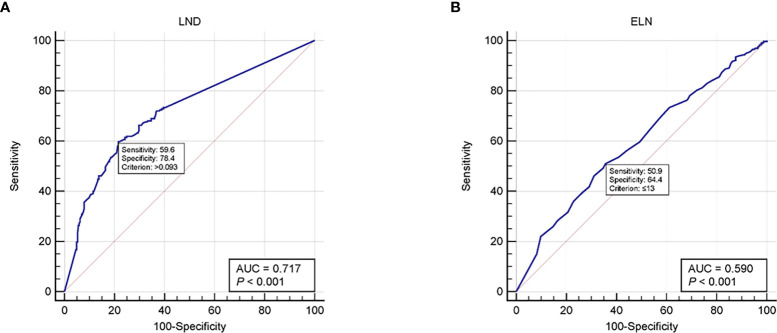
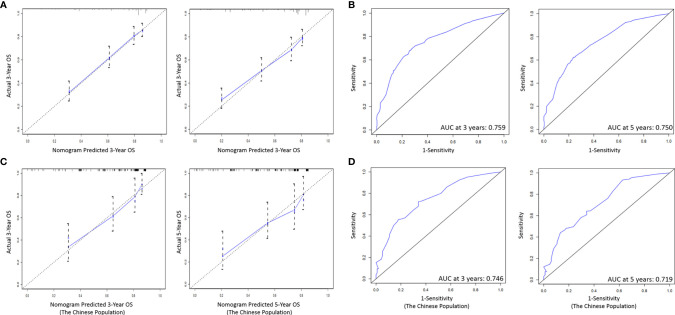
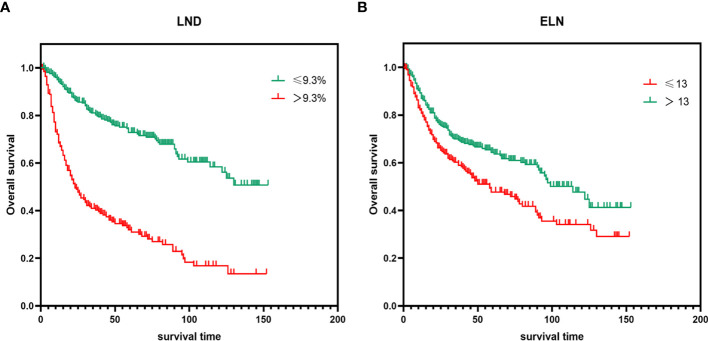
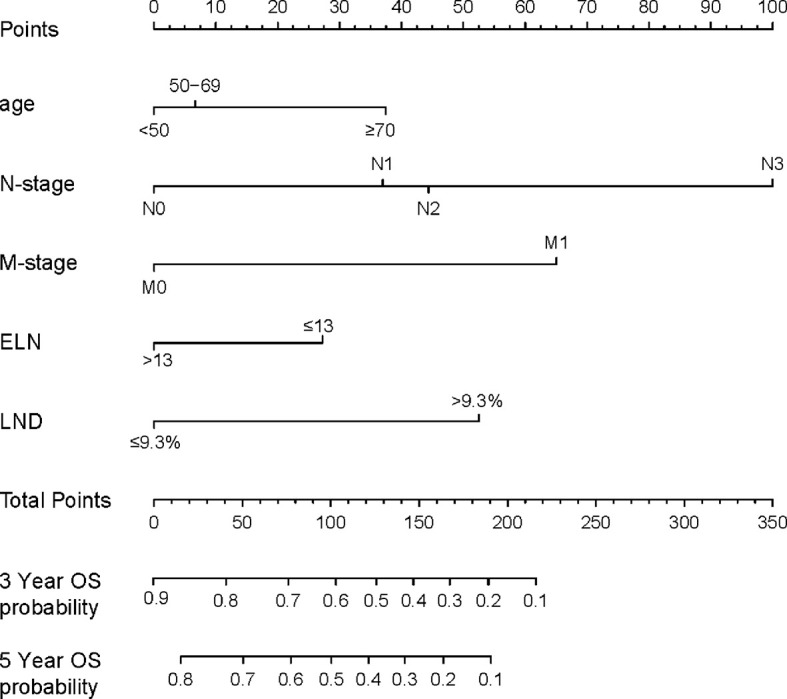
A total of 528 patients in the Surveillance, Epidemiology, and End Results cohort and 156 patients in the Chinese cohort were included in this study. Using the ROC curve, we found that the recommended cutoff values of ELN and LND were 13 and 9.3%, respectively (P <0.001). Kaplan-Meier curves suggested the significant differences of overall survival among different examined lymph nodes and lymph node density. Multivariate analysis indicated ELN and LND were independent prognostic factor for OS of penile cancer patients. Nomogram showed the contribution of ELN and LND to predicting OS was large. The C-index at 3-, and 5-year were 0.744 for overall survival (95% CI 0.711-0.777).
The more lymph nodes examined, the lower the density of lymph nodes, and the higher the long-term survival rate of penile cancer. We recommended 13 examined lymph nodes and lymph node density >9.3% as the cutoff value for evaluating the prognosis of penile cancer patients.
很少有研究探讨可用于预测阴茎癌患者生存率的最佳检查淋巴结数量和淋巴结密度临界值。我们进一步阐明了淋巴结密度和检查淋巴结数量在阴茎癌中的预后价值。
利用监测、流行病学和最终结果(SEER)数据库招募2010年至2015年的阴茎癌患者。对安徽医科大学第一附属医院阴茎癌患者的数据进行回顾性分析以作验证(2006 - 2016年)。根据受试者工作特征(ROC)曲线确定检查淋巴结数量和淋巴结密度的临界值。采用Kaplan - Meier生存分析比较不同组之间的生存差异。单因素和多因素Cox比例风险回归分析用于确定显著变量。在Cox比例风险回归模型的基础上,建立列线图并通过校准图和一致性指数(C指数)进行验证。
本研究纳入了SEER队列中的528例患者和中国队列中的156例患者。通过ROC曲线,我们发现推荐的检查淋巴结数量(ELN)和淋巴结密度(LND)临界值分别为13和9.3%(P <0.001)。Kaplan - Meier曲线表明不同检查淋巴结数量和淋巴结密度的患者总生存率存在显著差异。多因素分析表明ELN和LND是阴茎癌患者总生存期的独立预后因素。列线图显示ELN和LND对预测总生存期的贡献很大。总生存期3年和5年的C指数为0.744(95%可信区间0.711 - 0.777)。
检查的淋巴结越多,淋巴结密度越低,阴茎癌患者的长期生存率越高。我们建议将13个检查淋巴结和淋巴结密度>9.3%作为评估阴茎癌患者预后的临界值。