Diagnostic and Treatment Center for Refractory Diseases of Abdomen Surgery, Shanghai Tenth People's Hospital, Tongji University School of Medicine, Shanghai, China.
Institute for Intestinal Diseases, Tongji University School of Medicine, Shanghai, China.
Front Cell Infect Microbiol. 2021 Jul 6;11:657867. doi: 10.3389/fcimb.2021.657867. eCollection 2021.
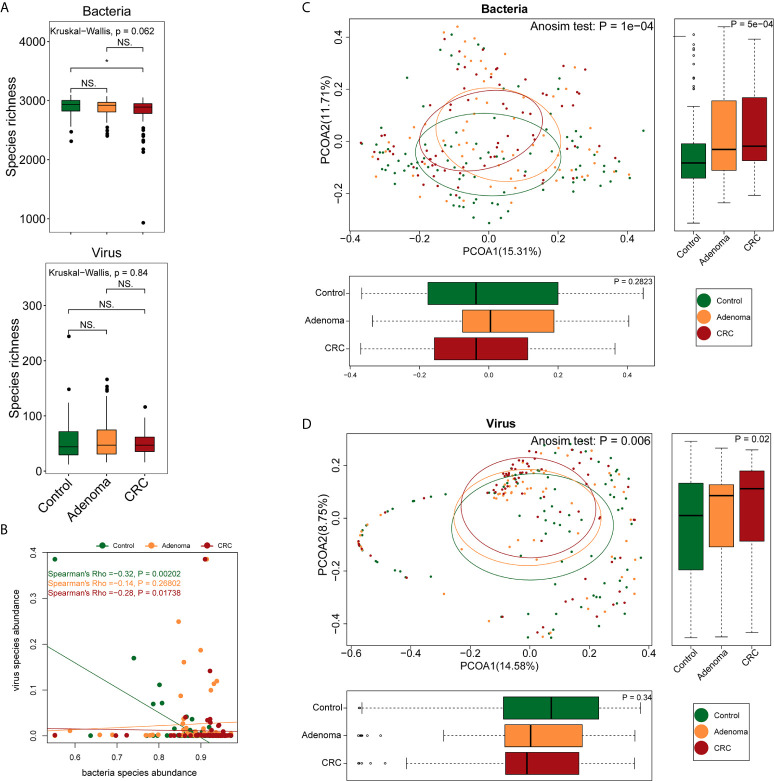
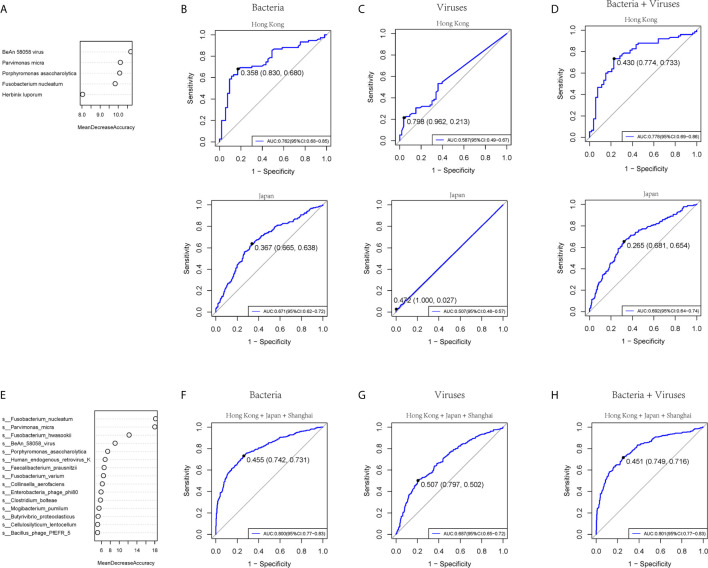
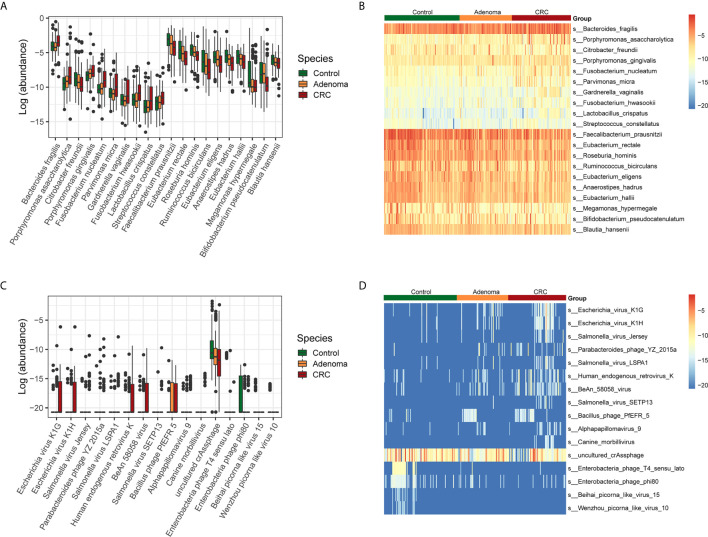
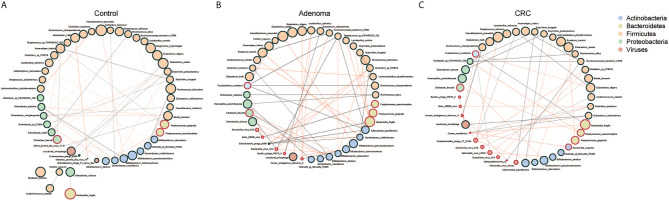
Gut microbiome alteration was closely associated with colorectal cancer (CRC). Previous studies had demonstrated the bacteria composition changes but lacked virome profiles, trans-kindom interactions, and reliable diagnostic model explorations in CRC. Hence, we performed metagenomic sequencing to investigate the gut microbiome and microbial interactions in adenoma and CRC patients. We found the decreased microbial diversity in CRC and revealed the taxonomic alterations of bacteria and viruses were highly associated with CRC at the species level. The relative abundance of oral-derived species, such as , , , and , increased. At the same time, butyrate-producing and anti-inflammatory microbes decreased in adenoma and CRC by non-parametric Kruskal-Wallis test. Despite that, the relative abundance of and increased, whereas some phages, including and , decreased along with CRC development. Gut bacteria was negatively associated with viruses in CRC and healthy control by correlation analysis (P=0.017 and 0.002, respectively). Viruses were much more dynamic than the bacteria as the disease progressed, and the altered microbial interactions were distinctively stage-dependent. The degree centrality of microbial interactions decreased while closeness centrality increased along with the adenoma to cancer development. was the key bacteriophage that enriched in healthy controls and positively associated with butyrate-producing bacteria. Diagnostic tests based on bacteria by random forest confirmed in independent cohorts showed better performance than viruses for CRC. In conclusion, our study revealed the novel CRC-associated bacteria and viruses that exhibited specific differences and intensive microbial correlations, which provided a reliable diagnostic panel for CRC.
肠道微生物组的改变与结直肠癌(CRC)密切相关。之前的研究已经证明了细菌组成的变化,但缺乏病毒组谱、跨领域相互作用以及 CRC 中可靠的诊断模型探索。因此,我们进行了宏基因组测序,以研究腺瘤和 CRC 患者的肠道微生物组和微生物相互作用。我们发现 CRC 中微生物多样性降低,并揭示了细菌和病毒的分类变化在物种水平上与 CRC 高度相关。口腔来源物种的相对丰度增加,如 、 、 、 。同时,丁酸产生菌和抗炎微生物通过非参数 Kruskal-Wallis 检验在腺瘤和 CRC 中减少。尽管如此, 和 的相对丰度增加,而一些噬菌体,包括 和 ,随着 CRC 的发展而减少。通过相关性分析,CRC 患者的肠道细菌与病毒呈负相关(P=0.017 和 0.002)。与细菌相比,病毒在疾病进展过程中更加活跃,并且改变的微生物相互作用具有明显的阶段依赖性。随着腺瘤向癌症的发展,微生物相互作用的中心度降低,接近度增加。 是一种丰富存在于健康对照组并与丁酸产生菌呈正相关的关键噬菌体。基于细菌的随机森林的独立队列验证的诊断测试表明,对于 CRC 来说,其性能优于病毒。总之,我们的研究揭示了新型 CRC 相关细菌和病毒,它们表现出特定的差异和强烈的微生物相关性,为 CRC 提供了一个可靠的诊断面板。