Meroni Elisa, Stakenborg Nathalie, Gomez-Pinilla Pedro J, Stakenborg Michelle, Aguilera-Lizarraga Javier, Florens Morgane, Delfini Marcello, de Simone Veronica, De Hertogh Gert, Goverse Gera, Matteoli Gianluca, Boeckxstaens Guy E
Translational Research Center for Gastrointestinal Disorders (TARGID), Lab for Intestinal Neuro-Immune Interaction, Department of Chronic Diseases, Metabolism and Ageing, Katholieke Universiteit Leuven - University of Leuven, Leuven, Belgium.
Translational Research Center for Gastrointestinal Disorders (TARGID), Lab for Mucosal Immunology, Department of Chronic Diseases, Metabolism and Ageing, Katholieke Universiteit Leuven - University of Leuven, Leuven, Belgium.
Front Med (Lausanne). 2021 Jul 7;8:694268. doi: 10.3389/fmed.2021.694268. eCollection 2021.
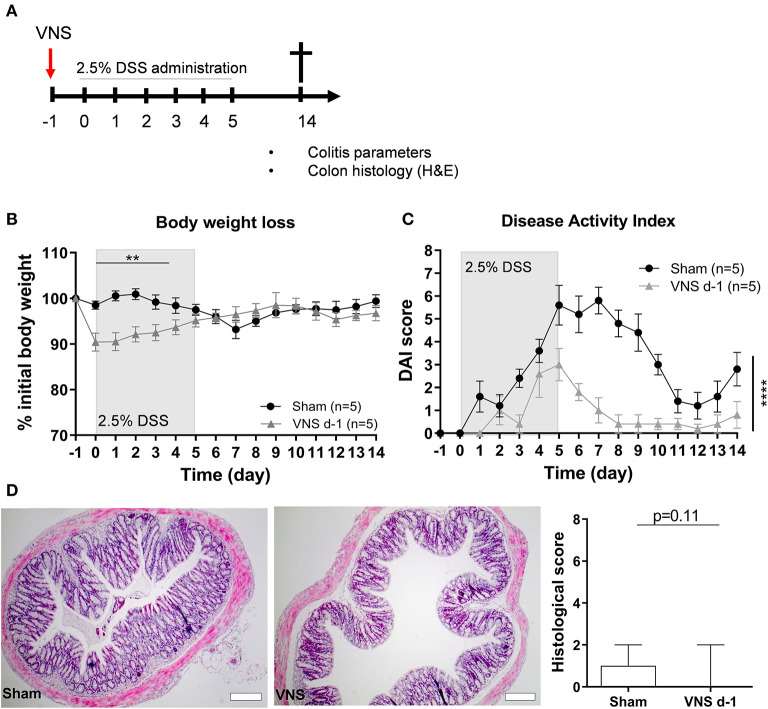
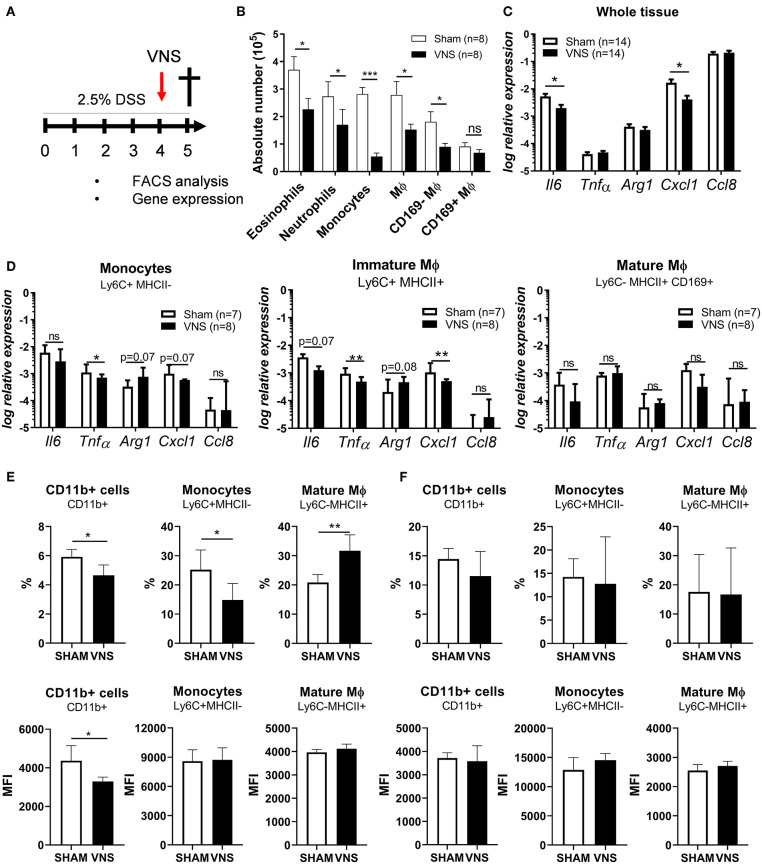
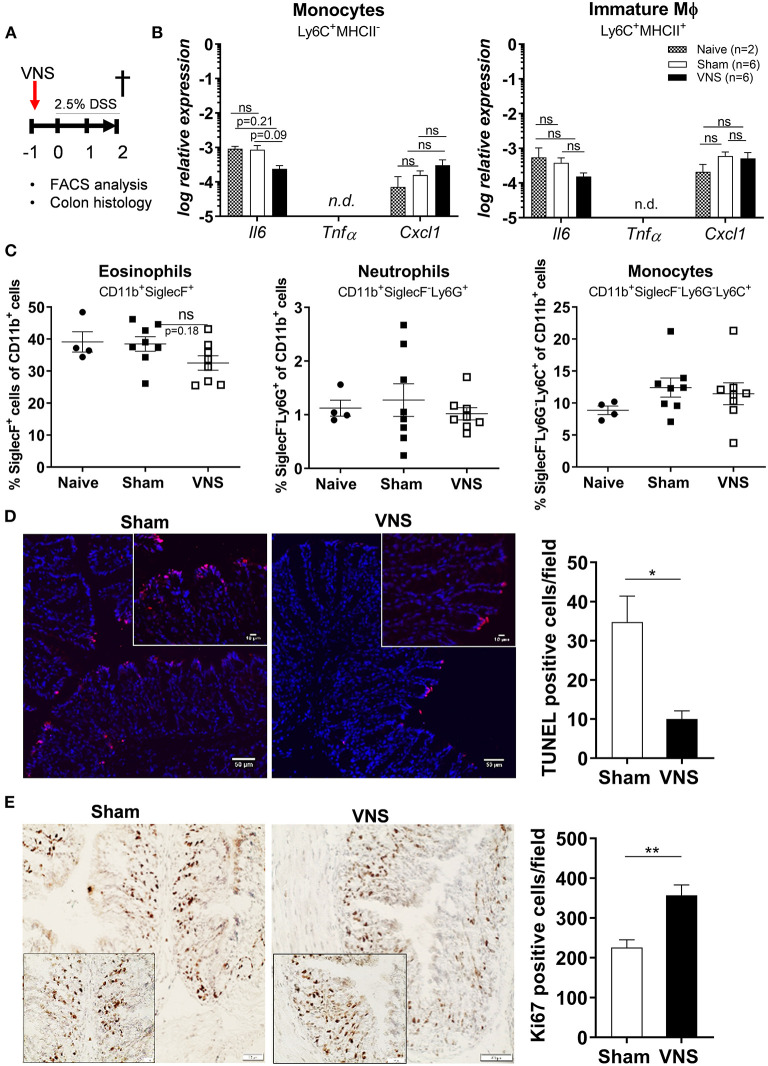
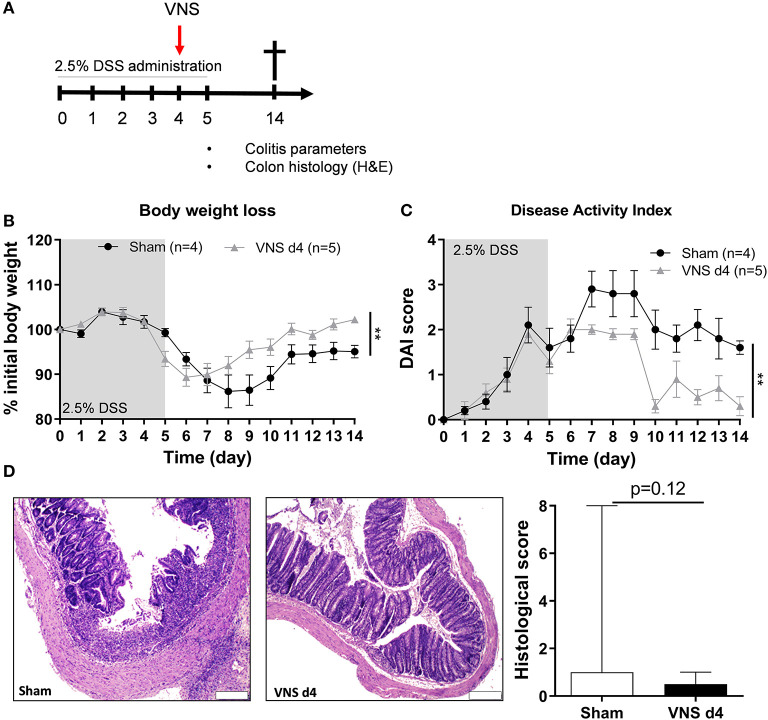
We previously showed increased susceptibility to dextran sulfate sodium (DSS)-induced colitis in vagotomized mice. Here, we evaluated whether vagus nerve stimulation (VNS) is able to reduce the severity of DSS colitis and aimed to unravel the mechanism involved. Colitis was induced in wild type mice by 2.5% DSS administration in drinking water for 5 days. VNS (5 Hz, 1 ms, 1 mA) was applied 1 day prior to and after 4 days of DSS administration to evaluate changes in epithelial integrity and inflammatory response, respectively. Epithelial integrity was assessed using TUNEL and Ki67 staining. Monocytes, immature and mature macrophages were sorted from colonic samples and gene expression levels of pro-inflammatory cytokines were studied. VNS applied prior to DSS administration (i.e., prophylactic VNS) reduced disease activity index (VNS 0.8 ± 0.6 vs. sham 2.8 ± 0.7, < 0.001, = 5) and tended to improve histology score. Prophylactic VNS significantly increased epithelial cell proliferation and diminished apoptosis compared to sham stimulation. VNS applied at day 4 during DSS administration (i.e., therapeutic VNS) decreased the influx of monocytes, monocyte-derived macrophages and neutrophils, and significantly reduced pro-inflammatory cytokine expression (i.e., α and ) in immature macrophages compared to sham stimulation. A single period of VNS applied prior to DSS exposure reduced DSS-induced colitis by an improvement in epithelial integrity. On the other hand, VNS applied during the inflammatory phase of DSS colitis reduced cytokine expression in immature macrophages. Our data further underscores the potential of VNS as novel therapeutic approach for inflammatory bowel diseases.
我们之前发现,迷走神经切断术的小鼠对葡聚糖硫酸钠(DSS)诱导的结肠炎易感性增加。在此,我们评估了迷走神经刺激(VNS)是否能够减轻DSS结肠炎的严重程度,并旨在阐明其中涉及的机制。通过在饮用水中给予2.5% DSS 5天,在野生型小鼠中诱导结肠炎。在给予DSS前1天和给予DSS 4天后分别应用VNS(5 Hz,1 ms,1 mA),以分别评估上皮完整性和炎症反应的变化。使用TUNEL和Ki67染色评估上皮完整性。从结肠样本中分选单核细胞、未成熟和成熟巨噬细胞,并研究促炎细胞因子的基因表达水平。在给予DSS之前应用VNS(即预防性VNS)可降低疾病活动指数(VNS为0.8±0.6,假手术组为2.8±0.7,<0.001,n = 5),并倾向于改善组织学评分。与假手术刺激相比,预防性VNS显著增加上皮细胞增殖并减少细胞凋亡。在给予DSS第4天应用VNS(即治疗性VNS)可减少单核细胞、单核细胞衍生的巨噬细胞和中性粒细胞的流入,与假手术刺激相比,可显著降低未成熟巨噬细胞中促炎细胞因子的表达(即α和)。在DSS暴露前应用单个周期的VNS可通过改善上皮完整性来减轻DSS诱导的结肠炎。另一方面,在DSS结肠炎的炎症期应用VNS可降低未成熟巨噬细胞中的细胞因子表达。我们的数据进一步强调了VNS作为炎症性肠病新治疗方法的潜力。