Charytan Chaim, Manllo-Karim Roberto, Martin Edouard R, Steer Dylan, Bernardo Marializa, Dua Sohan L, Moustafa Moustafa A, Saha Gopal, Bradley Charles, Eyassu Meraf, Leong Robert, Saikali Khalil G, Liu Cameron, Szczech Lynda, Yu Kin-Hung P
Nephrology Associates, PC, Queens, New York, USA.
South Texas Kidney Specialists, PA, McAllen, Teas, USA.
Kidney Int Rep. 2021 Apr 17;6(7):1829-1839. doi: 10.1016/j.ekir.2021.04.007. eCollection 2021 Jul.
Erythropoiesis-stimulating agents, standard of care for anemia of end-stage kidney disease, are associated with cardiovascular events. We evaluated the efficacy and safety of roxadustat, an oral hypoxia-inducible factor prolyl hydroxylase inhibitor that stimulates erythropoiesis.
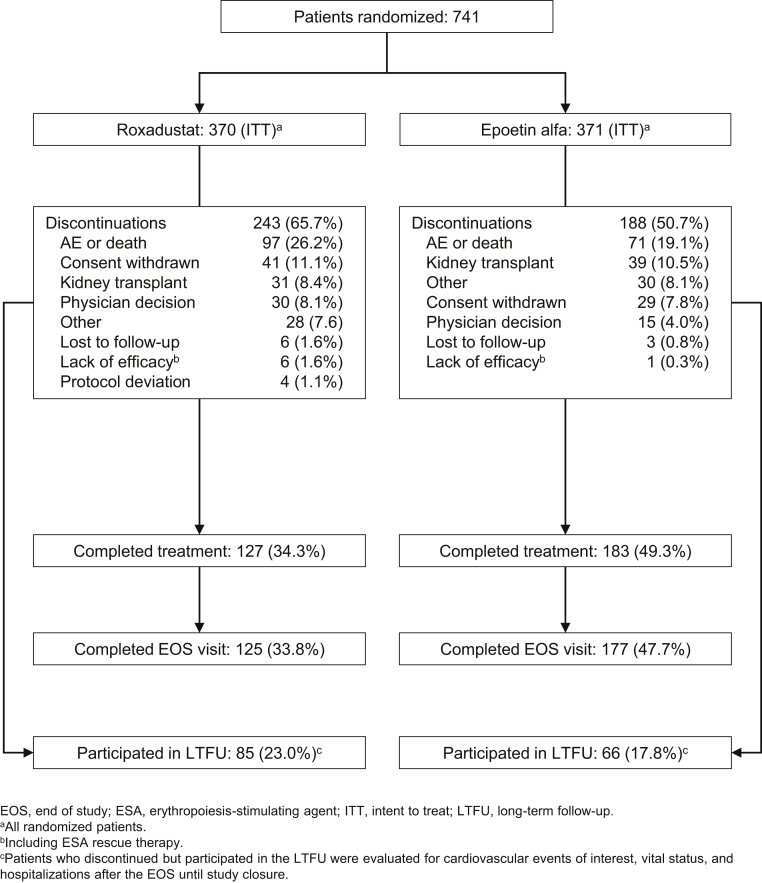
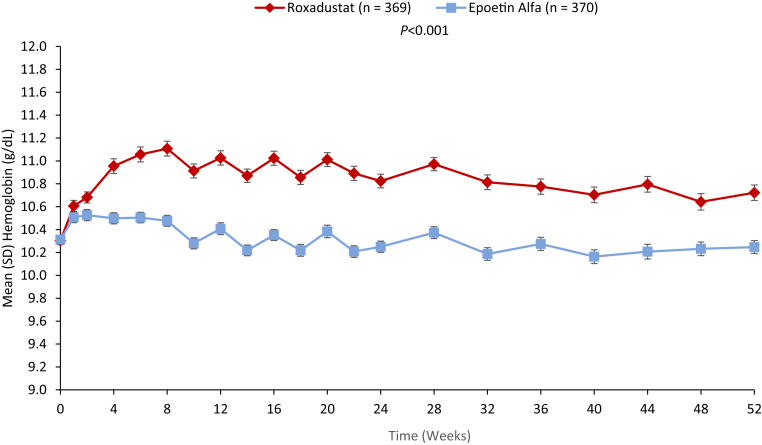
SIERRAS was a phase 3, randomized, open-label, active-controlled study enrolled adults on dialysis for end-stage kidney disease receiving erythropoiesis-stimulating agents for anemia. Patients were randomized (1:1) to thrice-weekly roxadustat or epoetin alfa. Doses were based on previous epoetin alfa dose and adjusted in the roxadustat arm to maintain hemoglobin at ∼11 g/dl during treatment. Epoetin alfa dosing was adjusted per US package insert. Primary efficacy endpoint was mean hemoglobin (g/dl) change from baseline averaged over weeks 28 to 52. Treatment-emergent adverse events were monitored.
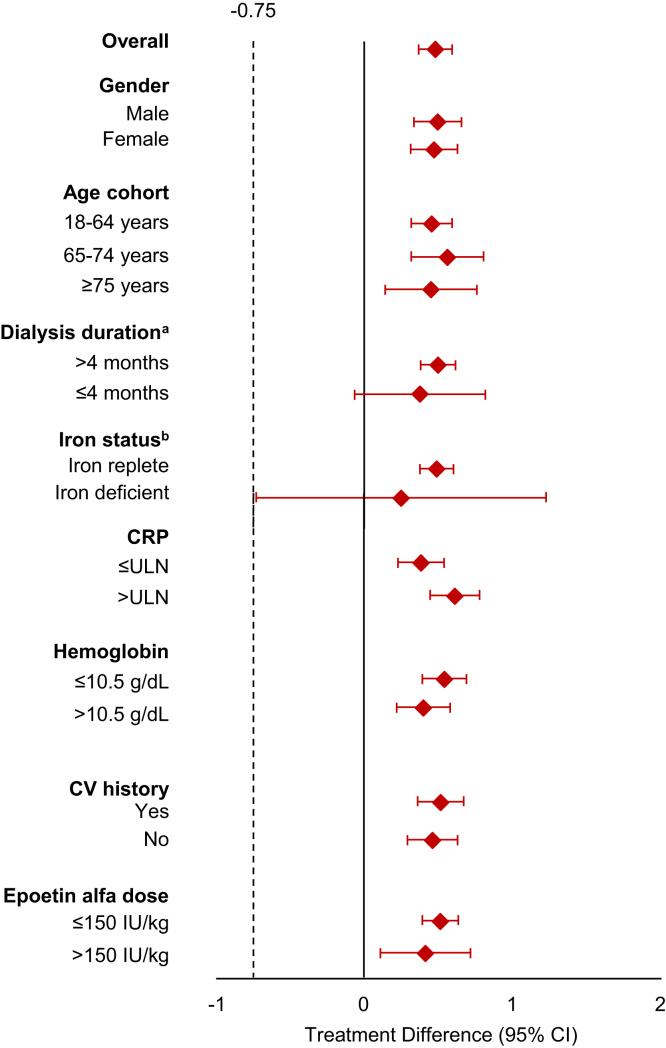
Enrolled patients (roxadustat, = 370 and epoetin alfa, = 371) had similar mean (SD) baseline hemoglobin levels (10.30 [0.66] g/dl). Mean (SD) hemoglobin changes for weeks 28 to 52 were 0.39 (0.93) and -0.09 (0.84) in roxadustat and epoetin alfa, respectively. Roxadustat was noninferior (least squares mean difference: 0.48 [95% confidence interval: 0.37, 0.59]; < 0001) to epoetin alfa. Tolerability was comparable between treatments.
In end-stage kidney disease, roxadustat was noninferior to epoetin alfa in up to 52 weeks of treatment in this erythropoietin-stimulating agent conversion study. Roxadustat had an acceptable tolerability profile.
促红细胞生成素是终末期肾病贫血的标准治疗药物,与心血管事件相关。我们评估了罗沙司他(一种口服的缺氧诱导因子脯氨酰羟化酶抑制剂,可刺激红细胞生成)的疗效和安全性。
SIERRAS是一项3期、随机、开放标签、活性对照研究,纳入了接受促红细胞生成素治疗贫血的终末期肾病透析成人患者。患者按1:1随机分组,分别接受每周三次的罗沙司他或促红细胞生成素α治疗。剂量根据先前促红细胞生成素α的剂量确定,罗沙司他组的剂量会进行调整,以在治疗期间将血红蛋白维持在约11g/dl。促红细胞生成素α的给药剂量根据美国药品说明书进行调整。主要疗效终点是第28至52周期间平均血红蛋白(g/dl)较基线的变化。监测治疗期间出现的不良事件。
入组患者(罗沙司他组n = 370,促红细胞生成素α组n = 371)的平均(标准差)基线血红蛋白水平相似(10.30 [0.66] g/dl)。罗沙司他组和促红细胞生成素α组在第28至52周期间的平均(标准差)血红蛋白变化分别为0.39(0.93)和 -0.09(0.84)。罗沙司他不劣于促红细胞生成素α(最小二乘均值差异:0.48 [95%置信区间:0.37, 0.59];P < 0.0001)。两种治疗的耐受性相当。
在这项促红细胞生成素转换治疗研究中,对于终末期肾病患者,罗沙司他在长达52周的治疗中不劣于促红细胞生成素α。罗沙司他具有可接受的耐受性。