
S494 糖基化位点影响 SARS-CoV-2 RBD 对 ACE2 的亲和力及其感染力:一项分子动力学研究。
S494 O-glycosylation site on the SARS-CoV-2 RBD affects the virus affinity to ACE2 and its infectivity; a molecular dynamics study.
机构信息
Institute for Nanoscience and Nanotechnology, Sharif University of Technology, Tehran, 14588, Iran.
Faculty of Life Sciences and Biotechnology, Shahid Beheshti University, Tehran, Iran.
出版信息
Sci Rep. 2021 Jul 26;11(1):15162. doi: 10.1038/s41598-021-94602-w.
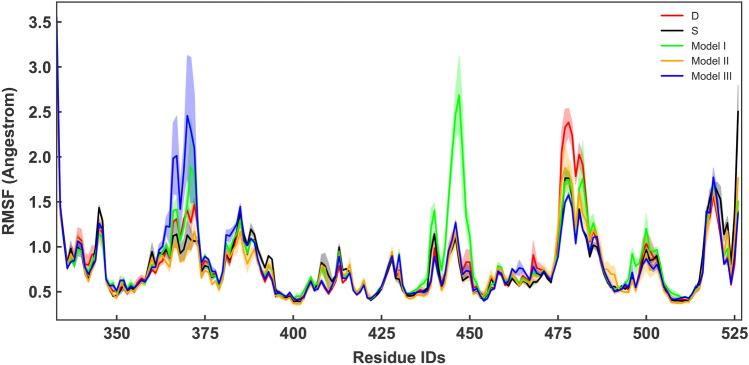
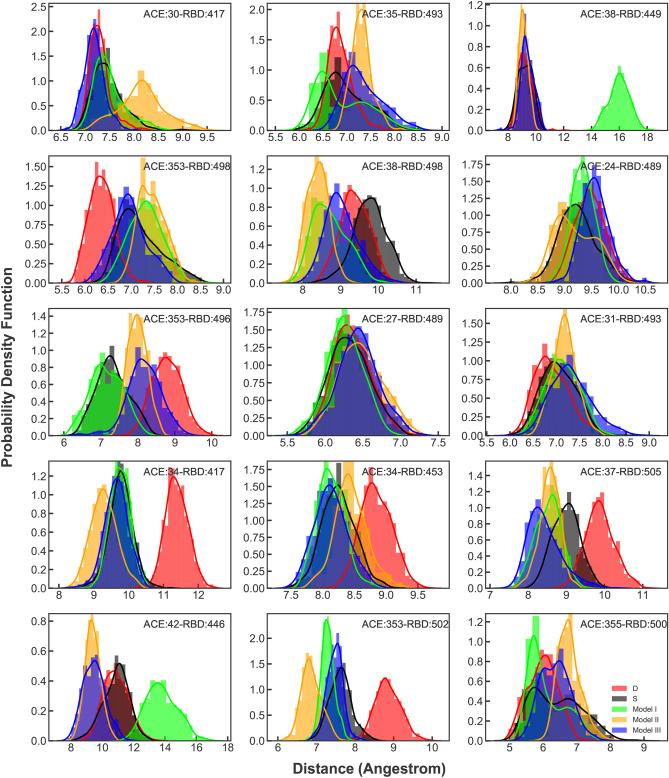
SARS-CoV-2 is a strain of Coronavirus family that caused the ongoing pandemic of COVID-19. Several studies showed that the glycosylation of virus spike (S) protein and the Angiotensin-Converting Enzyme 2 (ACE2) receptor on the host cell is critical for the virus infectivity. Molecular Dynamics (MD) simulations were used to explore the role of a novel mutated O-glycosylation site (D494S) on the Receptor Binding Domain (RBD) of S protein. This site was suggested as a key mediator of virus-host interaction. By exploring the dynamics of three O-glycosylated models and the control systems of unglcosylated S4944 and S494D complexes, it was shown that the decoration of S494 with elongated O-glycans results in stabilized interactions on the direct RBD-ACE2. Calculation of the distances between RBD and two major H1, H2 helices of ACE2 and the interacting pairs of amino acids in the interface showed that the elongated O-glycan maintains these interactions by forming several polar contacts with the neighbouring residues while it would not interfere in the direct binding interface. Relative binding free energy of RBD-ACE2 is also more favorable in the O-glycosylated models with longer glycans. The increase of RBD binding affinity to ACE2 depends on the size of attached O-glycan. By increasing the size of O-glycan, the RBD-ACE2 binding affinity will increase. Hence, this crucial factor must be taken into account for any further inhibitory approaches towards RBD-ACE2 interaction.
SARS-CoV-2 是冠状病毒科的一种病毒,它引起了目前的 COVID-19 大流行。多项研究表明,病毒刺突(S)蛋白的糖基化和宿主细胞上的血管紧张素转化酶 2(ACE2)受体对于病毒的感染力至关重要。分子动力学(MD)模拟被用于探索 S 蛋白受体结合域(RBD)上一个新的突变 O-糖基化位点(D494S)的作用。该位点被认为是病毒-宿主相互作用的关键介质。通过探索三个 O-糖基化模型的动力学以及未糖基化的 S4944 和 S494D 复合物的对照体系,表明在 S494 上进行的 O-糖基化修饰可导致与 ACE2 的直接 RBD-ACE2 相互作用稳定。计算 RBD 与 ACE2 的两个主要 H1、H2 螺旋之间的距离以及界面处相互作用的氨基酸对表明,伸长的 O-聚糖通过与相邻残基形成几个极性接触来维持这些相互作用,而不会干扰直接结合界面。O-糖基化模型中 RBD-ACE2 的相对结合自由能也更有利。RBD 与 ACE2 的结合亲和力的增加取决于附着的 O-聚糖的大小。通过增加 O-聚糖的大小,RBD-ACE2 的结合亲和力将会增加。因此,对于任何针对 RBD-ACE2 相互作用的进一步抑制方法,都必须考虑到这一关键因素。




 Zotero 插件