Institute of Physiotherapy, School of Health Professions, Zurich University of Applied Sciences, Katharina-Sulzer-Platz 9, 8401, Winterthur, Switzerland.
Research Department, Reha Rheinfelden, Salinenstrasse 98, 4310, Rheinfelden, Switzerland.
BMC Neurol. 2021 Jul 27;21(1):297. doi: 10.1186/s12883-021-02266-w.
Motor imagery (MI) has been successfully applied in neurological rehabilitation. Little is known about the spontaneous selection of the MI perspectives in patients with sensorimotor impairments. What perspective is selected: internal (first-person view), or external (third-person view)? The aim was to evaluate the MI perspective preference in patients with sensorimotor impairments.
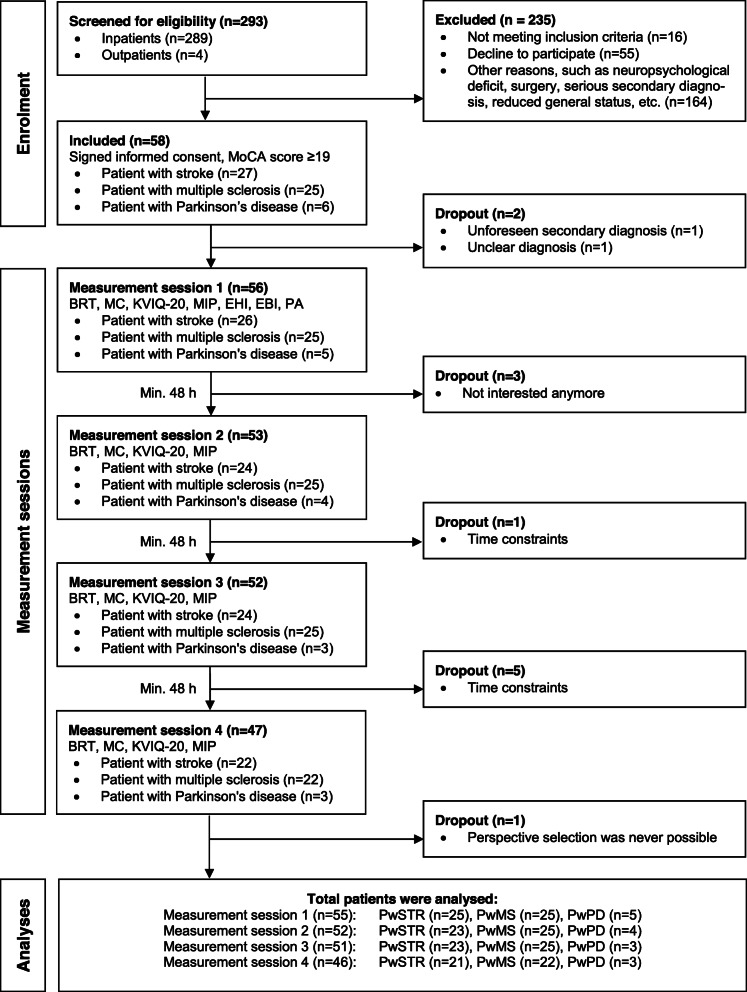
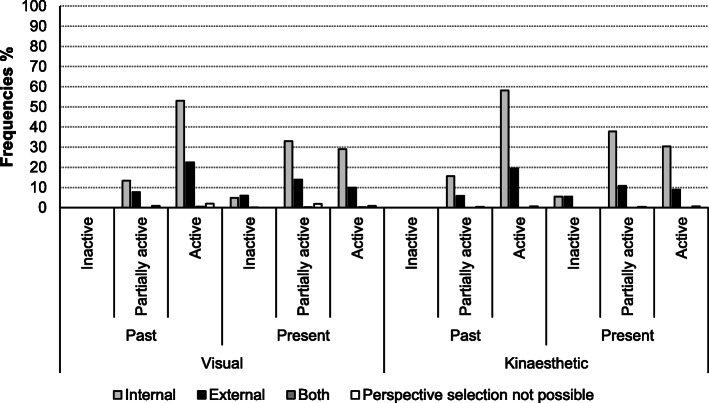
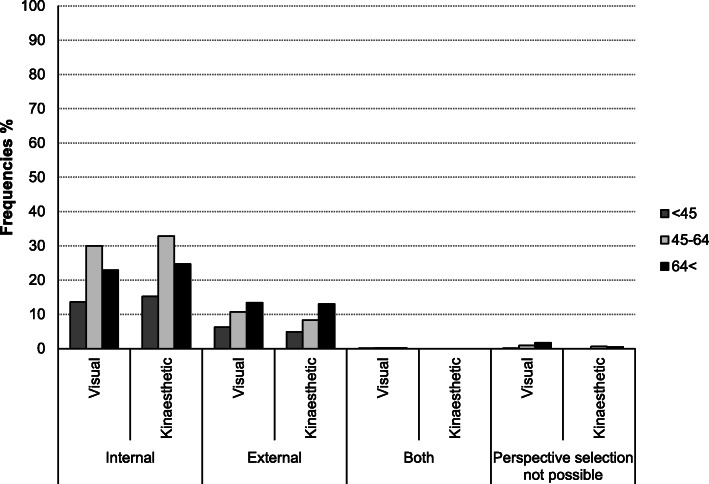
In a longitudinal study including four measurement sessions, 55 patients (25 stroke, 25 multiple sclerosis, 5 Parkinson's disease; 25 females; mean age 58 ± 14 years) were included. MI ability and perspective preference in both visual and kinaesthetic imagery modalities were assessed using the Kinaesthetic and Visual Imagery Questionnaire-20 (KVIQ-20), the body rotation task (BRT), and mental chronometry (MC). Additionally, patients' activity level was assessed. Descriptive analyses were performed regarding different age- (< 45, 45-64, > 64), activity levels (inactive, partially active, active), and KVIQ-20 movement classifications (axial, proximal, distal, upper and lower limb). A mixed-effects model was used to investiage the relationship between the primary outcome (MI perspective: internal, external) with the explanatory variables age, MI modality (visual, kinaesthetic), movement type (axial, proximal, distal), activity levels and the different assessments (KVIQ-20, BRT, MC).
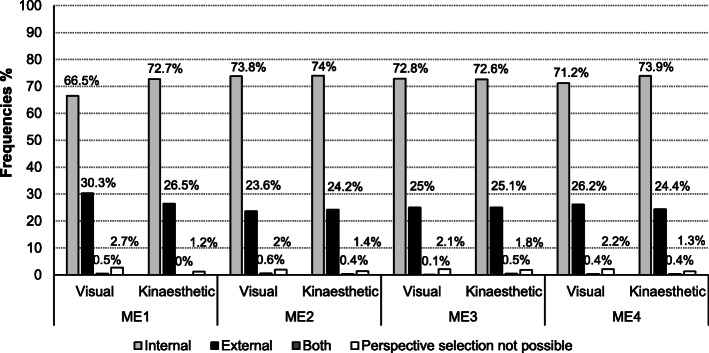
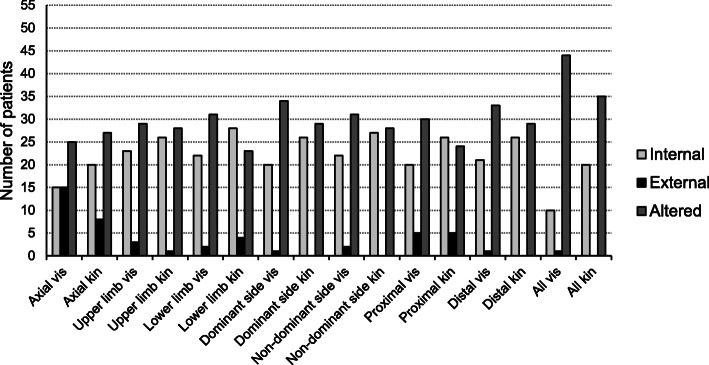
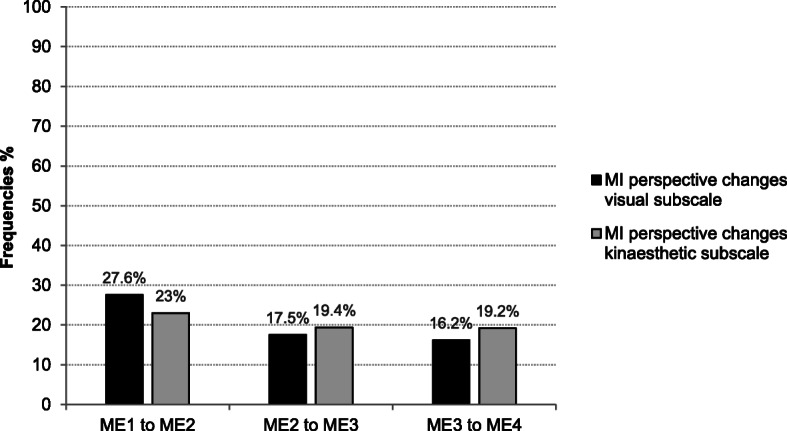
Imagery modality was not a significant predictor of perspective preference. Over the four measurement sessions, patients tended to become more consistent in their perspective selection, however, time point was not a significant predictor. Movement type was a significant predictor: imagination of distal vs. axial and proximal vs. axial movements were both associated with preference for external perspective. Patients with increased physical activity level tend to use internal imagery, however, this effect was borderline not statistically significant. Age was neither a significant precictor. Regarding the MI assessments, the KVIQ- 20 score was a significant predictor. The patients with higher test scores tend to use the external perspective.
It is recommended to evaluate the spontaneous MI perspective selection to design patient-specific MI training interventions. Distal movements (foot, finger) may be an indicator when evaluating the consistency of the MI perspective in patients with sensorimotor impairments.
运动想象(MI)已成功应用于神经康复。对于感觉运动障碍患者自发选择 MI 视角的情况知之甚少。他们会选择哪种视角:内部(第一人称视角)或外部(第三人称视角)?本研究旨在评估感觉运动障碍患者的 MI 视角偏好。
本研究为一项包含四个测量阶段的纵向研究,共纳入 55 名患者(25 例脑卒中,25 例多发性硬化症,5 例帕金森病;25 名女性;平均年龄 58±14 岁)。使用 Kinaesthetic and Visual Imagery Questionnaire-20(KVIQ-20)、身体旋转任务(BRT)和心理计时(MC)评估 MI 能力和两种视觉和动觉想象模式下的视角偏好。此外,还评估了患者的活动水平。对不同年龄(<45 岁、45-64 岁、>64 岁)、活动水平(不活跃、部分活跃、活跃)和 KVIQ-20 运动分类(轴向、近端、远端、上肢和下肢)的患者进行了描述性分析。使用混合效应模型研究主要结果(MI 视角:内部、外部)与年龄、MI 模式(视觉、动觉)、运动类型(轴向、近端、远端)、活动水平和不同评估(KVIQ-20、BRT、MC)之间的关系。
想象模式不是视角偏好的显著预测因素。在四个测量阶段中,患者在选择视角时变得更加一致,但时间点不是显著的预测因素。运动类型是一个显著的预测因素:与想象远端和近端运动相比,想象轴向运动更倾向于选择外部视角。身体活动水平较高的患者更倾向于使用内部想象,但这种影响具有统计学意义。年龄也不是一个显著的预测因素。关于 MI 评估,KVIQ-20 得分是一个显著的预测因素。得分较高的患者更倾向于使用外部视角。
建议评估自发的 MI 视角选择,以设计针对特定患者的 MI 训练干预措施。在评估感觉运动障碍患者的 MI 视角一致性时,远端运动(脚、手指)可能是一个指标。