Graduate School of Education, Dongguk University, Seoul, Republic of Korea.
Department of Radiation Oncology, Ansan Hospital, Korea University, Gyeonggido, Republic of Korea.
J Med Internet Res. 2021 Sep 2;23(9):e29642. doi: 10.2196/29642.
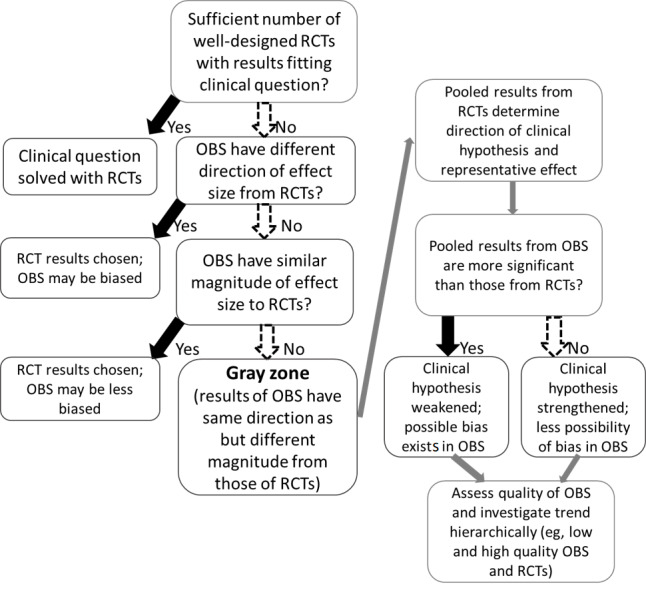
The necessity of including observational studies in meta-analyses has been discussed in the literature, but a synergistic analysis method for combining randomized and observational studies has not been reported. Observational studies differ in validity depending on the degree of the confounders' influence. Combining interpretations may be challenging, especially if the statistical directions are similar but the magnitude of the pooled results are different between randomized and observational studies (the "gray zone").
To overcome these hindrances, in this study, we aim to introduce a logical method for clinical interpretation of randomized and observational studies.
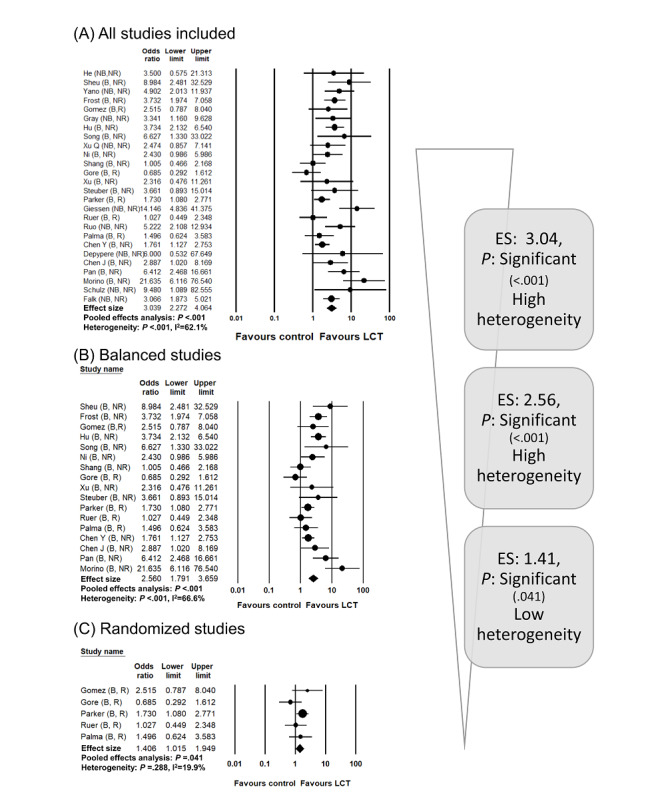
We designed a stepwise-hierarchical pooled analysis method to analyze both distribution trends and individual pooled results by dividing the included studies into at least three stages (eg, all studies, balanced studies, and randomized studies).
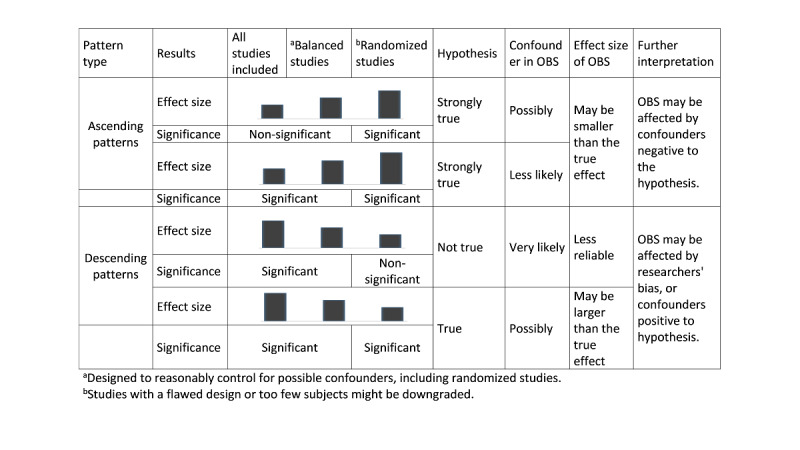
According to the model, the validity of a hypothesis is mostly based on the pooled results of randomized studies (the highest stage). Ascending patterns in which effect size and statistical significance increase gradually with stage strengthen the validity of the hypothesis; in this case, the effect size of the observational studies is lower than that of the true effect (eg, because of the uncontrolled effect of negative confounders). Descending patterns in which decreasing effect size and statistical significance gradually weaken the validity of the hypothesis suggest that the effect size and statistical significance of the observational studies is larger than the true effect (eg, because of researchers' bias).
We recommend using the stepwise-hierarchical pooled analysis approach for meta-analyses involving randomized and observational studies.
文献中已经讨论了将观察性研究纳入荟萃分析的必要性,但尚未报道一种用于合并随机和观察性研究的协同分析方法。观察性研究的有效性因混杂因素影响程度而异。合并解释可能具有挑战性,特别是如果随机和观察性研究的统计方向相似,但汇总结果的大小不同(“灰色地带”)。
为了克服这些障碍,本研究旨在介绍一种用于随机和观察性研究的临床解释的逻辑方法。
我们设计了一个逐步分层的汇总分析方法,通过将纳入的研究分为至少三个阶段(例如,所有研究、平衡研究和随机研究)来分析分布趋势和个体汇总结果。
根据该模型,假设的有效性主要基于随机研究的汇总结果(最高阶段)。随着阶段的上升,效应大小和统计显著性逐渐增加的上升模式增强了假设的有效性;在这种情况下,观察性研究的效应大小低于真实效应(例如,由于负混杂因素的不受控制的影响)。随着效应大小和统计显著性逐渐降低的下降模式削弱了假设的有效性,表明观察性研究的效应大小和统计显著性大于真实效应(例如,由于研究人员的偏见)。
我们建议在涉及随机和观察性研究的荟萃分析中使用逐步分层的汇总分析方法。