Mertens Attakias T, Santo Jonathan B, Markopoulou Katerina, Chase Bruce A
Department of Psychology, University of Nebraska at Omaha, Omaha, NE, United States of America.
Department of Neurology, NorthShore University Health System, Evanston, IL, United States of America.
Clin Park Relat Disord. 2019 Jul 20;1:13-20. doi: 10.1016/j.prdoa.2019.07.003. eCollection 2019.
Accurate early diagnosis of Parkinson's disease is hampered by its long prodromal period and the variable manifestations of its motor symptoms. While olfactory dysfunction can occur before motor-symptom onset and serve as a non-disease-specific diagnostic aid, its underlying causes are incompletely understood.
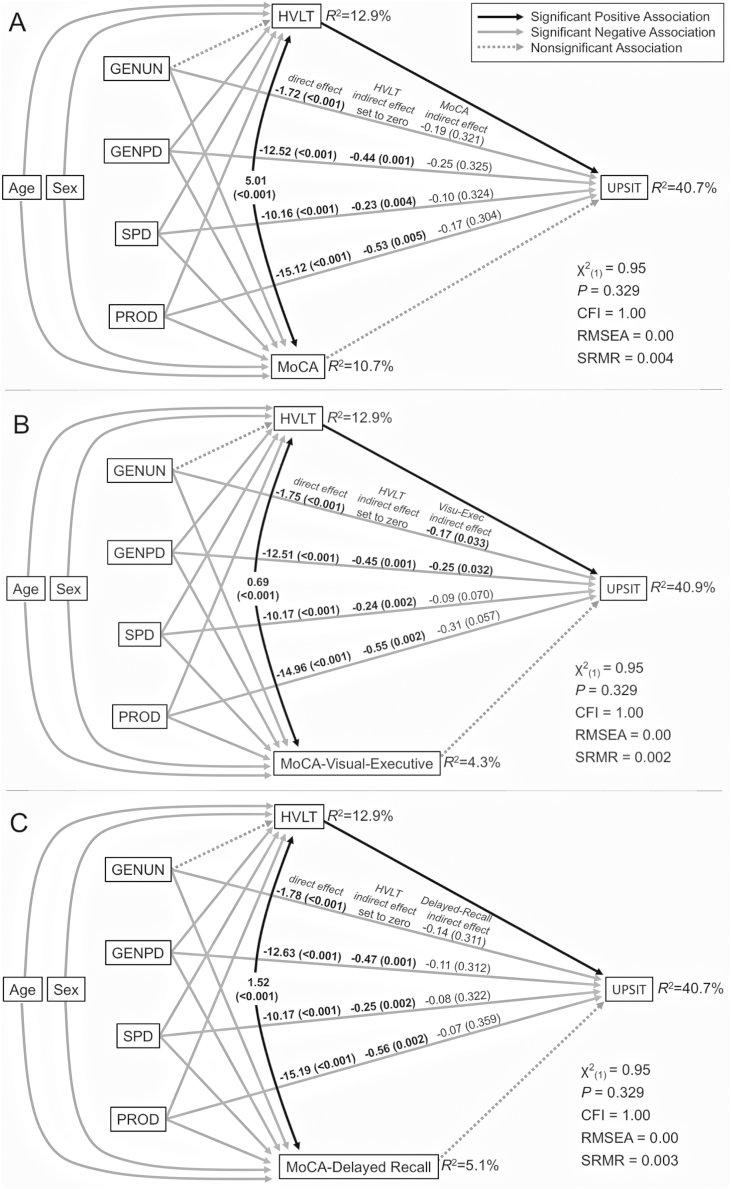
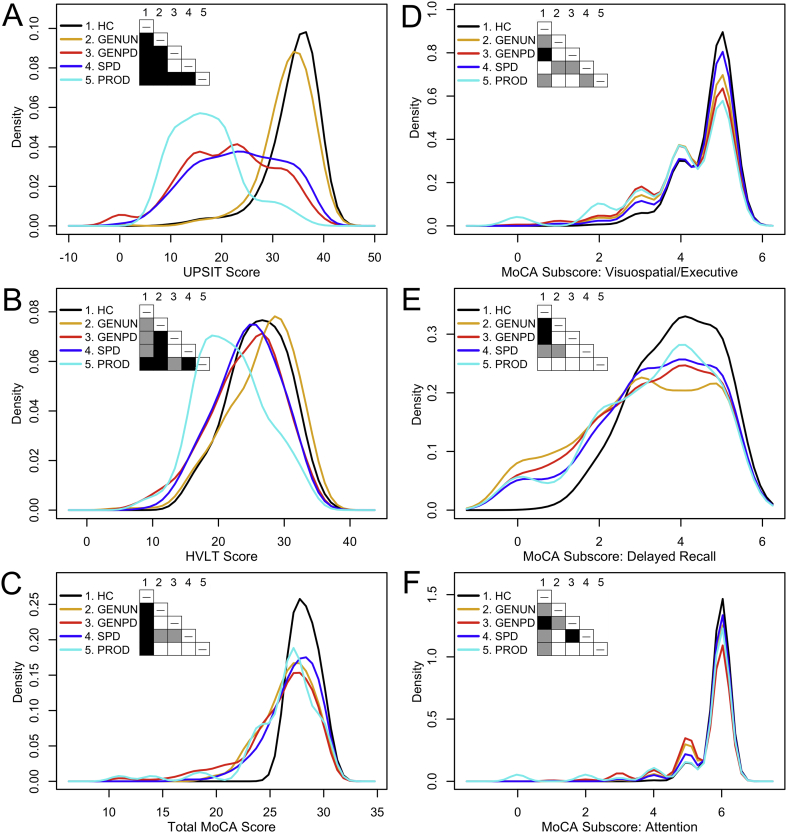
Correlation analyses, univariate density estimates, ANOVA and regression evaluated relationships between scores on the Montreal Cognitive Assessment and Hopkins Verbal Learning Test and those on the University of Pennsylvania Smell Identification Test in 1280 Parkinson's Progression Markers Initiative subjects placed into five diagnostic categories. Structural equation modeling identified cognitive measures having significant indirect effects on olfactory-function-test scores.
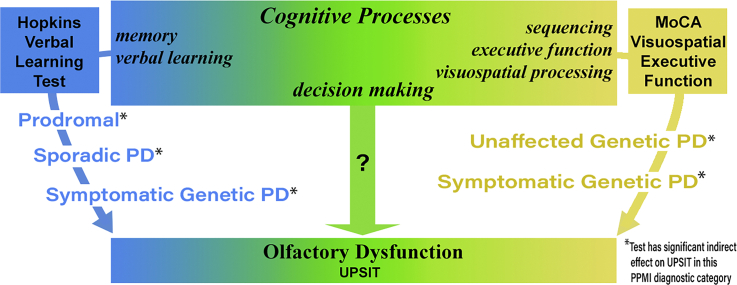
Global cognition, verbal learning and memory, attention, delayed-recall, and visuospatial/executive function scores show weak-to-moderate, significant associations with olfactory-function-test scores. Associations are stronger in symptomatic than asymptomatic subjects having mutations in , or . Score distributions are nonuniform across diagnostic categories. Linear regression found that all cognitive measures except attention predicted olfactory-function-test scores. Three structural equation models assessing indirect effects of verbal learning/memory with either global cognition, visuospatial/executive function, or delayed-recall had a good statistical fit to the data. Only verbal learning/memory scores significantly help explain olfactory-function-test scores in all symptomatic diagnostic categories (-0.56 < b < -0.23, 0.001 < < .005). Visuospatial/executive-function test scores help explain olfactory-function-test scores in both genetic Parkinson's disease diagnostic categories (-0.25 < b < -0.17, 0.032 < < .033).
Impaired verbal learning/memory and visuospatial/executive function contributes to lower performance on olfactory function tests in Parkinson's disease. As both of these domains impact decision-making, decision-making in turn may impact olfactory assessment in Parkinson's disease.
帕金森病漫长的前驱期及其运动症状的多样表现阻碍了其早期准确诊断。虽然嗅觉功能障碍可在运动症状出现之前发生,并作为一种非疾病特异性的诊断辅助手段,但其潜在原因尚未完全明确。
相关性分析、单变量密度估计、方差分析和回归分析评估了1280名帕金森病进展标志物计划受试者在蒙特利尔认知评估和霍普金斯言语学习测试中的得分与宾夕法尼亚大学嗅觉识别测试得分之间的关系,这些受试者被分为五个诊断类别。结构方程模型确定了对嗅觉功能测试得分有显著间接影响的认知指标。
整体认知、言语学习与记忆、注意力、延迟回忆以及视觉空间/执行功能得分与嗅觉功能测试得分呈弱至中度的显著关联。在有 、 或 基因突变的有症状受试者中,这种关联比无症状受试者更强。得分分布在各诊断类别中不均匀。线性回归发现,除注意力外,所有认知指标均能预测嗅觉功能测试得分。三个评估言语学习/记忆通过整体认知、视觉空间/执行功能或延迟回忆产生间接影响的结构方程模型对数据有良好的统计拟合度。只有言语学习/记忆得分在所有有症状诊断类别中显著有助于解释嗅觉功能测试得分(-0.56 < b < -0.23,0.001 < <.005)。视觉空间/执行功能测试得分在两个遗传性帕金森病诊断类别中有助于解释嗅觉功能测试得分(-0.25 < b < -0.17,0.032 < <.033)。
言语学习/记忆和视觉空间/执行功能受损导致帕金森病患者嗅觉功能测试表现较差。由于这两个领域都会影响决策,决策反过来可能会影响帕金森病的嗅觉评估。