Program in Medical and Population Genetics and Cardiovascular Disease Initiative, Broad Institute of MIT and Harvard, Cambridge, MA (S.H.C., S.J.J., A.W.H., J.L.H., V.N.M., L.-C.W., M.D.C., C.J.-Y.L., H.L.R., C.R., P.T.E., S.A.L.).
Department of Translational Data Science and Informatics (C.M.H., B.K.F.), Geisinger, Danville, PA.
Circ Genom Precis Med. 2021 Aug;14(4):e003300. doi: 10.1161/CIRCGEN.120.003300. Epub 2021 Jul 28.
Alterations in electrocardiographic (ECG) intervals are well-known markers for arrhythmia and sudden cardiac death (SCD) risk. While the genetics of arrhythmia syndromes have been studied, relations between electrocardiographic intervals and rare genetic variation at a population level are poorly understood.
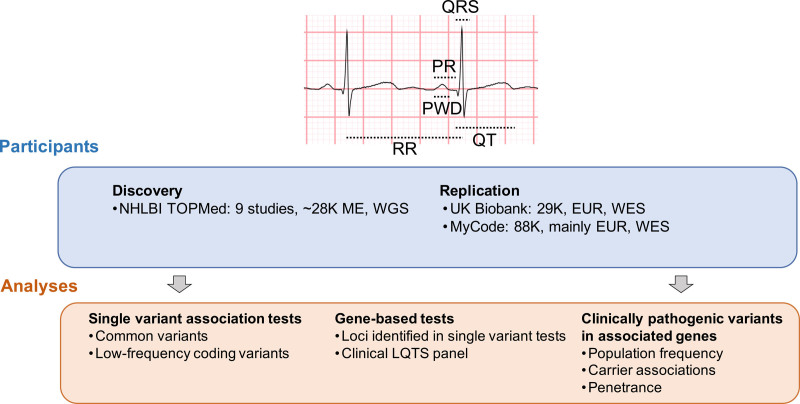
Using a discovery sample of 29 000 individuals with whole-genome sequencing from Trans-Omics in Precision Medicine and replication in nearly 100 000 with whole-exome sequencing from the UK Biobank and MyCode, we examined associations between low-frequency and rare coding variants with 5 routinely measured electrocardiographic traits (RR, P-wave, PR, and QRS intervals and corrected QT interval).
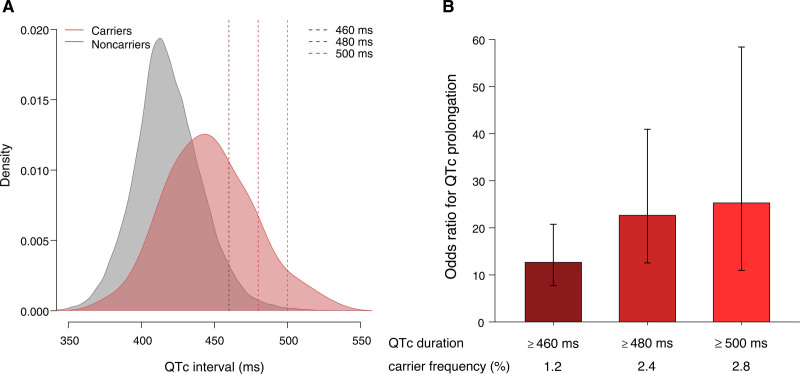
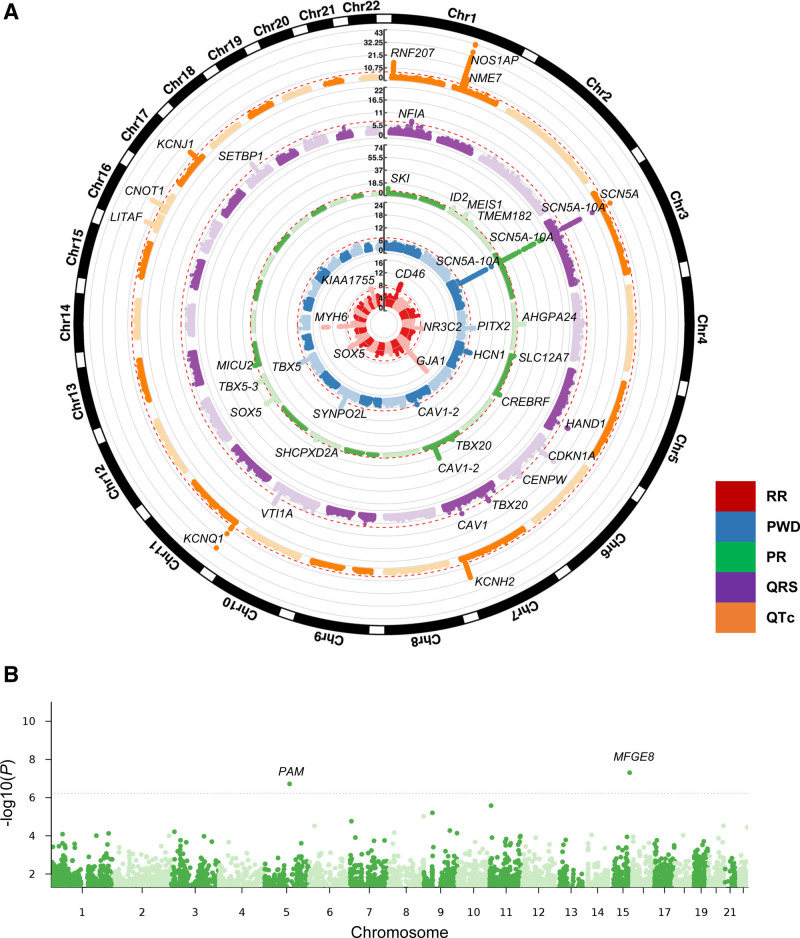
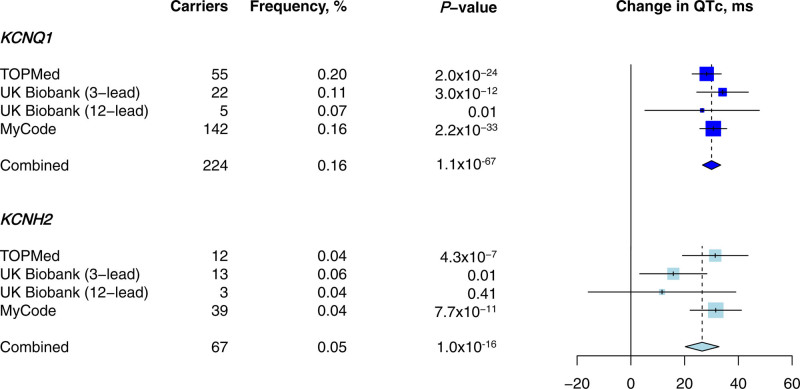
We found that rare variants associated with population-based electrocardiographic intervals identify established monogenic SCD genes (, , and ), a controversial monogenic SCD gene (), and novel genes ( and ) involved in cardiac conduction. Loss-of-function and pathogenic variants, carried by 0.1% of individuals, were associated with a nearly 6-fold increased odds of the first-degree atrioventricular block (=8.4×10). Similar variants in and (0.2% of individuals) were associated with a 23-fold increased odds of marked corrected QT interval prolongation (=4×10), a marker of SCD risk. Incomplete penetrance of such deleterious variation was common as over 70% of carriers had normal electrocardiographic intervals.
Our findings indicate that large-scale high-depth sequence data and electrocardiographic analysis identifies monogenic arrhythmia susceptibility genes and rare variants with large effects. Known pathogenic variation in conventional arrhythmia and SCD genes exhibited incomplete penetrance and accounted for only a small fraction of marked electrocardiographic interval prolongation.
心电图(ECG)间期的改变是心律失常和心脏性猝死(SCD)风险的已知标志物。虽然已经研究了心律失常综合征的遗传学,但在人群水平上,心电图间期与罕见遗传变异之间的关系还知之甚少。
我们使用来自精准医学中的全基因组测序的 29000 名个体的发现样本,以及来自 UK Biobank 和 MyCode 的近 100000 名个体的全外显子组测序进行复制,研究了 5 种常规测量的心电图特征(RR、P 波、PR、QRS 间期和校正 QT 间期)与低频和罕见编码变异之间的关联。
我们发现,与人群心电图间隔相关的罕见变异可识别已确立的单基因 SCD 基因(、和)、有争议的单基因 SCD 基因()以及涉及心脏传导的新基因(和)。由 0.1%的个体携带的功能丧失和致病性变异与一级房室传导阻滞的几率增加近 6 倍(=8.4×10)相关。同样,在和(0.2%的个体)中发现的变异与明显校正 QT 间期延长的几率增加 23 倍(=4×10)相关,这是 SCD 风险的一个标志物。这种有害变异的不完全外显率很常见,因为超过 70%的携带者具有正常的心电图间隔。
我们的研究结果表明,大规模高深度序列数据和心电图分析可识别单基因心律失常易感性基因和具有较大影响的罕见变异。传统心律失常和 SCD 基因中的已知致病性变异表现出不完全外显率,仅占明显心电图间期延长的一小部分。