Department of Medicine, Yale School of Medicine, New Haven, Connecticut, United States of America.
Yale Center for Analytical Sciences, Yale University, New Haven, Connecticut, United States of America.
PLoS One. 2021 Jul 28;16(7):e0254453. doi: 10.1371/journal.pone.0254453. eCollection 2021.
Limited therapeutic options exist for coronavirus disease 2019 (COVID-19). COVID-19 convalescent plasma (CCP) is a potential therapeutic, but there is limited data for patients with moderate-to-severe disease.
What are outcomes associated with administration of CCP in patients with moderate-to-severe COVID-19 infection?
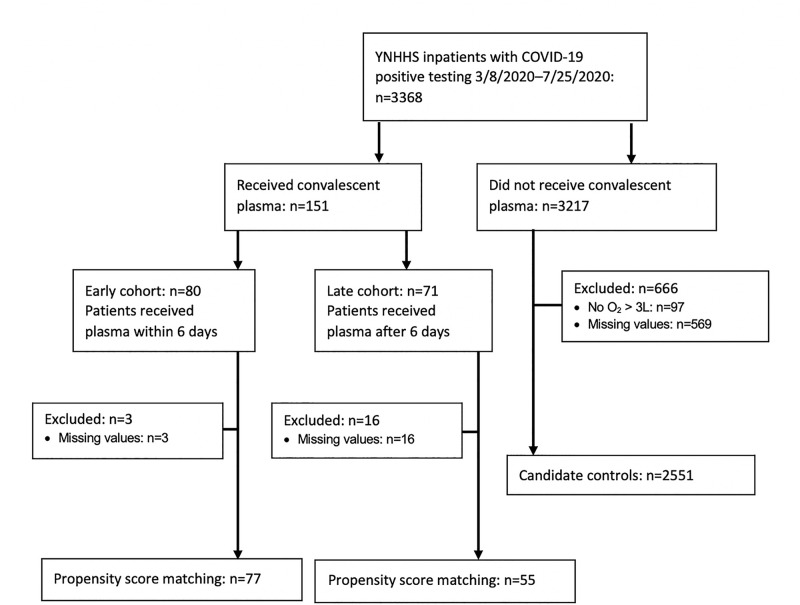
We conducted a propensity score-matched analysis of patients with moderate-to-severe COVID-19. The primary endpoints were in-hospital mortality. Secondary endpoints were number of days alive and ventilator-free at 30 days; length of hospital stay; and change in WHO scores from CCP administration (or index date) to discharge. Of 151 patients who received CCP, 132 had complete follow-up data. Patients were transfused after a median of 6 hospital days; thus, we investigated the effect of convalescent plasma before and after this timepoint with 77 early (within 6 days) and 55 late (after 6 days) recipients. Among 3,217 inpatients who did not receive CCP, 2,551 were available for matching.
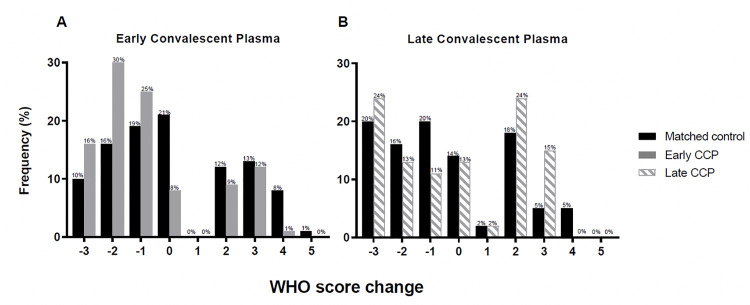
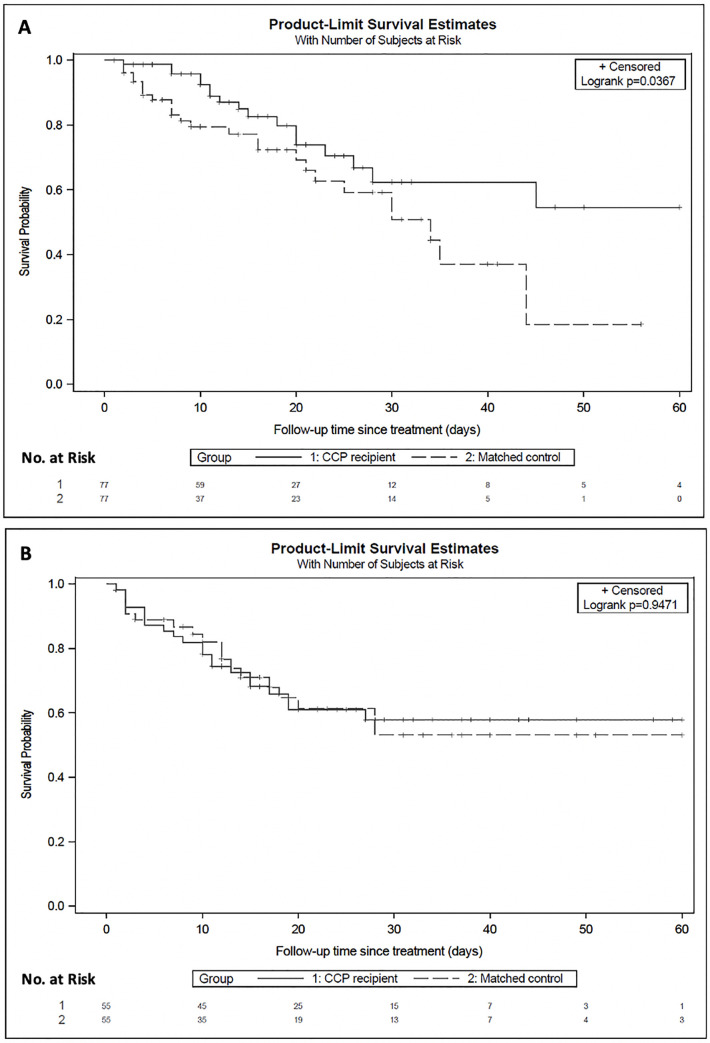
Early CCP recipients, of whom 31 (40%) were on mechanical ventilation, had lower 14-day (15% vs 23%) and 30-day (38% vs 49%) mortality compared to a matched unexposed cohort, with nearly 50% lower likelihood of in-hospital mortality (HR 0.52, [95% CI 0.28-0.96]; P = 0.036). Early plasma recipients had more days alive and ventilator-free at 30 days (+3.3 days, [95% CI 0.2 to 6.3 days]; P = 0.04) and improved WHO scores at 7 days (-0.8, [95% CI: -1.2 to -0.4]; P = 0.0003) and hospital discharge (-0.9, [95% CI: -1.5 to -0.3]; P = 0.004) compared to the matched unexposed cohort. No clinical differences were observed in late plasma recipients.
Early administration of CCP improves outcomes in patients with moderate-to-severe COVID-19, while improvement was not observed with late CCP administration. The importance of timing of administration should be addressed in specifically designed trials.
目前针对 2019 年冠状病毒病(COVID-19)的治疗方法有限。COVID-19 恢复期血浆(CCP)是一种有潜力的治疗方法,但针对中度至重度疾病患者的数据有限。
在中度至重度 COVID-19 感染患者中,给予 CCP 会带来哪些结果?
我们对中度至重度 COVID-19 患者进行了倾向评分匹配分析。主要终点是住院死亡率。次要终点是 30 天内存活且无呼吸机天数;住院时间;以及从 CCP 给药(或指数日期)到出院时的 WHO 评分变化。在接受 CCP 的 151 名患者中,有 132 名患者具有完整的随访数据。患者在中位住院 6 天后接受输血;因此,我们通过 77 名早期(6 天内)和 55 名晚期(6 天后)接受者,研究了 CCP 给药前和给药后的效果。在未接受 CCP 的 3217 名住院患者中,有 2551 名可用于匹配。
早期接受 CCP 的患者中,有 31 名(40%)接受机械通气,14 天(15%比 23%)和 30 天(38%比 49%)死亡率较低,院内死亡率降低近 50%(HR 0.52,[95%CI 0.28-0.96];P=0.036)。早期接受血浆的患者在 30 天内存活且无呼吸机天数更多(+3.3 天,[95%CI 0.2 至 6.3 天];P=0.04),在第 7 天和出院时的 WHO 评分改善(-0.8,[95%CI:-1.2 至-0.4];P=0.0003)和(-0.9,[95%CI:-1.5 至-0.3];P=0.004)与匹配的未暴露组相比。在晚期接受 CCP 的患者中未观察到临床差异。
早期给予 CCP 可改善中度至重度 COVID-19 患者的预后,而晚期给予 CCP 则无改善。应在专门设计的试验中解决给药时机的重要性。