Clinic for Poultry, University of Veterinary Medicine Hannover, Hannover 30559, Germany.
Institute of Immunology, University of Veterinary Medicine Hannover, Hannover 30559, Germany.
Poult Sci. 2021 Sep;100(9):101360. doi: 10.1016/j.psj.2021.101360. Epub 2021 Jun 30.
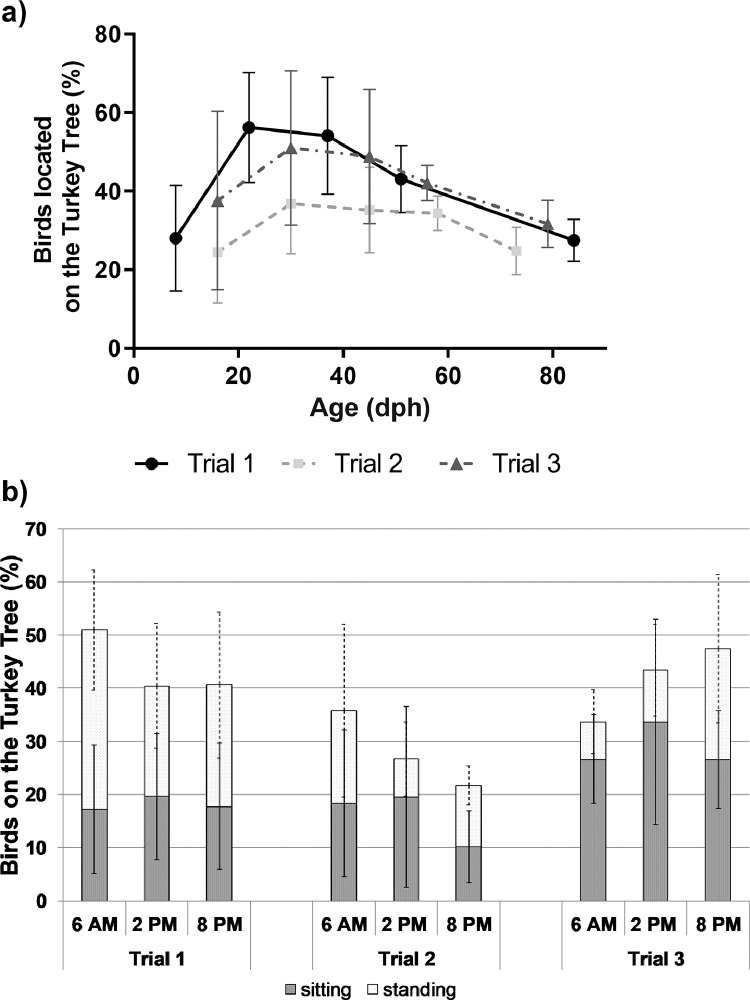
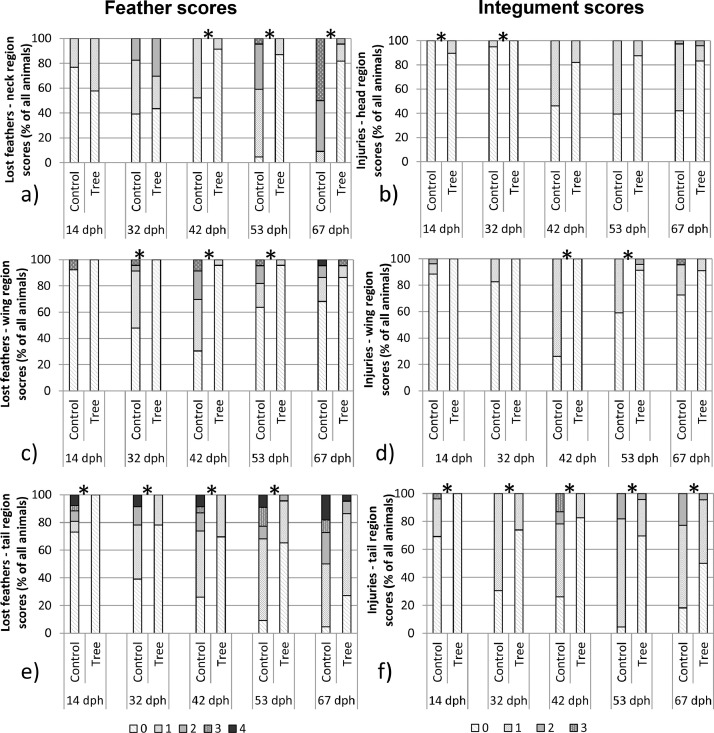
Under commercial conditions turkeys are housed in large groups in poorly structured environments. This leads to stress and subsequently to pecking and cannibalism. Environmental enrichment is suggested to reduce stress and feather pecking, thus leading to an increase of the overall flock health. However, the effect of increasing age on the use of enrichment elements and on the behavior repertoire as well as its correlation with health parameters has scarcely been studied. Therefore, our objective was to investigate the influence of environmental enrichment on the behavioral repertoire and on health parameters of turkeys. In 3 consecutive trials, female turkeys were housed up to 12 wk either in an unstructured (control group) or enriched environment (EE group) featuring elevated plateaus at different levels ("turkey tree"). Behavior parameters, clinical health, and immune parameters were determined at selected time points. The percentage of birds using the turkey tree increased with age up to 55 to 77% at 22 to 30 d post hatch (dph). Thereafter, the number of birds located on the turkey tree decreased to 25 to 32% at 73 to 79 dph. Feather pecking and fighting was significantly lower in the EE group compared to the control group in 2 and 3 trials, respectively (P < 0.05). The integrity of feathers and integument, scored in the head/neck, wing, and tail regions was repeatedly better in the EE birds compared to control birds at most investigated time points (P < 0.05), suggesting a reduction in stress related aggression by the use of the turkey tree. Head pecking, running and flying activity, foraging, and preening were overall comparable between the EE and the control group (P > 0.05). Humoral immunity as determined by vaccination-induced anti-Newcastle disease virus antibody titers was not affected by the turkey tree use. The flow cytometric evaluation of blood monocyte and T-lymphocyte numbers showed no repeatable difference between control and EE groups. Interestingly, compared to the control groups, EE birds displayed significantly higher numbers of circulating MHC class II lymphocytes and lower numbers of thrombocytes at various time points compared to controls (P < 0.05). This study provides clear evidence that environmental enrichment with plateaus not only leads to an altered behavioral repertoire but also modifies some of the investigated immune parameters, implying that EE may have a modulatory effect on turkeys' immunity and overall fitness. Further studies are needed to understand the correlation between behavior and health parameters in birds more closely.
在商业条件下,火鸡被成群地饲养在结构不佳的环境中。这会导致压力,进而导致啄食和同类相食。环境丰容被认为可以减轻压力和啄羽,从而提高整个禽类的健康水平。然而,年龄的增加对丰容元素的使用和行为谱的影响,以及与健康参数的相关性,几乎没有被研究过。因此,我们的目的是研究环境丰容对火鸡行为谱和健康参数的影响。在 3 个连续的试验中,雌性火鸡在无结构(对照组)或丰容(EE 组)环境中饲养至 12 周,丰容环境中设有不同高度的凸起平台(“火鸡树”)。在选定的时间点测定行为参数、临床健康和免疫参数。随着日龄的增加,使用火鸡树的鸟类比例从孵化后 22 至 30 天(dph)的 55%至 77%增加。此后,73 至 79 dph 时,位于火鸡树上的鸟类数量减少至 25%至 32%。在 2 次和 3 次试验中,EE 组的啄羽和打架行为明显低于对照组(P < 0.05)。在大多数研究时间点,EE 鸟类头部/颈部、翅膀和尾部羽毛和皮肤的完整性评分均明显优于对照组(P < 0.05),这表明使用火鸡树减少了与压力相关的攻击性。头部啄食、跑动和飞行活动、觅食和理羽在 EE 组和对照组之间总体上是可比的(P > 0.05)。通过接种诱导抗新城疫病毒抗体滴度测定的体液免疫不受火鸡树使用的影响。血液单核细胞和 T 淋巴细胞数量的流式细胞术评估未显示对照组和 EE 组之间的可重复差异。有趣的是,与对照组相比,EE 鸟类在多个时间点的循环 MHC Ⅱ类淋巴细胞数量显著较高,血小板数量显著较低(P < 0.05)。这项研究提供了明确的证据,表明使用带有凸起的环境丰容不仅会导致行为谱发生改变,还会改变一些研究中的免疫参数,这意味着 EE 可能对火鸡的免疫和整体健康状况具有调节作用。需要进一步的研究来更密切地了解鸟类行为和健康参数之间的相关性。