
未修复的工业盐沼中甲烷排放的微生物驱动因素。
Microbial drivers of methane emissions from unrestored industrial salt ponds.
机构信息
Department of Energy Joint Genome Institute, Lawrence Berkeley National Laboratory, Berkeley, CA, USA.
Southern California Coastal Water Research Project, Costa Mesa, CA, USA.
出版信息
ISME J. 2022 Jan;16(1):284-295. doi: 10.1038/s41396-021-01067-w. Epub 2021 Jul 28.
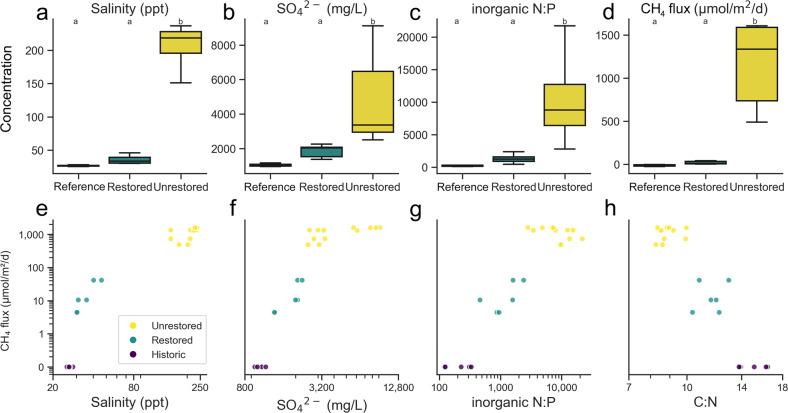
Wetlands are important carbon (C) sinks, yet many have been destroyed and converted to other uses over the past few centuries, including industrial salt making. A renewed focus on wetland ecosystem services (e.g., flood control, and habitat) has resulted in numerous restoration efforts whose effect on microbial communities is largely unexplored. We investigated the impact of restoration on microbial community composition, metabolic functional potential, and methane flux by analyzing sediment cores from two unrestored former industrial salt ponds, a restored former industrial salt pond, and a reference wetland. We observed elevated methane emissions from unrestored salt ponds compared to the restored and reference wetlands, which was positively correlated with salinity and sulfate across all samples. 16S rRNA gene amplicon and shotgun metagenomic data revealed that the restored salt pond harbored communities more phylogenetically and functionally similar to the reference wetland than to unrestored ponds. Archaeal methanogenesis genes were positively correlated with methane flux, as were genes encoding enzymes for bacterial methylphosphonate degradation, suggesting methane is generated both from bacterial methylphosphonate degradation and archaeal methanogenesis in these sites. These observations demonstrate that restoration effectively converted industrial salt pond microbial communities back to compositions more similar to reference wetlands and lowered salinities, sulfate concentrations, and methane emissions.
湿地是重要的碳(C)汇,但在过去几个世纪中,许多湿地已经被破坏并转化为其他用途,包括工业盐生产。对湿地生态系统服务(如防洪和栖息地)的重新关注导致了许多恢复工作,但其对微生物群落的影响在很大程度上尚未得到探索。我们通过分析两个未恢复的前工业盐池、一个已恢复的前工业盐池和一个参考湿地的沉积物芯,研究了恢复对微生物群落组成、代谢功能潜力和甲烷通量的影响。与恢复后的湿地和参考湿地相比,未恢复的盐池的甲烷排放显著升高,这与所有样本中的盐度和硫酸盐呈正相关。16S rRNA 基因扩增子和 shotgun 宏基因组数据表明,与未恢复的盐池相比,恢复后的盐池具有与参考湿地更具系统发育和功能相似的群落。古菌甲烷生成基因与甲烷通量呈正相关,编码细菌甲基膦酸降解酶的基因也与甲烷通量呈正相关,这表明这些位点的甲烷既来自细菌甲基膦酸降解,也来自古菌甲烷生成。这些观察结果表明,恢复有效地将工业盐池微生物群落恢复为与参考湿地更相似的组成,降低了盐度、硫酸盐浓度和甲烷排放。



 Zotero 插件