Lim Chewan, Won Hoyoun, Ko Young Guk, Lee Seung Jun, Ahn Chul Min, Min Pil Ki, Lee Jae Hwan, Yoon Chang Hwan, Yu Cheol Woong, Lee Seung Whan, Lee Sang Rok, Choi Seung Hyuk, Chae In Ho, Choi Donghoon
Division of Cardiology, Department of Internal Medicine, Myongji Hospital, Hanyang University College of Medicine, Goyang, Korea.
Cardiovascular & Arrhythmia Center, Chung-Ang University Hospital, Chung-Ang University College of Medicine, Seoul, Korea.
Korean Circ J. 2021 Aug;51(8):696-707. doi: 10.4070/kcj.2021.0040.
Few studies have investigated the obesity paradox in clinical outcomes of peripheral artery disease (PAD). We investigated the association between body mass index (BMI) and clinical outcomes in PAD patients undergoing endovascular therapy (EVT).
Patients (n=2,914) from the retrospective Korean Vascular Intervention Society Endovascular Therapy in Lower Limb Artery Disease registry were categorized according to BMI: underweight (<18.5 kg/m², n=204), normal weight (18.5-25 kg/m², n=1,818), overweight (25-30 kg/m², n=766), or obese (≥30 kg/m², n=126). Groups were compared for major adverse cardiovascular events (MACE) and major adverse limb events (MALE).
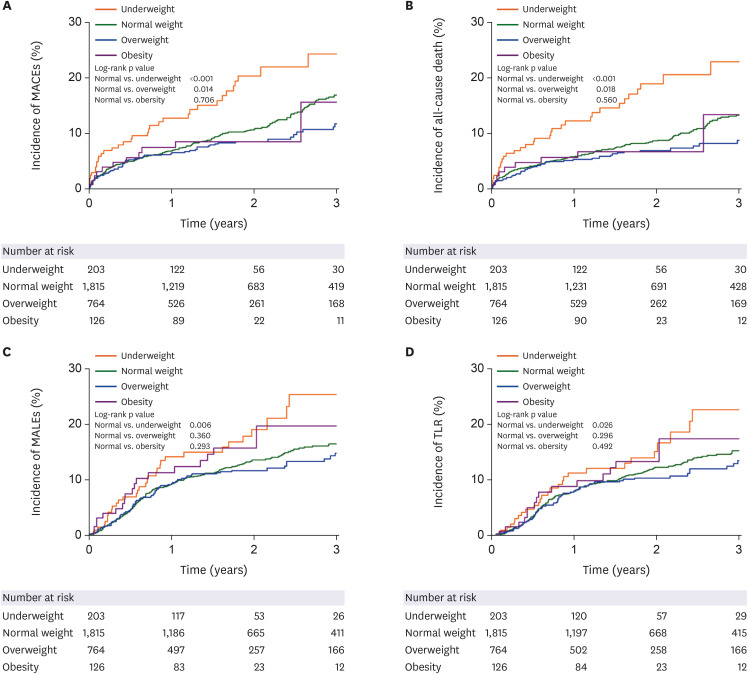
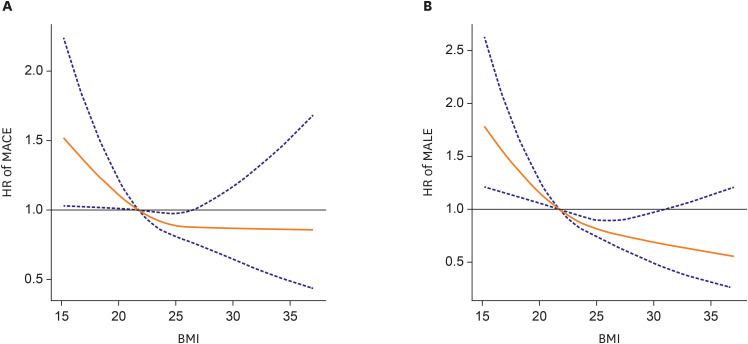
The underweight and obese groups were older and had more frequent critical limb ischemia and infrapopliteal artery disease than the normal or overweight groups (all p<0.001). Hypertension and diabetes were more frequent and current smoking was less frequent in the overweight and obese groups than the underweight or normal weight groups (all p <0.001). The underweight group showed the higher rates of MACE and MALE at 3 years (17.2%, 15.7%) compared with the normal weight (10.8%, 11.7%), overweight (8.4%, 10.7%), or obese groups (8.7%, 14.3%) (log-rank p<0.001, p=0.015). In contrast, the risk of MACE was lower in the overweight than the normal weight group (adjusted hazard ratio, 0.706; 95% CI, 0.537-0.928).
In PAD patients undergoing EVT, underweight was an independent predictor for MACE and MALE, whereas MACE risk was lower for overweight than normal weight patients.
ClinicalTrials.gov Identifier: NCT02748226.
很少有研究调查外周动脉疾病(PAD)临床结局中的肥胖悖论。我们研究了接受血管内治疗(EVT)的PAD患者体重指数(BMI)与临床结局之间的关联。
来自韩国血管介入学会下肢动脉疾病血管内治疗回顾性登记研究的患者(n = 2914)根据BMI进行分类:体重过轻(<18.5kg/m²,n = 204)、正常体重(18.5 - 25kg/m²,n = 1818)、超重(25 - 30kg/m²,n = 766)或肥胖(≥30kg/m²,n = 126)。比较各组的主要不良心血管事件(MACE)和主要不良肢体事件(MALE)。
体重过轻和肥胖组比正常或超重组年龄更大,严重肢体缺血和腘下动脉疾病更常见(所有p<0.001)。超重和肥胖组高血压和糖尿病更常见,当前吸烟比体重过轻或正常体重组更少见(所有p<0.001)。与正常体重组(10.8%,11.7%)、超重组(8.4%,10.7%)或肥胖组(8.7%,14.3%)相比,体重过轻组在3年时MACE和MALE发生率更高(17.2%,15.7%)(对数秩检验p<0.001,p = 0.015)。相反,超重患者MACE风险低于正常体重组(校正风险比,0.706;95%CI,0.537 - 0.928)。
在接受EVT的PAD患者中,体重过轻是MACE和MALE的独立预测因素,而超重患者MACE风险低于正常体重患者。
ClinicalTrials.gov标识符:NCT02748226。