
韩国血管介入学会下肢动脉疾病血管内治疗(K-VIS ELLA)登记研究中回顾性患者队列的基线特征
Baseline Characteristics of a Retrospective Patient Cohort in the Korean Vascular Intervention Society Endovascular Therapy in Lower Limb Artery Diseases (K-VIS ELLA) Registry.
作者信息
Ko Young-Guk, Ahn Chul-Min, Min Pil-Ki, Lee Jae-Hwan, Yoon Chang-Hwan, Yu Cheol Woong, Lee Seung Whan, Lee Sang-Rok, Choi Seung Hyuk, Koh Yoon Seok, Chae In-Ho, Choi Donghoon
机构信息
Division of Cardiology, Department of Internal Medicine, Severance Cardiovascular Hospital, Yonsei University College of Medicine, Seoul, Korea.
Division of Cardiology, Department of Internal Medicine, Gangnam Severance Hospital, Yonsei University College of Medicine, Seoul, Korea.
出版信息
Korean Circ J. 2017 Jul;47(4):469-476. doi: 10.4070/kcj.2017.0020. Epub 2017 Jul 27.
BACKGROUND AND OBJECTIVES
The Korean Vascular Intervention Society Endovascular Therapy in Lower Limb Artery Diseases (K-VIS ELLA) Registry is a multicenter observational study with retrospective and prospective cohorts of patients with lower extremity peripheral artery disease (PAD) undergoing endovascular treatment. In this study, we report the baseline characteristics of this retrospective cohort.
SUBJECTS AND METHODS
In the present study we analyzed datasets of 3073 patients with 3972 target limbs from a retrospective cohort treated with endovascular therapy in 31 Korean hospitals. Data regarding patient baseline clinical and lesion characteristics and postintervention medications were collected from electronic medical records.
RESULTS
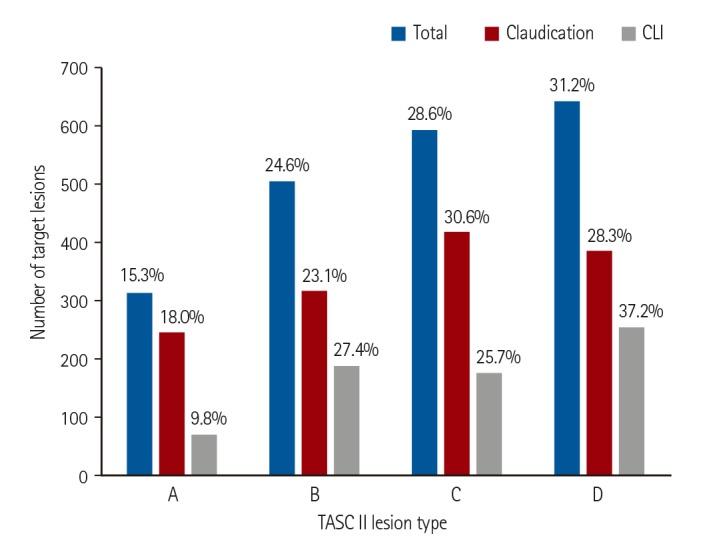
The mean patient age was 68.3±9.4 years. The majority were male (82.1%) with comorbidities such as diabetes mellitus (58.0%), hypertension (73.4%), and coronary artery disease (CAD; 55.3%). Patients more commonly presented with intermittent claudication (66.3%) than with critical limb ischemia (CLI; 33.7%). Femoropopliteal artery (41.2%) was the most common target vessel for endovascular treatment, followed by the aortoiliac (35.6%) and infrapopliteal arteries (23.2%). TransAtlantic Inter-Society Consensus for the Management of Peripheral Artery Disease (TASC II) type C/D aortoiliac (48.0%) or femoropopliteal lesions (60.2%) were frequent targets of endovascular treatment. At hospital discharge, only 73.1% of patients received dual antiplatelet therapy and 69.2% received a statin.
CONCLUSION
The majority of Korean patients with PAD exhibited conventional risk factors, such as male sex, older age, diabetes, and hypertension with coexisting CAD. Complex lesions were frequently treated with endovascular therapy. However, the rate of adherence to guidelines regarding post-procedural medical treatment requires improvement.
背景与目的
韩国血管介入学会下肢动脉疾病血管内治疗(K-VIS ELLA)注册研究是一项多中心观察性研究,纳入接受血管内治疗的下肢外周动脉疾病(PAD)患者的回顾性和前瞻性队列。在本研究中,我们报告该回顾性队列的基线特征。
对象与方法
在本研究中,我们分析了来自韩国31家医院接受血管内治疗的回顾性队列中3073例患者、3972条目标肢体的数据集。从电子病历中收集患者基线临床和病变特征以及干预后用药的数据。
结果
患者的平均年龄为68.3±9.4岁。大多数为男性(82.1%),伴有糖尿病(58.0%)、高血压(73.4%)和冠状动脉疾病(CAD;55.3%)等合并症。与严重肢体缺血(CLI;33.7%)相比,患者更常表现为间歇性跛行(66.3%)。股腘动脉(41.2%)是血管内治疗最常见的目标血管,其次是主髂动脉(35.6%)和腘以下动脉(23.2%)。血管腔内治疗的常见目标是跨大西洋血管外科学会外周动脉疾病管理共识(TASC II)C/D型主髂动脉(48.0%)或股腘病变(60.2%)。出院时,仅73.1%的患者接受双联抗血小板治疗,69.2%的患者接受他汀类药物治疗。
结论
大多数韩国PAD患者表现出传统危险因素,如男性、老年、糖尿病、高血压以及并存CAD。复杂病变常接受血管内治疗。然而,术后药物治疗的指南遵循率有待提高。


 Zotero 插件