Kupitz Dennis, Wissel Heiko, Wuestemann Jan, Bluemel Stephanie, Pech Maciej, Amthauer Holger, Kreissl Michael C, Grosser Oliver S
Department of Radiology and Nuclear Medicine, University Hospital Magdeburg, Magdeburg, Germany.
Department of Nuclear Medicine, Charité - Universitätsmedizin Berlin, Corporate Member of Freie Universität Berlin, Humboldt-Universität zu Berlin, and Berlin Institute of Health, Berlin, Germany.
EJNMMI Phys. 2021 Jul 30;8(1):57. doi: 10.1186/s40658-021-00405-3.
The introduction of hybrid SPECT/CT devices enables quantitative imaging in SPECT, providing a methodological setup for quantitation using SPECT tracers comparable to PET/CT. We evaluated a specific quantitative reconstruction algorithm for SPECT data using a Tc-filled NEMA phantom. Quantitative and qualitative image parameters were evaluated for different parametrizations of the acquisition and reconstruction protocol to identify an optimized quantitative protocol.
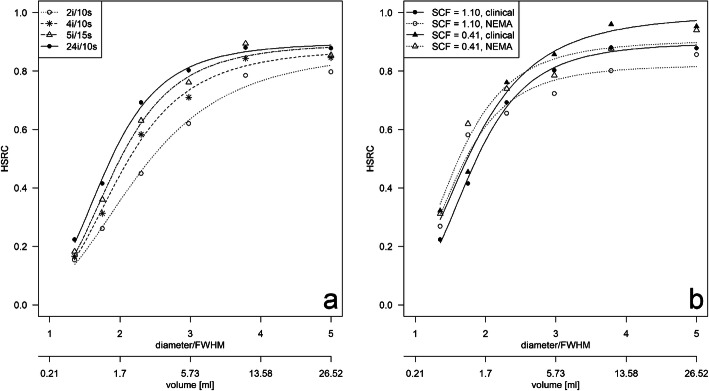
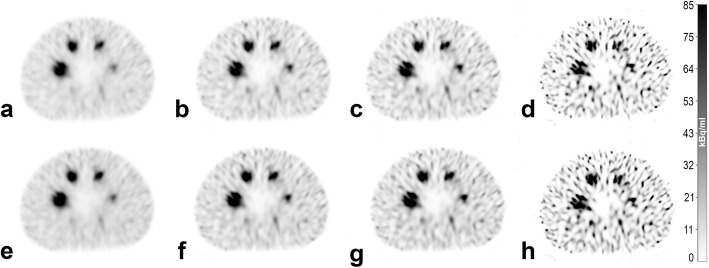
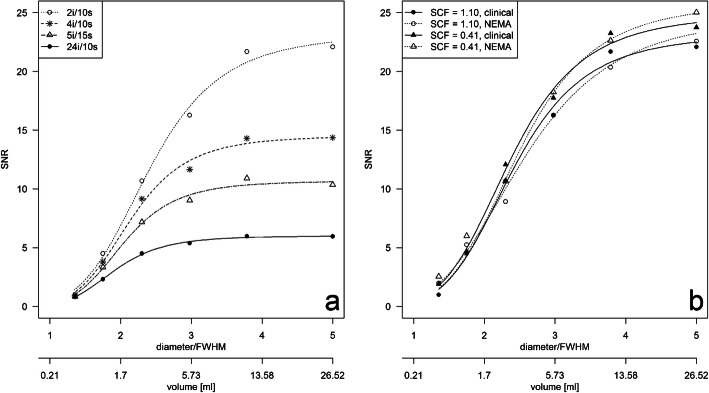
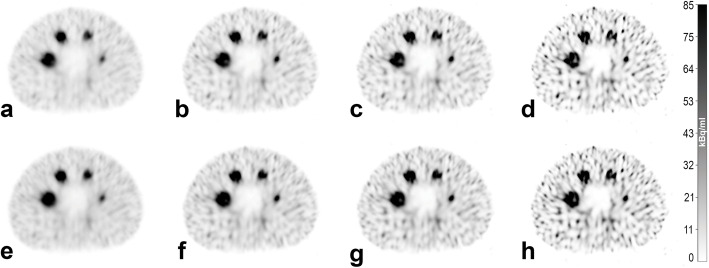
The reconstructed activity concentration (AC) and the signal-to-noise ratio (SNR) of all examined protocols (n = 16) were significantly affected by the parametrization of the weighting factor k used in scatter correction, the total number of iterations and the sphere volume (all, p < 0.0001). The two examined SPECT acquisition protocols (with 60 or 120 projections) had a minor impact on the AC and no significant impact on the SNR. In comparison to the known AC, the use of default scatter correction (k = 0.47) or object-specific scatter correction (k = 0.18) resulted in an underestimation of AC in the largest sphere volume (26.5 ml) by - 13.9 kBq/ml (- 16.3%) and - 7.1 kBq/ml (- 8.4%), respectively. An increase in total iterations leads to an increase in estimated AC and a decrease in SNR. The mean difference between AC and known AC decreased with an increasing number of total iterations (e.g., for 20 iterations (2 iterations/10 subsets) = - 14.6 kBq/ml (- 17.1%), 240 iterations (24i/10s) = - 8.0 kBq/ml (- 9.4%), p < 0.0001). In parallel, the mean SNR decreased significantly from 2i/10s to 24i/10s by 76% (p < 0.0001).
Quantitative SPECT imaging is feasible with the used reconstruction algorithm and hybrid SPECT/CT, and its consistent implementation in diagnostics may provide perspectives for quantification in routine clinical practice (e.g., assessment of bone metabolism). When combining quantitative analysis and diagnostic imaging, we recommend using two different reconstruction protocols with task-specific optimized setups (quantitative vs. qualitative reconstruction). Furthermore, individual scatter correction significantly improves both quantitative and qualitative results.
混合型SPECT/CT设备的引入使得SPECT能够进行定量成像,为使用与PET/CT相当的SPECT示踪剂进行定量分析提供了一种方法学设置。我们使用填充锝的NEMA体模评估了一种针对SPECT数据的特定定量重建算法。针对采集和重建协议的不同参数设置,对定量和定性图像参数进行了评估,以确定优化的定量协议。
所有检查协议(n = 16)的重建活度浓度(AC)和信噪比(SNR)均受到散射校正中使用的加权因子k的参数设置、总迭代次数和球体体积的显著影响(所有p < 0.0001)。两种检查的SPECT采集协议(60或120个投影)对AC影响较小,对SNR无显著影响。与已知的AC相比,使用默认散射校正(k = 0.47)或特定对象散射校正(k = 0.18)分别导致最大球体体积(26.5 ml)中的AC低估了-13.9 kBq/ml(-16.3%)和-7.1 kBq/ml(-8.4%)。总迭代次数的增加会导致估计的AC增加而SNR降低。AC与已知AC之间的平均差异随着总迭代次数的增加而减小(例如,对于20次迭代(2次迭代/10个子集)= -14.6 kBq/ml(-17.1%),240次迭代(24i/10s)= -8.0 kBq/ml(-9.4%),p < 0.0001)。同时,平均SNR从2i/10s到24i/10s显著降低了76%(p < 0.0001)。
使用所采用的重建算法和混合型SPECT/CT进行定量SPECT成像是可行的,并且在诊断中的一致应用可能为常规临床实践中的定量分析(如骨代谢评估)提供前景。在结合定量分析和诊断成像时,我们建议使用两种具有特定任务优化设置(定量与定性重建)的不同重建协议。此外,个体散射校正显著改善了定量和定性结果。