College of Public Health, Zhengzhou University, Zhengzhou, China.
Henan Province Center for Disease Control and Prevention, Zhengzhou, China.
PLoS One. 2021 Jul 30;16(7):e0255033. doi: 10.1371/journal.pone.0255033. eCollection 2021.
Severe fever with thrombocytopenia syndrome (SFTS) is a serious infectious disease with a fatality of up to 30%. To identify the severity of SFTS precisely and quickly is important in clinical practice.
From June to July 2020, 71 patients admitted to the Infectious Department of Joint Logistics Support Force No. 990 Hospital were enrolled in this study. The most frequently observed symptoms and laboratory parameters on admission were collected by investigating patients' electronic records. Decision trees were built to identify the severity of SFTS. Accuracy and Youden's index were calculated to evaluate the identification capacity of the models.
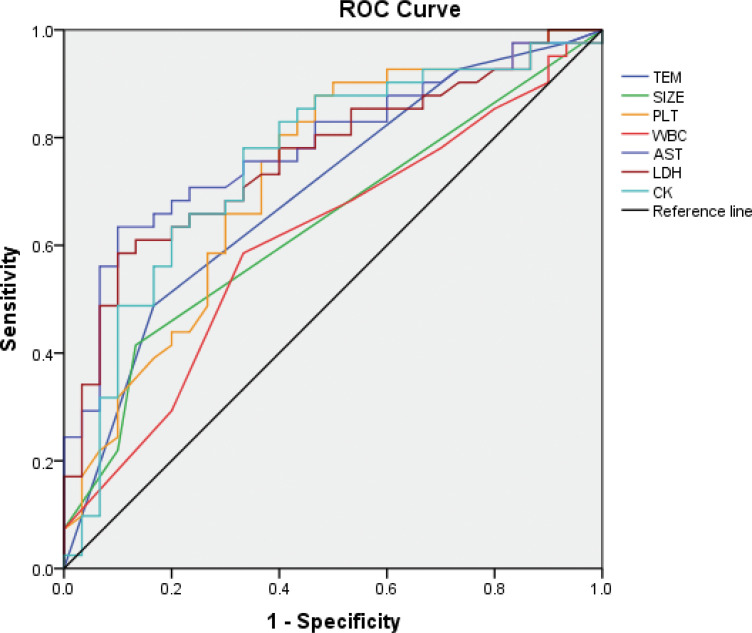
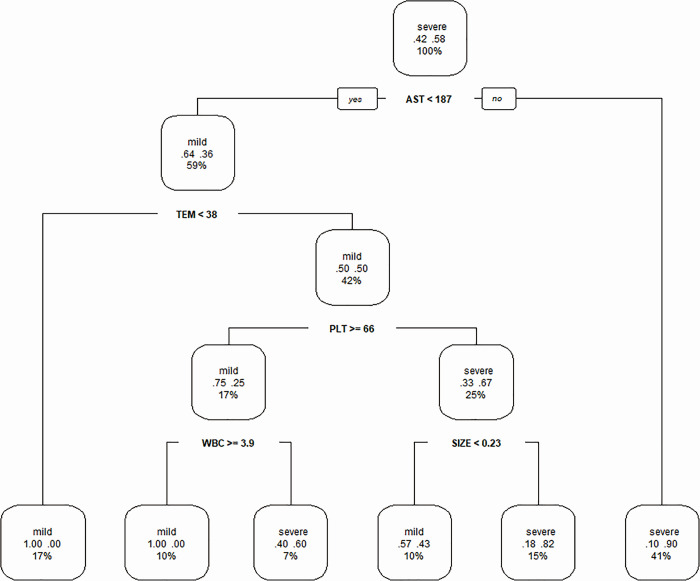
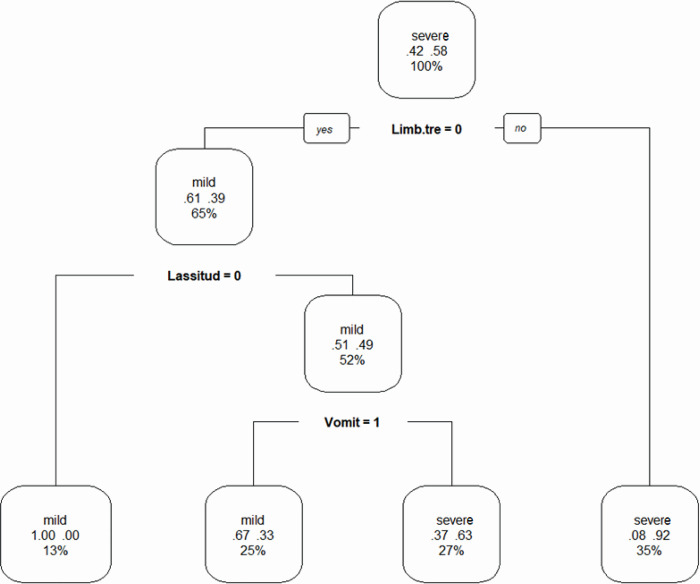
Clinical characteristics, including body temperature (p = 0.011), the size of the lymphadenectasis (p = 0.021), and cough (p = 0.017), and neurologic symptoms, including lassitude (p<0.001), limb tremor (p<0.001), hypersomnia (p = 0.009), coma (p = 0.018) and dysphoria (p = 0.008), were significantly different between the mild and severe groups. As for laboratory parameters, PLT (p = 0.006), AST (p<0.001), LDH (p<0.001), and CK (p = 0.003) were significantly different between the mild and severe groups of SFTS patients. A decision tree based on laboratory parameters and one based on demographic and clinical characteristics were built. Comparing with the decision tree based on demographic and clinical characteristics, the decision tree based on laboratory parameters had a stronger prediction capacity because of its higher accuracy and Youden's index.
Decision trees can be applied to predict the severity of SFTS.
严重发热伴血小板减少综合征(SFTS)是一种严重的传染病,死亡率高达 30%。在临床实践中,准确快速地识别 SFTS 的严重程度非常重要。
2020 年 6 月至 7 月,我们共纳入了 71 例收入联勤保障部队第 990 医院感染科的患者。通过调查患者的电子病历,收集入院时最常见的症状和实验室参数。建立决策树以识别 SFTS 的严重程度。计算准确性和 Youden 指数以评估模型的识别能力。
临床特征,包括体温(p = 0.011)、淋巴结肿大的大小(p = 0.021)和咳嗽(p = 0.017),以及神经系统症状,包括乏力(p<0.001)、肢体震颤(p<0.001)、嗜睡(p = 0.009)、昏迷(p = 0.018)和烦躁不安(p = 0.008),在轻症和重症组之间有显著差异。就实验室参数而言,PLT(p = 0.006)、AST(p<0.001)、LDH(p<0.001)和 CK(p = 0.003)在 SFTS 患者的轻症和重症组之间有显著差异。我们建立了一个基于实验室参数的决策树和一个基于人口统计学和临床特征的决策树。与基于人口统计学和临床特征的决策树相比,基于实验室参数的决策树具有更强的预测能力,因为它具有更高的准确性和 Youden 指数。
决策树可用于预测 SFTS 的严重程度。