• 文献检索
  • 文档翻译
  • 深度研究
  • 学术资讯
  • Suppr Zotero 插件Zotero 插件
  • 邀请有礼
  • 套餐&价格
  • 历史记录
应用&插件
Suppr Zotero 插件Zotero 插件浏览器插件Mac 客户端Windows 客户端微信小程序
定价
高级版会员购买积分包购买API积分包
服务
文献检索文档翻译深度研究API 文档MCP 服务
关于我们
关于 Suppr公司介绍联系我们用户协议隐私条款
关注我们

Suppr 超能文献

核心技术专利:CN118964589B侵权必究
粤ICP备2023148730 号-1Suppr @ 2026

文献检索

告别复杂PubMed语法,用中文像聊天一样搜索,搜遍4000万医学文献。AI智能推荐,让科研检索更轻松。

立即免费搜索

文件翻译

保留排版,准确专业,支持PDF/Word/PPT等文件格式,支持 12+语言互译。

免费翻译文档

深度研究

AI帮你快速写综述,25分钟生成高质量综述,智能提取关键信息,辅助科研写作。

立即免费体验

结直肠癌肝转移切除术后循环肿瘤 DNA 与病理反应及无复发生存相关。

Postoperative circulating tumour DNA is associated with pathologic response and recurrence-free survival after resection of colorectal cancer liver metastases.

机构信息

Department of Medical Oncology, Amsterdam UMC, Cancer Center Amsterdam, University of Amsterdam, the Netherlands.

Department of Pathology, The Netherlands Cancer Institute, Plesmanlaan 121, Amsterdam 1066CX, the Netherlands.

出版信息

EBioMedicine. 2021 Aug;70:103498. doi: 10.1016/j.ebiom.2021.103498. Epub 2021 Jul 29.

DOI:10.1016/j.ebiom.2021.103498
PMID:34333237
原文链接:https://pmc.ncbi.nlm.nih.gov/articles/PMC8340125/
Abstract

BACKGROUND

Recurrence rates after resection of colorectal cancer liver metastases (CRLM) are high and correlate with worse survival. Postoperative circulating tumour DNA (ctDNA) is a promising prognostic biomarker. Focusing on patients with resected CRLM, this study aimed to evaluate the association between the detection of postoperative ctDNA, pathologic response and recurrence-free survival (RFS).

METHODS

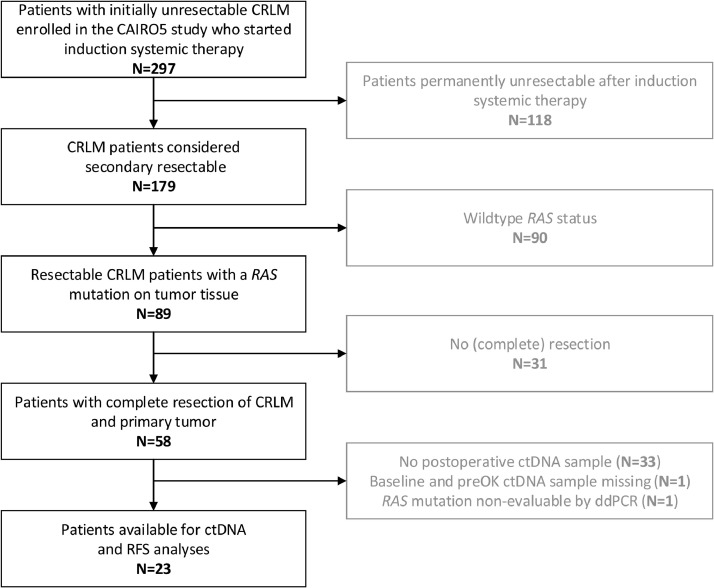
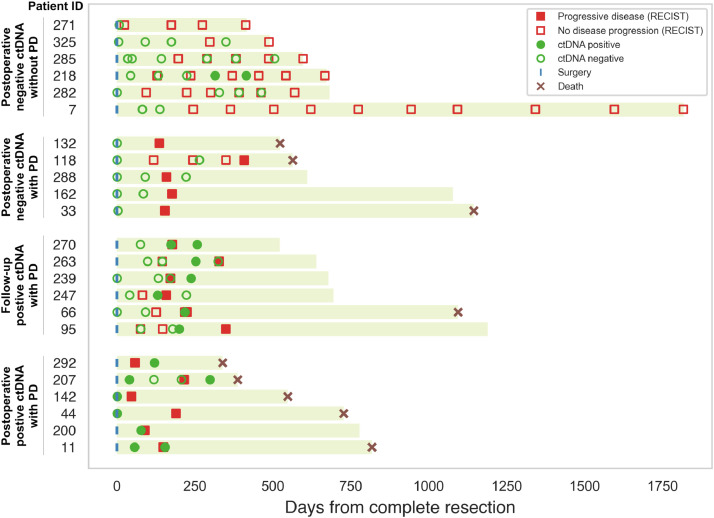
Twenty-three patients were selected from an ongoing phase-3 trial who underwent resection of RAS-mutant CRLM after induction systemic treatment. CtDNA analysis was performed by droplet digital PCR using blood samples collected at baseline, before and after resection. Pathologic response of CRLM was determined via the Tumour Regression Grading system.

FINDINGS

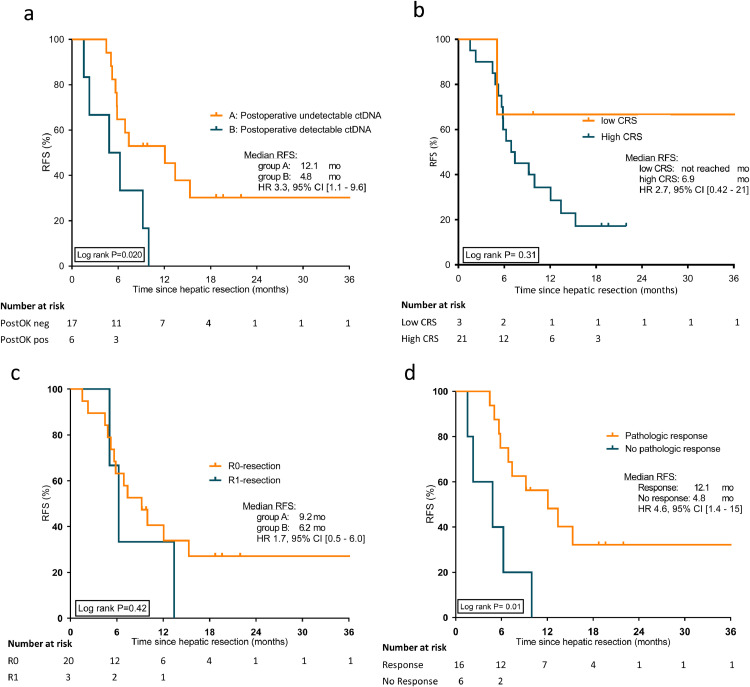
With a median follow-up of 19.6 months, the median RFS for patients with detectable (N = 6, [26%]) and undetectable (N = 17, [74%]) postoperative ctDNA was 4.8 versus 12.1 months, respectively. Among 21 patients with available tumour tissue, pathologic response in patients with detectable compared to undetectable postoperative ctDNA was found in one of six (17%) and 15 of 15 (100%) patients, respectively (p < 0.001). In univariable Cox regression analyses both postoperative detectable ctDNA (HR = 3.3, 95%CI = 1.1-9.6, p = 0.03) and pathologic non-response (HR = 4.6, 95%CI = 1.4-15, p = 0.01) were associated with poorer RFS and were strongly correlated (r = 0.88, p < 0.001). After adjusting for clinical characteristics in pairwise multivariable analyses, postoperative ctDNA status remained associated with RFS.

INTERPRETATION

The detection of postoperative ctDNA after secondary resection of CRLM is a promising prognostic factor for RFS and appeared to be highly correlated with pathologic response.

FUNDING

None.

摘要

背景

结直肠癌肝转移(CRLM)切除术后的复发率较高,与生存预后较差相关。术后循环肿瘤 DNA(ctDNA)是一种很有前途的预后生物标志物。本研究聚焦于接受过 CRLM 切除术的患者,旨在评估术后 ctDNA 检测、病理缓解与无复发生存(RFS)之间的关联。

方法

从正在进行的一项三期临床试验中选择了 23 名接受诱导性全身治疗后行 RAS 突变型 CRLM 切除术的患者。通过使用血液样本在基线时、手术前和手术后进行液滴数字 PCR 分析,检测 ctDNA。通过肿瘤回归分级系统来确定 CRLM 的病理缓解情况。

结果

在中位随访 19.6 个月后,ctDNA 可检测(N=6,[26%])和不可检测(N=17,[74%])患者的中位 RFS 分别为 4.8 个月和 12.1 个月。在 21 名有可用肿瘤组织的患者中,在术后 ctDNA 可检测的患者中,病理缓解的比例为 6 例中的 1 例(17%),而在术后 ctDNA 不可检测的患者中,15 例中的 15 例(100%),两者差异有统计学意义(p<0.001)。在单变量 Cox 回归分析中,术后可检测 ctDNA(HR=3.3,95%CI=1.1-9.6,p=0.03)和病理无缓解(HR=4.6,95%CI=1.4-15,p=0.01)均与 RFS 较差相关,且两者呈强相关(r=0.88,p<0.001)。在两两多变量分析中调整临床特征后,术后 ctDNA 状态仍与 RFS 相关。

结论

CRLM 二次切除术后 ctDNA 的检测是 RFS 的一个很有前途的预后因素,并且与病理缓解高度相关。

资金来源

无。

https://cdn.ncbi.nlm.nih.gov/pmc/blobs/107d/8340125/db676b116ef8/gr3.jpg
https://cdn.ncbi.nlm.nih.gov/pmc/blobs/107d/8340125/0d33209774d0/gr1.jpg
https://cdn.ncbi.nlm.nih.gov/pmc/blobs/107d/8340125/160dfd6e5795/gr2.jpg
https://cdn.ncbi.nlm.nih.gov/pmc/blobs/107d/8340125/db676b116ef8/gr3.jpg
https://cdn.ncbi.nlm.nih.gov/pmc/blobs/107d/8340125/0d33209774d0/gr1.jpg
https://cdn.ncbi.nlm.nih.gov/pmc/blobs/107d/8340125/160dfd6e5795/gr2.jpg
https://cdn.ncbi.nlm.nih.gov/pmc/blobs/107d/8340125/db676b116ef8/gr3.jpg

相似文献

1
Postoperative circulating tumour DNA is associated with pathologic response and recurrence-free survival after resection of colorectal cancer liver metastases.结直肠癌肝转移切除术后循环肿瘤 DNA 与病理反应及无复发生存相关。
EBioMedicine. 2021 Aug;70:103498. doi: 10.1016/j.ebiom.2021.103498. Epub 2021 Jul 29.
2
Circulating tumor DNA dynamics and recurrence risk in patients undergoing curative intent resection of colorectal cancer liver metastases: A prospective cohort study.在接受结直肠癌肝转移根治性切除术后患者中循环肿瘤 DNA 动力学与复发风险:一项前瞻性队列研究。
PLoS Med. 2021 May 3;18(5):e1003620. doi: 10.1371/journal.pmed.1003620. eCollection 2021 May.
3
Pre-hepatectomy dynamic circulating tumor DNA to predict pathologic response to preoperative chemotherapy and post-hepatectomy recurrence in patients with colorectal liver metastases.术前动态循环肿瘤 DNA 预测结直肠癌肝转移患者术前化疗病理反应及术后复发。
Hepatol Int. 2024 Jun;18(3):1029-1039. doi: 10.1007/s12072-023-10628-4. Epub 2024 Mar 1.
4
Dynamic monitoring of circulating tumor DNA to predict prognosis and efficacy of adjuvant chemotherapy after resection of colorectal liver metastases.动态监测循环肿瘤 DNA 预测结直肠肝转移切除术后辅助化疗的预后和疗效。
Theranostics. 2021 May 12;11(14):7018-7028. doi: 10.7150/thno.59644. eCollection 2021.
5
Tumour-agnostic circulating tumour DNA analysis for improved recurrence surveillance after resection of colorectal liver metastases: A prospective cohort study.用于改善结直肠癌肝转移切除术后复发监测的肿瘤非特异性循环肿瘤DNA分析:一项前瞻性队列研究
Eur J Cancer. 2022 Mar;163:163-176. doi: 10.1016/j.ejca.2021.12.026. Epub 2022 Jan 22.
6
Personalized circulating tumor DNA monitoring improves recurrence surveillance and management after curative resection of colorectal liver metastases: a prospective cohort study.个体化循环肿瘤 DNA 监测可改善结直肠癌肝转移术后的复发监测和管理:一项前瞻性队列研究。
Int J Surg. 2024 May 1;110(5):2776-2787. doi: 10.1097/JS9.0000000000001236.
7
Significance of postoperative follow-up of patients with metastatic colorectal cancer using circulating tumor DNA.转移性结直肠癌患者使用循环肿瘤 DNA 进行术后随访的意义。
World J Gastroenterol. 2019 Dec 28;25(48):6939-6948. doi: 10.3748/wjg.v25.i48.6939.
8
Recurrence Prediction by Circulating Tumor DNA in the Patient with Colorectal Liver Metastases After Hepatectomy: A Prospective Biomarker Study.术后结直肠癌肝转移患者循环肿瘤 DNA 预测复发:一项前瞻性生物标志物研究。
Ann Surg Oncol. 2023 Aug;30(8):4916-4926. doi: 10.1245/s10434-023-13362-1. Epub 2023 May 23.
9
Circulating tumor DNA for prognosis assessment and postoperative management after curative-intent resection of colorectal liver metastases.循环肿瘤 DNA 用于结直肠肝转移灶根治性切除术后的预后评估和术后管理。
Int J Cancer. 2022 May 1;150(9):1537-1548. doi: 10.1002/ijc.33924. Epub 2022 Jan 19.
10
Codon 13 KRAS mutation predicts patterns of recurrence in patients undergoing hepatectomy for colorectal liver metastases.第 13 密码子 KRAS 突变可预测行肝切除术的结直肠癌肝转移患者的复发模式。
Cancer. 2016 Sep 1;122(17):2698-707. doi: 10.1002/cncr.30085. Epub 2016 May 31.

引用本文的文献

1
Combining the DNA methylation markers of circulating tumor cells with immune infiltrating cells to assess recurrence and prognosis and to suggest a therapeutic strategy in stage III-IV colorectal cancer.结合循环肿瘤细胞的DNA甲基化标志物与免疫浸润细胞,以评估III-IV期结直肠癌的复发和预后,并提出治疗策略。
Front Immunol. 2025 Jul 28;16:1607548. doi: 10.3389/fimmu.2025.1607548. eCollection 2025.
2
Multi-omics in colorectal cancer liver metastasis: applications and research advances.结直肠癌肝转移中的多组学:应用与研究进展
Cancer Biol Med. 2025 Jun 26;22(6):618-38. doi: 10.20892/j.issn.2095-3941.2025.0066.
3
Updates on Liquid Biopsy and ctDNA in Transplant Oncology.
移植肿瘤学中液体活检与循环肿瘤DNA的最新进展
Cancers (Basel). 2025 Jun 10;17(12):1930. doi: 10.3390/cancers17121930.
4
Circulating tumor DNA as a biomarker of prognosis prediction in colorectal cancer: a systematic review and meta-analysis.循环肿瘤DNA作为结直肠癌预后预测的生物标志物:一项系统评价和荟萃分析。
J Natl Cancer Cent. 2024 Dec 12;5(2):167-178. doi: 10.1016/j.jncc.2024.05.007. eCollection 2025 Apr.
5
Liver venous deprivation (LVD) before extended hepatectomy: a French multicentric retrospective cohort.扩大肝切除术前的肝静脉剥夺(LVD):一项法国多中心回顾性队列研究
Hepatobiliary Surg Nutr. 2024 Dec 1;13(6):937-949. doi: 10.21037/hbsn-24-315. Epub 2024 Nov 5.
6
Stool and blood biomarkers for colorectal cancer management: an update on screening and disease monitoring.粪便和血液生物标志物在结直肠癌管理中的应用:筛查和疾病监测的最新进展。
Mol Cancer. 2024 Nov 19;23(1):259. doi: 10.1186/s12943-024-02174-w.
7
Feasibility of ctDNA in detecting minimal residual disease and predicting recurrence for colorectal cancer liver metastases.循环肿瘤DNA检测结直肠癌肝转移微小残留病及预测复发的可行性
Front Oncol. 2024 Oct 8;14:1418696. doi: 10.3389/fonc.2024.1418696. eCollection 2024.
8
Challenges and Opportunities for Precision Surgery for Colorectal Liver Metastases.结直肠癌肝转移精准手术面临的挑战与机遇
Cancers (Basel). 2024 Jun 28;16(13):2379. doi: 10.3390/cancers16132379.
9
Circulating tumour DNA-Based molecular residual disease detection in resectable cancers: a systematic review and meta-analysis.基于循环肿瘤 DNA 的可切除癌症分子残留病检测:系统评价和荟萃分析。
EBioMedicine. 2024 May;103:105109. doi: 10.1016/j.ebiom.2024.105109. Epub 2024 Apr 13.
10
Personalized circulating tumor DNA monitoring improves recurrence surveillance and management after curative resection of colorectal liver metastases: a prospective cohort study.个体化循环肿瘤 DNA 监测可改善结直肠癌肝转移术后的复发监测和管理:一项前瞻性队列研究。
Int J Surg. 2024 May 1;110(5):2776-2787. doi: 10.1097/JS9.0000000000001236.