Mochizuki Kazuki, Ishiyama Shiori, Hariya Natsuyo, Goda Toshinao
Department of Local Produce and Food Sciences, Faculty of Life and Environmental Sciences, University of Yamanashi, Yamanashi, Japan.
Department of Integrated Applied Life Science, Integrated Graduate School of Medicine, Engineering, and Agricultural Sciences, University of Yamanashi, Yamanashi, Japan.
Front Mol Biosci. 2021 Jul 15;8:682696. doi: 10.3389/fmolb.2021.682696. eCollection 2021.
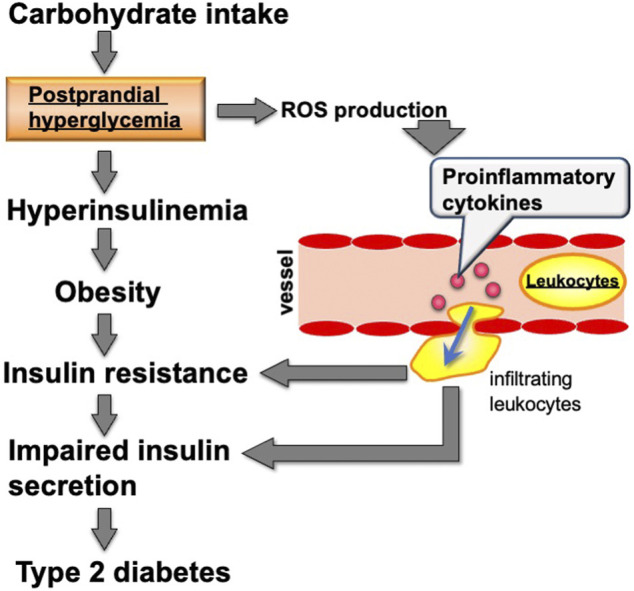
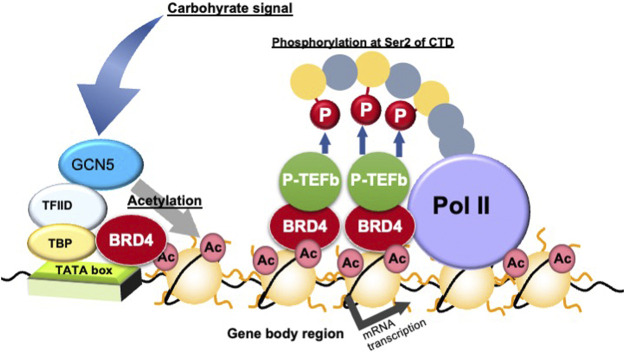
Studies indicate that induction of metabolic gene expression by nutrient intake, and in response to subsequently secreted hormones, is regulated by transcription factors binding to cis-elements and associated changes of epigenetic memories (histone modifications and DNA methylation) located in promoter and enhancer regions. Carbohydrate intake-mediated induction of metabolic gene expression is regulated by histone acetylation and the histone acetylation reader bromodomain-containing protein 4 (BRD4) on the gene body region, which corresponds to the transcribed region of the gene. In this review, we introduce carbohydrate-responsive metabolic gene regulation by (i) transcription factors and epigenetic memory in promoter/enhancer regions (promoter/enhancer-based epigenetics), and (ii) histone acetylation and BRD4 in the gene body region (gene body-based epigenetics). Expression of carbohydrate-responsive metabolic genes related to nutrient digestion and absorption, fat synthesis, inflammation in the small intestine, liver and white adipose tissue, and in monocytic/macrophage-like cells are regulated by various transcription factors. The expression of these metabolic genes are also regulated by transcription elongation histone acetylation and BRD4 in the gene body region. Additionally, the expression of genes related to fat synthesis, and the levels of acetylated histones and BRD4 in fat synthesis-related genes, are downregulated in white adipocytes under insulin resistant and/or diabetic conditions. In contrast, expression of carbohydrate-responsive metabolic genes and/or histone acetylation and BRD4 binding in the gene body region of these genes, are upregulated in the small intestine, liver, and peripheral leukocytes (innate leukocytes) under insulin resistant and/or diabetic conditions. In conclusion, histone acetylation and BRD4 binding in the gene body region as well as transcription factor binding in promoter/enhancer regions regulate the expression of carbohydrate-responsive metabolic genes in many metabolic organs. Insulin resistant and diabetic conditions induce the development of metabolic diseases, including type 2 diabetes, by reducing the expression of BRD4-targeted carbohydrate-responsive metabolic genes in white adipose tissue and by inducing the expression of BRD4-targeted carbohydrate-responsive metabolic genes in the liver, small intestine, and innate leukocytes including monocytes/macrophages and neutrophils.
研究表明,营养物质摄入诱导代谢基因表达,并响应随后分泌的激素,这一过程由转录因子与顺式元件结合以及启动子和增强子区域中表观遗传记忆(组蛋白修饰和DNA甲基化)的相关变化所调控。碳水化合物摄入介导的代谢基因表达诱导作用,由基因体区域(对应于基因的转录区域)的组蛋白乙酰化和含溴结构域蛋白4(BRD4,一种组蛋白乙酰化读取蛋白)所调控。在本综述中,我们介绍了碳水化合物应答性代谢基因的调控机制,包括:(i)启动子/增强子区域中的转录因子和表观遗传记忆(基于启动子/增强子的表观遗传学),以及(ii)基因体区域中的组蛋白乙酰化和BRD4(基于基因体的表观遗传学)。与营养物质消化吸收、脂肪合成、小肠、肝脏和白色脂肪组织以及单核细胞/巨噬细胞样细胞中的炎症相关的碳水化合物应答性代谢基因的表达,受多种转录因子调控。这些代谢基因的表达还受基因体区域中转录延伸、组蛋白乙酰化和BRD4的调控。此外,在胰岛素抵抗和/或糖尿病状态下,白色脂肪细胞中与脂肪合成相关的基因表达、脂肪合成相关基因中的组蛋白乙酰化水平和BRD4水平均下调。相反,在胰岛素抵抗和/或糖尿病状态下,小肠、肝脏和外周白细胞(先天性白细胞)中碳水化合物应答性代谢基因的表达以及这些基因在基因体区域中的组蛋白乙酰化和BRD4结合均上调。总之,基因体区域中的组蛋白乙酰化和BRD4结合以及启动子/增强子区域中的转录因子结合,在许多代谢器官中调控碳水化合物应答性代谢基因的表达。胰岛素抵抗和糖尿病状态通过降低白色脂肪组织中BRD4靶向的碳水化合物应答性代谢基因的表达,以及诱导肝脏、小肠和包括单核细胞/巨噬细胞和中性粒细胞在内的先天性白细胞中BRD4靶向的碳水化合物应答性代谢基因的表达,导致包括2型糖尿病在内的代谢性疾病的发生。