Department of Emergency Medicine, Zhongshan Hospital, Fudan University, Shanghai, China.
Shanghai Medical College, Fudan University, Shanghai, China.
J Immunol Res. 2021 Jul 9;2021:9917302. doi: 10.1155/2021/9917302. eCollection 2021.
The prognostic nutritional index (PNI) has been reported to significantly correlate with poor survival and postoperative complications in patients with various diseases, but its relationship with mortality in COVID-19 patients has not been addressed.
A multicenter retrospective study involving patients with severe COVID-19 was conducted to investigate whether malnutrition and other clinical characteristics could be used to stratify the patients based on risk.
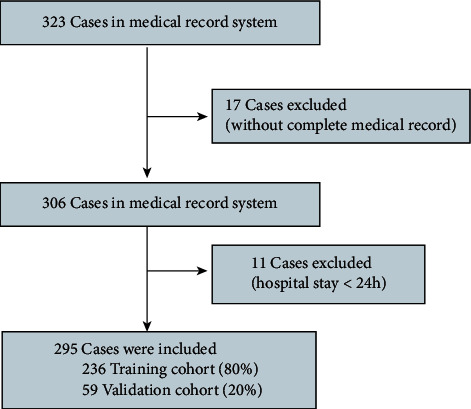
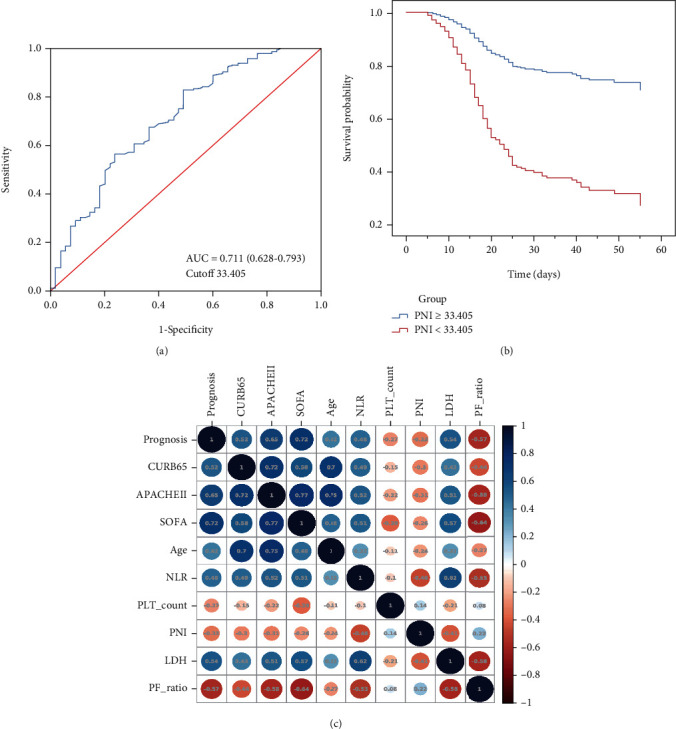
A total of 395 patients were included in our study, with 236 patients in the training cohort, 59 patients in the internal validation cohort, and 100 patients in the external validation cohort. During hospitalization, 63/236 (26.69%) and 14/59 (23.73%) patients died in the training and validation cohorts, respectively. PNI had the strongest relationships with the neutrophil-lymphocyte ratio (NLR) and lactate dehydrogenase (LDH) level but was less strongly correlated with the CURB65, APACHE II, and SOFA scores. The baseline PNI score, platelet (PLT) count, LDH level, and PaO/FiO (P/F) ratio were independent predictors of mortality in COVID-19 patients. A nomogram incorporating these four predictors showed good calibration and discrimination in the derivation and validation cohorts. A PNI score less than 33.405 was associated with a higher risk of mortality in severe COVID-19 patients in the Cox regression analysis.
These findings have implications for predicting the risk of mortality in COVID-19 patients at the time of admission and provide the first direct evidence that a lower PNI is related to a worse prognosis in severe COVID-19 patients.
预后营养指数(PNI)已被报道与各种疾病患者的不良预后和术后并发症显著相关,但它与 COVID-19 患者死亡率的关系尚未得到解决。
进行了一项涉及重症 COVID-19 患者的多中心回顾性研究,以调查营养不良和其他临床特征是否可用于根据风险对患者进行分层。
本研究共纳入 395 例患者,其中训练队列 236 例,内部验证队列 59 例,外部验证队列 100 例。住院期间,训练队列和验证队列中分别有 63/236(26.69%)和 14/59(23.73%)患者死亡。PNI 与中性粒细胞-淋巴细胞比值(NLR)和乳酸脱氢酶(LDH)水平的关系最强,但与 CURB65、APACHE II 和 SOFA 评分的关系较弱。基线 PNI 评分、血小板(PLT)计数、LDH 水平和 PaO/FiO(P/F)比值是 COVID-19 患者死亡的独立预测因素。包含这四个预测因素的列线图在推导和验证队列中均显示出良好的校准度和区分度。Cox 回归分析显示,PNI 评分小于 33.405 与重症 COVID-19 患者死亡风险增加相关。
这些发现提示在入院时预测 COVID-19 患者死亡风险具有重要意义,并首次直接证明较低的 PNI 与重症 COVID-19 患者预后不良相关。