Ando Koji, Hu Qingjiang, Kasagi Yuta, Oki Eiji, Mori Masaki
Department of Surgery and Science Kyushu University Fukuoka Japan.
Ann Gastroenterol Surg. 2021 Feb 15;5(4):419-426. doi: 10.1002/ags3.12440. eCollection 2021 Jul.
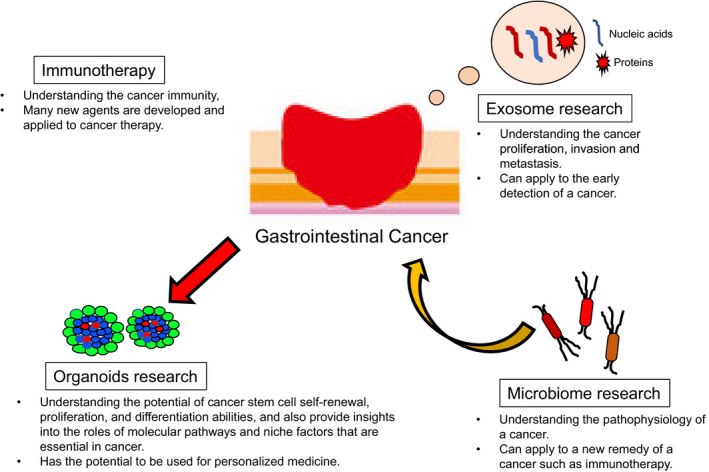
Cancer research has made remarkable progress and new discoveries are beginning to be made. For example, the discovery of immune checkpoint inhibition mechanisms in cancer cells has led to the development of immune checkpoint inhibitors that have benefited many cancer patients. In this review, we will introduce and describe the latest novel areas of cancer research: exosomes, microbiome, immunotherapy. and organoids. Exosomes research will lead to further understanding of the mechanisms governing cancer proliferation, invasion, and metastasis, as well as the development of cancer detection and therapeutic methods. Microbiome are important in understanding the disease. Immunotherapy is the fourth treatment in cancer therapy. Organoid biology will further develop with a goal of translating the research into personalized therapy. These research areas may result in the creation of new cancer treatments in the future.
癌症研究取得了显著进展,新的发现也不断涌现。例如,癌细胞中免疫检查点抑制机制的发现促使了免疫检查点抑制剂的研发,使许多癌症患者受益。在本综述中,我们将介绍并描述癌症研究的最新前沿领域:外泌体、微生物组、免疫疗法和类器官。外泌体研究将有助于进一步了解癌症增殖、侵袭和转移的机制,以及癌症检测和治疗方法的开发。微生物组对于理解疾病很重要。免疫疗法是癌症治疗中的第四种治疗方式。类器官生物学将进一步发展,目标是将研究转化为个性化治疗。这些研究领域未来可能会催生新的癌症治疗方法。