Mattek Alison M, Burr Daisy A, Shin Jin, Whicker Cady L, Kim M Justin
University of Oregon, Department of Psychology.
Duke University, Department of Psychology & Neuroscience.
Affect Sci. 2020 Mar;1(1):42-56. doi: 10.1007/s42761-020-00007-9. Epub 2020 Apr 18.
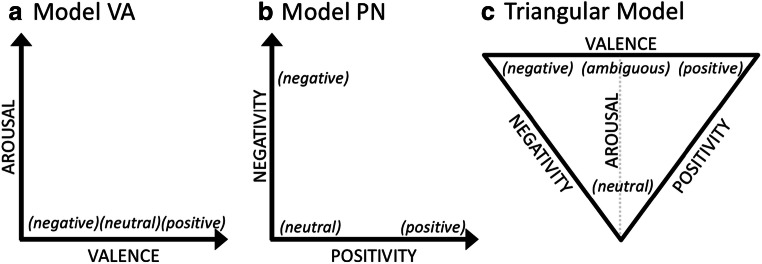
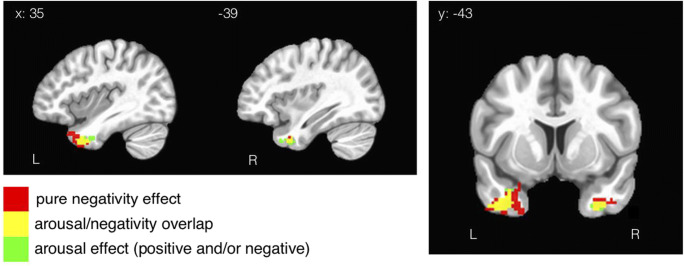
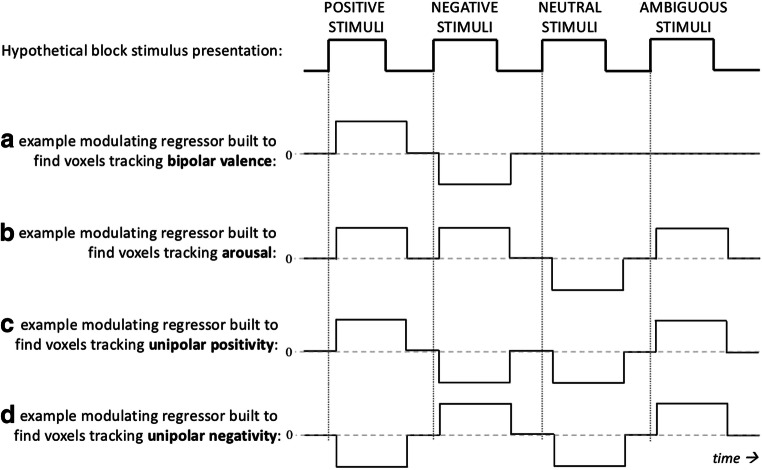
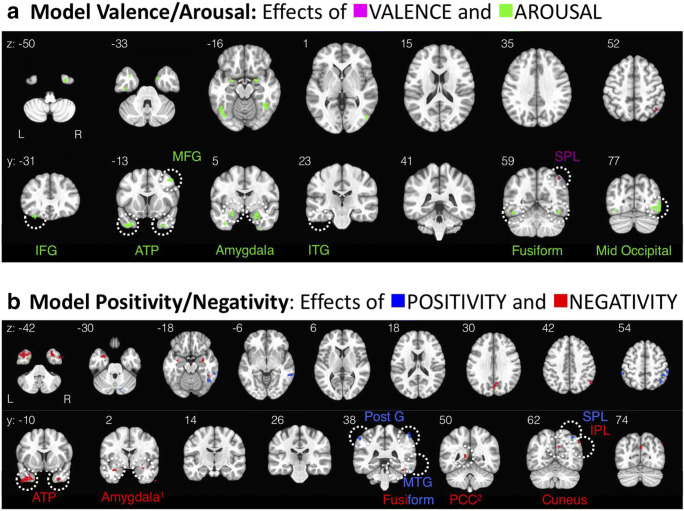
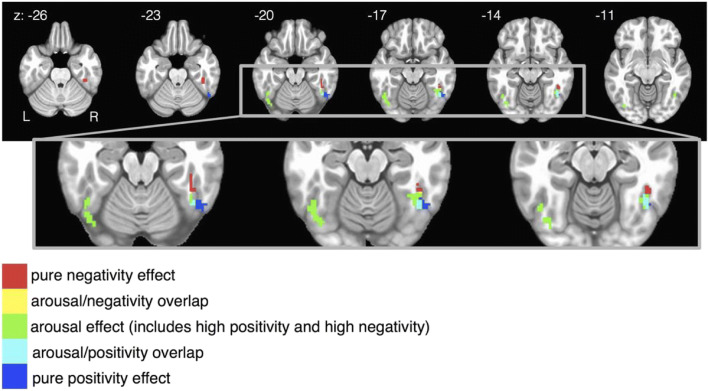
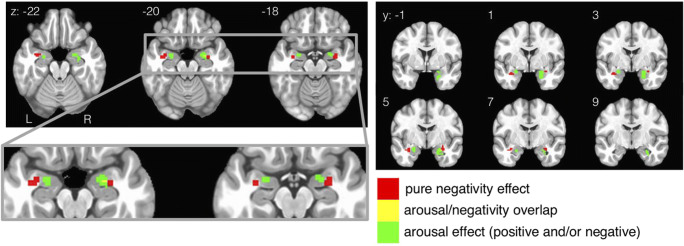
The events we experience day to day can be described in terms of their affective quality: some are rewarding, others are upsetting, and still others are inconsequential. These natural distinctions reflect an underlying representational structure used to classify affective quality. In affective psychology, many experiments model this representational structure with two dimensions, using either the dimensions of valence and arousal, or alternatively, the dimensions of positivity and negativity. Using fMRI, we show that it is optimal to use all four dimensions to examine the data. Our findings include: (1) a gradient representation of valence that is anatomically organized along the fusiform gyrus, and (2) distinct subregions within bilateral amygdala that track arousal versus negativity. Importantly, these results would have remained concealed had either of the commonly used 2-dimensional approaches been adopted , demonstrating the utility of our approach.
有些是有回报的,有些是令人苦恼的,还有些是无关紧要的。这些自然的区分反映了一种用于对情感性质进行分类的潜在表征结构。在情感心理学中,许多实验用两个维度对这种表征结构进行建模,要么使用效价和唤醒度维度,要么使用积极性和消极性维度。通过功能磁共振成像,我们表明使用所有四个维度来检查数据是最优的。我们的发现包括:(1)沿着梭状回在解剖学上有组织的效价梯度表征,以及(2)双侧杏仁核内追踪唤醒度与消极性的不同子区域。重要的是,如果采用任何一种常用的二维方法,这些结果都将被掩盖,这证明了我们方法的实用性。