O'Rourke Norm, Sixsmith Andrew, Michael Tal, Bachner Yaacov G
Department of Public Health and Multidisciplinary Center for Research On Aging, Ben-Gurion University of the Negev, P.O. Box 653, 8410501, Be'er Sheva, Israel.
STAR Institute, Simon Fraser University, Vancouver, BC, Canada.
Int J Bipolar Disord. 2021 Aug 2;9(1):24. doi: 10.1186/s40345-021-00229-1.
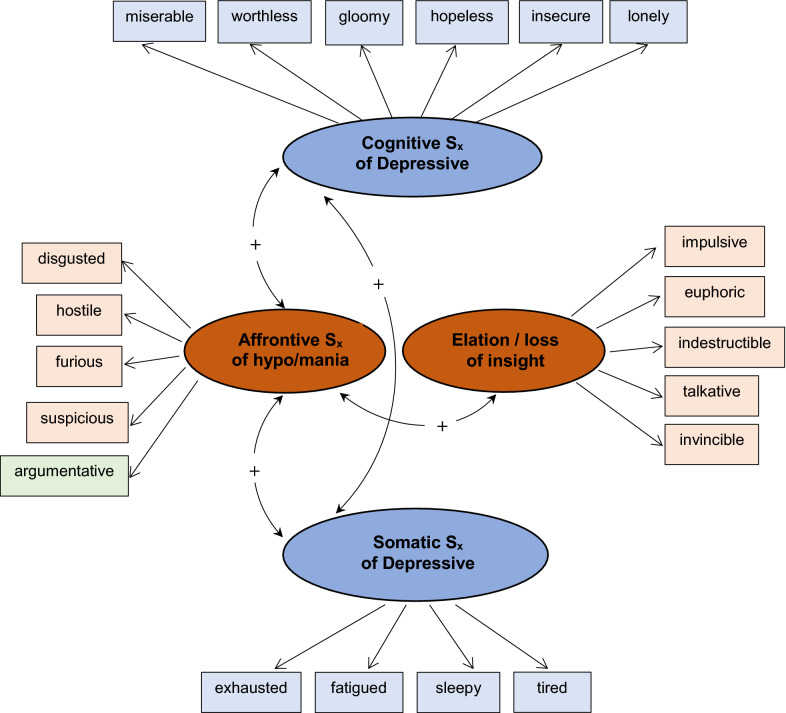
Research with the BDS (Bipolar Disorder Symptom Scale) suggests a 4-factor structure of responses: two depression (cognitive, somatic) and two hypo/mania factors (elation/loss of insight, affrontive symptoms). The two depression and two hypo/mania factors are correlated; and affrontive symptoms of hypo/mania (e.g., furious, disgusted, argumentative) are positively correlated with both depression factors suggesting pathways for mixed symptom presentation. This grouping of affrontive symptoms of hypo/mania organically emerged in exploratory research and has subsequently been supported in confirmatory analyses between samples and over time. The BDS has been clinically validated with BD outpatients.
Over 19 days, we recruited an international sample of 784 adults with BD using micro-targeted, social media advertising (M = 44.48 years, range 18-82). All participants indicated that they had BD (subtype, if known) and had been diagnosed with BD (month, year). This sample size was sufficient to confirm the 4-factor model across subtypes and compare the three (BD I, BD II, BD NOS). Responses to 19 of 20 BDS items were psychometrically consistent across BD subtypes. Only responses to the 'hopeless' item were significantly higher for those with BD II.
When comparing models, it appears that affrontive symptoms are significantly and uniformly associated with hypo/mania and both depression factors across subtypes. In contrast to BD diagnostic criteria, this suggests that affrontive symptoms are central to the clinical presentation of hypo/mania and mixed symptomology across BD subtypes.
对双相情感障碍症状量表(BDS)的研究表明,其反应具有四因素结构:两个抑郁因素(认知、躯体)和两个轻躁狂/躁狂因素(欣快/洞察力丧失、冒犯性症状)。两个抑郁因素和两个轻躁狂/躁狂因素相互关联;轻躁狂/躁狂的冒犯性症状(如愤怒、厌恶、好争论)与两个抑郁因素均呈正相关,提示了混合症状表现的途径。轻躁狂/躁狂的冒犯性症状这一分类在探索性研究中自然出现,随后在样本间及不同时间的验证性分析中得到了支持。BDS已在双相情感障碍门诊患者中得到临床验证。
在19天内,我们通过精准定向的社交媒体广告招募了784名患有双相情感障碍的成年国际样本(平均年龄M = 44.48岁,范围18 - 82岁)。所有参与者均表明他们患有双相情感障碍(若已知亚型)且已被诊断为双相情感障碍(诊断月份、年份)。该样本量足以跨亚型确认四因素模型并比较三种类型(双相I型、双相II型、未特定型双相情感障碍)。20项BDS条目中19项的反应在双相情感障碍各亚型间的心理测量学上是一致的。只有“绝望”这一条目的反应在双相II型患者中显著更高。
在比较模型时,冒犯性症状似乎在各亚型中均与轻躁狂/躁狂及两个抑郁因素显著且一致地相关。与双相情感障碍的诊断标准不同,这表明冒犯性症状是双相情感障碍各亚型轻躁狂/躁狂及混合症状临床表现的核心。