Sander Stefan, Müller Robert, Ahrens Mike, Kaupp Martin, Braun Thomas
Department of Chemistry, Humboldt-Universität zu Berlin, Brook-Taylor-Str. 2, 12489, Berlin, Germany.
Institut für Chemie, Technische Universität Berlin, Theoretische Chemie/Quantenchemie, Sekr.C7, Straße des 17. Juni 135, 10623, Berlin, Germany.
Chemistry. 2021 Oct 13;27(57):14287-14298. doi: 10.1002/chem.202102451. Epub 2021 Sep 8.
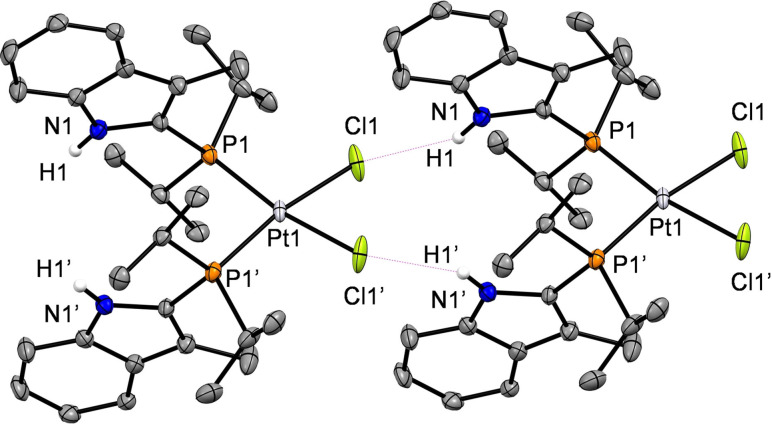
The reaction of [PtCl (COD)] (COD=1,5-cyclooctadiene) with diisopropyl-2-(3-methyl)indolylphosphine (iPr P(C H N)) led to the formation of the platinum(ii) chlorido complexes, cis-[PtCl {iPr P(C H N)} ] (1) and trans-[PtCl {iPr P(C H N)} ] (2). The cis-complex 1 reacted with NEt yielding the complex cis-[PtCl{κ -(P,N)-iPr P(C H N)}{iPr P(C H N)}] (3) bearing a cyclometalated κ -(P,N)-phosphine ligand, while the isomer 2 with a trans-configuration did not show any reactivity towards NEt . Treatment of 1 or 3 with (CH ) NF (TMAF) resulted in the formation of the twofold cyclometalated complex cis-[Pt{κ -(P,N)-iPr P(C H N)} ] (4). The molecular structures of the complexes 1-4 were determined by single-crystal X-ray diffraction. The fluorido complex cis-[PtF{κ -(P,N)-iPr P(C H N)}{iPr P(C H N)}] ⋅ (HF) (5 ⋅ (HF) ) was formed when complex 4 was treated with different hydrogen fluoride sources. The Pt(ii) fluorido complex 5 ⋅ (HF) exhibits intramolecular hydrogen bonding in its outer coordination sphere between the fluorido ligand and the NH group of the 3-methylindolyl moiety. In contrast to its chlorido analogue 3, complex 5 ⋅ (HF) reacted with CO or the ynamide 1-(2-phenylethynyl)-2-pyrrolidinone to yield the complexes trans-[Pt(CO){κ -(P,C)-iPr P(C H NCO)}{iPr P(C H N)}][F(HF) ] (7) and a complex, which we suggest to be cis-[Pt{C=C(Ph)OCN(C H )}{κ -(P,N)-iPr P(C H N)}{iPr P(C H N)}][F(HF) ] (9), respectively. The structure of 9 was assigned on the basis of DFT calculations as well as NMR and IR data. Hydrogen bonding of HF and NH to fluoride was proven to be crucial for the existence of 7 and 9.
[PtCl(COD)](COD = 1,5 - 环辛二烯)与二异丙基 - 2 - (3 - 甲基)吲哚基膦(iPr₂P(C₉H₆N))反应生成了铂(II)氯配合物,顺式 - [PtCl₂{iPr₂P(C₉H₆N)}₂](1)和反式 - [PtCl₂{iPr₂P(C₉H₆N)}₂](2)。顺式配合物1与NEt₃反应生成了带有环金属化κ²-(P,N)-膦配体的配合物顺式 - [PtCl{κ²-(P,N)-iPr₂P(C₉H₆N)}{iPr₂P(C₉H₆N)}](3),而具有反式构型的异构体2对NEt₃没有任何反应活性。用(CH₃)₃NF(TMAF)处理1或3会生成双环金属化配合物顺式 - [Pt{κ²-(P,N)-iPr₂P(C₉H₆N)}₂](4)。配合物1 - 4的分子结构通过单晶X射线衍射确定。当配合物4用不同的氟化氢源处理时,生成了氟化物配合物顺式 - [PtF{κ²-(P,N)-iPr₂P(C₉H₆N)}{iPr₂P(C₉H₆N)}]·(HF)(5·(HF))。铂(II)氟化物配合物5·(HF)在其外部配位球中,氟化物配体与3 - 甲基吲哚基部分的NH基团之间存在分子内氢键。与其氯类似物3不同,配合物5·(HF)与CO或烯酰胺1 - (2 - 苯基乙炔基)-2 - 吡咯烷酮反应,分别生成配合物反式 - [Pt(CO){κ²-(P,C)-iPr₂P(C₉H₆NCO)}{iPr₂P(C₉H₆N)}][F(HF)](7)和一个我们认为是顺式 - [Pt{C = C(Ph)OCN(C₄H₈)}{κ²-(P,N)-iPr₂P(C₉H₆N)}{iPr₂P(C₉H₆N)}][F(HF)](9)的配合物。9的结构是根据密度泛函理论计算以及核磁共振和红外数据确定的。事实证明,HF和NH与氟化物之间的氢键对于7和9的存在至关重要。