
RR-XGBoost 组合模型在微空气质量检测仪数据校准中的应用。
Application of RR-XGBoost combined model in data calibration of micro air quality detector.
机构信息
Public Foundational Courses Department, Nanjing Vocational University of Industry Technology, Nanjing, 210023, China.
School of Mechanical Engineering, Nanjing Vocational University of Industry Technology, Nanjing, 210023, China.
出版信息
Sci Rep. 2021 Aug 2;11(1):15662. doi: 10.1038/s41598-021-95027-1.
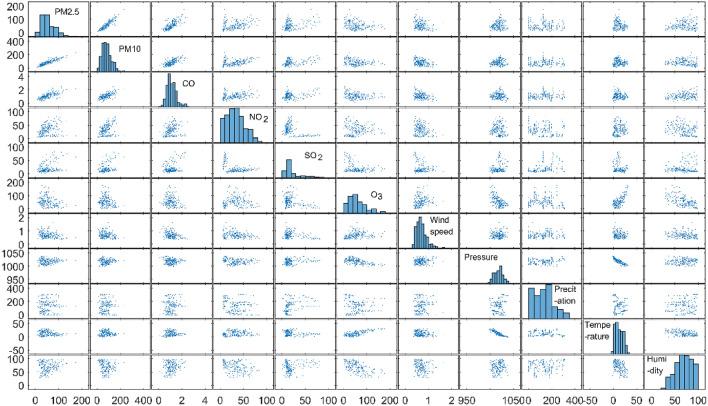
Grid monitoring is the current development direction of atmospheric monitoring. The micro air quality detector is of great help to the grid monitoring of the atmosphere, so higher requirements are put forward for the accuracy of the micro air quality detector. This paper presents a model to calibrate the measurement data of the micro air quality detector using the monitoring data of the air quality monitoring station. The concentration of six types of air pollutants is the research object of this study to establish a calibration model for the measurement data of the micro air quality detector. The first step is to use correlation analysis to find out the main factors affecting the concentration of the six types of pollutants. The second step uses Ridge Regression (RR) to select variables, find out the factors that have significant effects on the concentration of pollutants, and give the quantitative relationship between these factors and the pollutants. Finally, the predicted value of the ridge regression model and the measurement data of the micro air quality detector are used as input variables, and the Extreme Gradient Boosting (XGBoost) algorithm is used to give the final pollutant concentration prediction model. We named the combined model of ridge regression and XGBoost algorithm RR-XGBoost model. Relative Mean Absolute Percent Error (MAPE), Mean Absolute Error (MAE), goodness of fit (R), and Root Mean Square Error (RMSE) were used to evaluate the prediction accuracy of the RR-XGBoost model. The results show that the model is superior to some commonly used pollutant prediction methods such as random forest, support vector machine, and multilayer perceptron neural network in the evaluation of various indicators. The model not only has a good prediction effect on the training set but also on the test set, indicating that the model has good generalization ability. Using the RR-XGBoost model to calibrate the data of the micro air quality detector can make up for the shortcomings of the data monitoring accuracy of the micro air quality detector. The model plays an active role in the deployment of micro air quality detectors and grid monitoring of the atmosphere.
网格化监测是大气监测的发展方向。微空气质量监测仪对大气网格化监测具有重要意义,因此对微空气质量监测仪的精度提出了更高的要求。本文提出了一种利用空气质量监测站的监测数据来校准微空气质量监测仪测量数据的模型。本研究以六种空气污染物的浓度为研究对象,建立了微空气质量监测仪测量数据的校准模型。第一步,利用相关分析找出影响六种污染物浓度的主要因素。第二步,利用岭回归(RR)进行变量选择,找出对污染物浓度有显著影响的因素,并给出这些因素与污染物之间的定量关系。最后,将岭回归模型的预测值和微空气质量监测仪的测量数据作为输入变量,利用极端梯度提升(XGBoost)算法给出最终的污染物浓度预测模型。我们将岭回归和 XGBoost 算法的组合模型命名为 RR-XGBoost 模型。相对平均绝对百分比误差(MAPE)、平均绝对误差(MAE)、拟合优度(R)和均方根误差(RMSE)用于评估 RR-XGBoost 模型的预测精度。结果表明,该模型在评价各种指标时优于一些常用的污染物预测方法,如随机森林、支持向量机和多层感知机神经网络。该模型不仅对训练集有很好的预测效果,对测试集也有很好的预测效果,表明该模型具有很好的泛化能力。利用 RR-XGBoost 模型对微空气质量监测仪的数据进行校准,可以弥补微空气质量监测仪数据监测精度的不足。该模型在微空气质量监测仪的部署和大气网格化监测中发挥着积极的作用。




 Zotero 插件