Department of Non-Communicable Disease Control and Prevention, Zhejiang Provincial Center for Disease Control and Prevention, Hangzhou, China.
Clinical Trial Service Unit and Epidemiological Studies Unit (CTSU), Nuffield Department of Population Health, University of Oxford, Oxford, UK.
Menopause. 2021 Aug 2;28(10):1130-1142. doi: 10.1097/GME.0000000000001829.
The aim of this study was to investigate the potentially modifiable factors affecting age at natural menopause (ANM) in Chinese women.
We used cross-sectional data from the China Kadoorie Biobank study which that recruited 0.5 million (0.3 million women) Chinese adults aged 30 to 79 from 2004 to 2008. Multinomial logistic regression models were used to examine the relationships between ANM and various factors recorded at baseline.
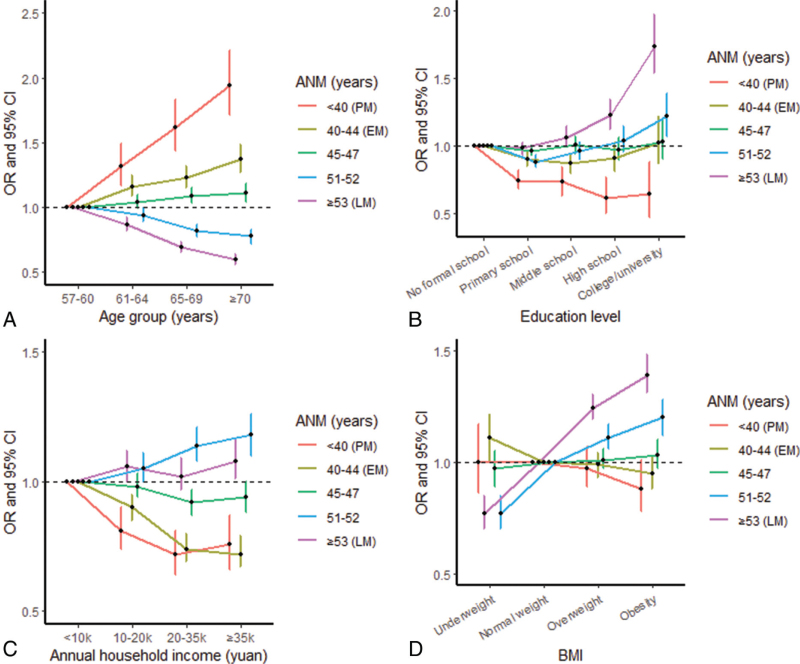
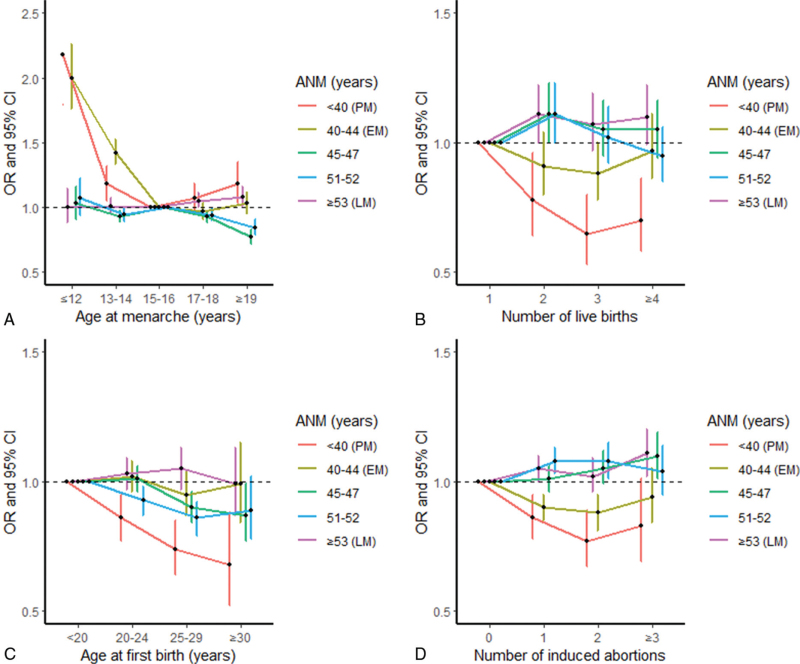
Among 87,349 postmenopausal women, the mean ANM (SD) was 48.7 (4.3) years. Older age, being a housewife, earlier menarche, and passive smoking were associated with both premature menopause (PM, ie, ANM <40 years) and early menopause (EM, ie, ANM between 40 and 44 years). A higher odds for EM was observed in women who were widowed (odds ratio: 1.10, 95% confidence interval: 1.04-1.16), had spontaneous abortions (1.33 [1.05-1.69]), current regular smoking (1.19 [1.07-1.37]), and frequent spicy food intake (1.11 [1.05-1.08]). Higher socioeconomic status; later first birth; more live births and induced abortions; longer breastfeeding; tea drinking, as well as intakes of meat, fruits, dairy, and soybean products; and increased body mass index gain were inversely associated with PM and/or EM. In contrast, women who had more pregnancies, occasional alcohol drinking, higher levels of physical activity or body mass index, vitamin intake, and hypertension were more likely to have a later age at menopause (LM, ie, ANM ≥53 years).
This large epidemiological study found a wide range of sociodemographic, lifestyle, dietary, and reproductive factors related to PM, EM, and LM in Chinese women.
本研究旨在探讨影响中国女性自然绝经年龄(ANM)的可改变因素。
我们使用了 2004 年至 2008 年中国慢性病前瞻性研究(CKB)的数据,该研究招募了 50 万名(300 万名女性)30 至 79 岁的中国成年人。使用多分类逻辑回归模型来检验 ANM 与基线时记录的各种因素之间的关系。
在 87349 名绝经后女性中,平均 ANM(SD)为 48.7(4.3)岁。年龄较大、家庭主妇、初潮较早和被动吸烟与早绝经(即 ANM<40 岁)和早绝经(即 ANM 在 40 至 44 岁之间)均相关。丧偶(比值比:1.10,95%置信区间:1.04-1.16)、自然流产(1.33[1.05-1.69])、经常规律吸烟(1.19[1.07-1.37])和频繁食用辛辣食物(1.11[1.05-1.08])的女性发生 EM 的几率更高。较高的社会经济地位;初产较晚;活产和人工流产较多;母乳喂养时间较长;饮茶,以及摄入肉类、水果、乳制品和豆制品;以及体重指数增加较多,与 PM 和/或 EM 呈负相关。相反,怀孕次数较多、偶尔饮酒、较高的体力活动或体重指数水平、维生素摄入和高血压的女性,绝经年龄较晚(即 ANM≥53 岁)的可能性更高。
这项大型流行病学研究发现了一系列与中国女性 PM、EM 和 LM 相关的社会人口学、生活方式、饮食和生殖因素。