Department of Psychiatry and Behavioral Sciences, University of California Davis, Davis, California.
Department of Psychiatry and Behavioral Sciences, University of California Davis, Davis, California.
Biol Psychiatry. 2021 Nov 1;90(9):643-651. doi: 10.1016/j.biopsych.2021.06.008. Epub 2021 Jun 12.
Magnetic resonance spectroscopy studies measuring brain glutamate separately from glutamine are helping elucidate schizophrenia pathophysiology. An expanded literature and improved methodologies motivate an updated meta-analysis examining effects of measurement quality and other moderating factors in characterizing abnormal glutamate levels in schizophrenia.
Searching previous meta-analyses and the MEDLINE database identified 83 proton magnetic resonance spectroscopy datasets published through March 25, 2020. Three quality metrics were extracted-Cramér-Rao lower bound (CRLB), line width, and coefficient of variation. Pooled effect sizes (Hedges' g) were calculated with random-effects, inverse variance-weighted models. Moderator analyses were conducted using quality metrics, field strength, echo time, medication, age, and stage of illness.
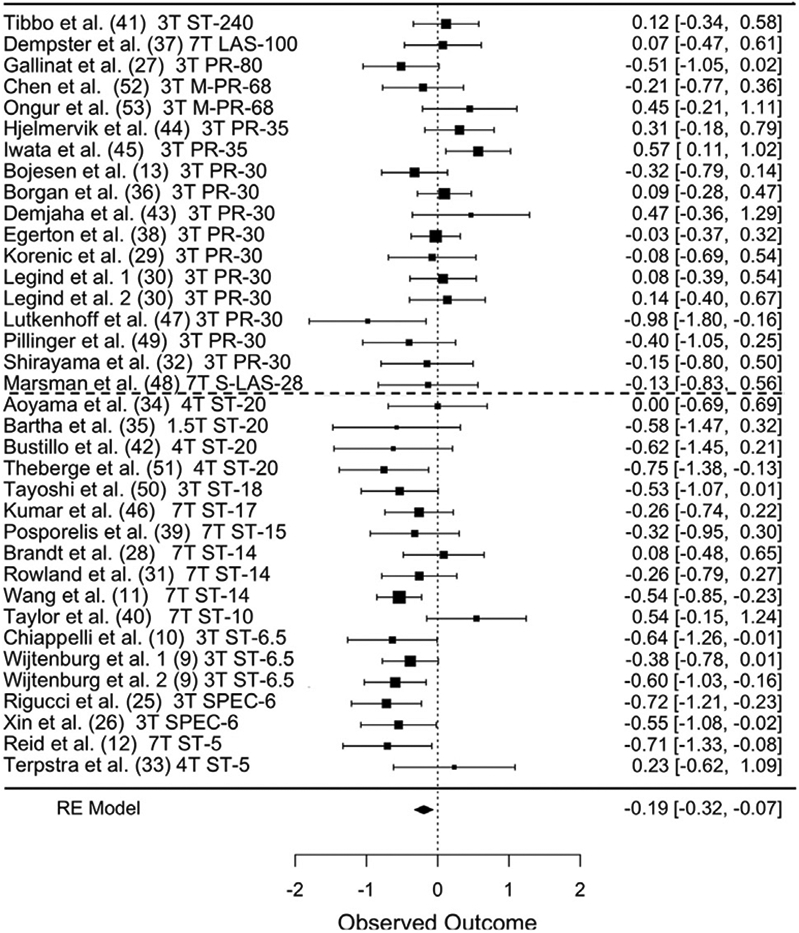
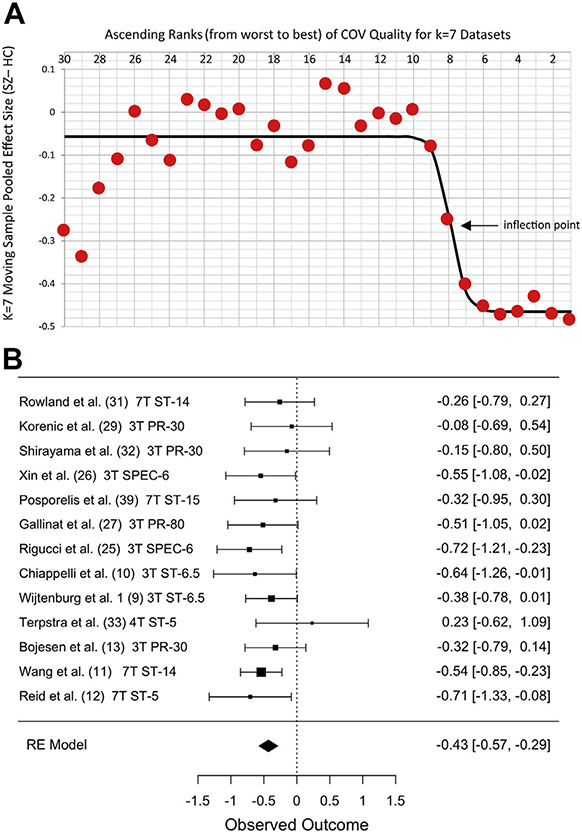
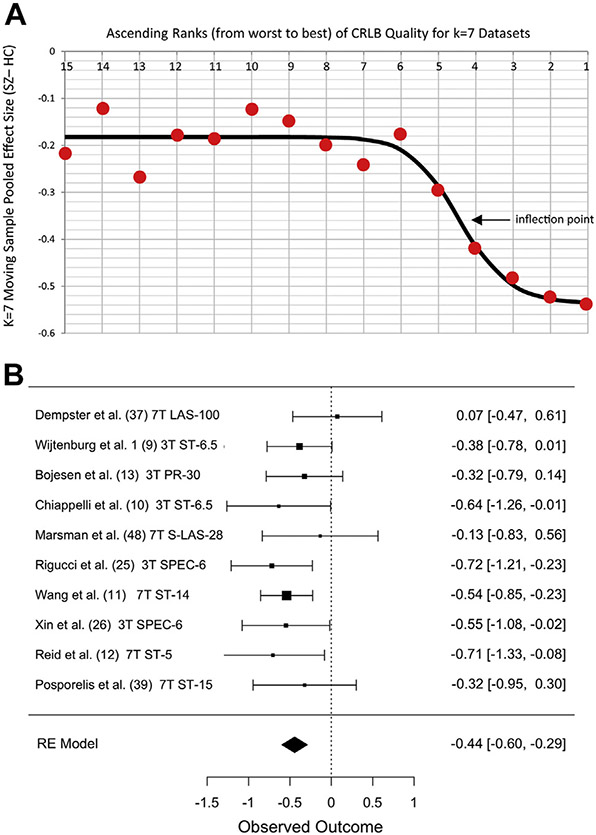
Across 36 datasets (2086 participants), medial prefrontal cortex glutamate was significantly reduced in patients (g = -0.19, confidence interval [CI] = -0.07 to -0.32). CRLB and coefficient of variation quality subgroups significantly moderated this effect. Glutamate was significantly more reduced in studies with lower CRLB or coefficient of variation (g = -0.44, CI = -0.29 to -0.60, and g = -0.43, CI = -0.29 to -0.57, respectively). Studies using echo time ≤20 ms also showed significantly greater reduction in glutamate (g = -0.41, CI = -0.26 to -0.55). Across 11 hippocampal datasets, group differences and moderator effects were nonsignificant. Group effects in thalamus and dorsolateral prefrontal cortex were also nonsignificant.
High-quality measurements reveal consistently reduced medial prefrontal cortex glutamate in schizophrenia. Stricter CRLB criteria and reduced nuisance variance may increase the sensitivity of future studies examining additional regions and the pathophysiological significance of abnormal glutamate levels in schizophrenia.
测量大脑谷氨酸的磁共振波谱研究分别从谷氨酰胺进行,有助于阐明精神分裂症的病理生理学。更广泛的文献和改进的方法促使我们进行了一项更新的荟萃分析,以检查在描述精神分裂症中谷氨酸水平异常时测量质量和其他调节因素的影响。
搜索以前的荟萃分析和 MEDLINE 数据库,确定了截至 2020 年 3 月 25 日发表的 83 个质子磁共振波谱数据集。提取了三个质量指标:克拉默-罗下限(CRLB)、线宽和变异系数。使用随机效应、逆方差加权模型计算了合并效应大小(Hedges' g)。使用质量指标、场强、回波时间、药物、年龄和疾病阶段进行了调节分析。
在 36 项研究(2086 名参与者)中,内侧前额叶皮质谷氨酸在患者中明显减少(g=-0.19,置信区间[CI]:-0.07 至-0.32)。CRLB 和变异系数质量亚组显著调节了这一效应。在 CRLB 或变异系数较低的研究中,谷氨酸的减少更为明显(g=-0.44,CI:-0.29 至-0.60,g=-0.43,CI:-0.29 至-0.57)。使用回波时间≤20 ms 的研究也显示出谷氨酸明显减少(g=-0.41,CI:-0.26 至-0.55)。在 11 个海马数据集上,组间差异和调节效应均无统计学意义。丘脑和背外侧前额叶皮质的组间效应也无统计学意义。
高质量的测量显示精神分裂症患者内侧前额叶皮质谷氨酸持续减少。更严格的 CRLB 标准和减少的干扰方差可能会提高未来研究检查其他区域以及精神分裂症中谷氨酸水平异常的病理生理意义的敏感性。