Nuffield Department of Population Health, University of Oxford, Oxford, England.
Nuffield Department of Population Health, Centre on Population Approaches for NCD Prevention, University of Oxford, Oxford, England.
PLoS One. 2021 Aug 4;16(8):e0254833. doi: 10.1371/journal.pone.0254833. eCollection 2021.
The provision and over-consumption of foods high in energy, saturated fat, free sugars or salt are important risk factors for poor diet and ill-health. In the UK, policies seek to drive improvement through voluntary reformulation of single nutrients in key food groups. There has been little consideration of the overall progress by individual companies. This study assesses recent changes in the nutrient profile of brands and products sold by the top 10 food and beverage companies in the UK.
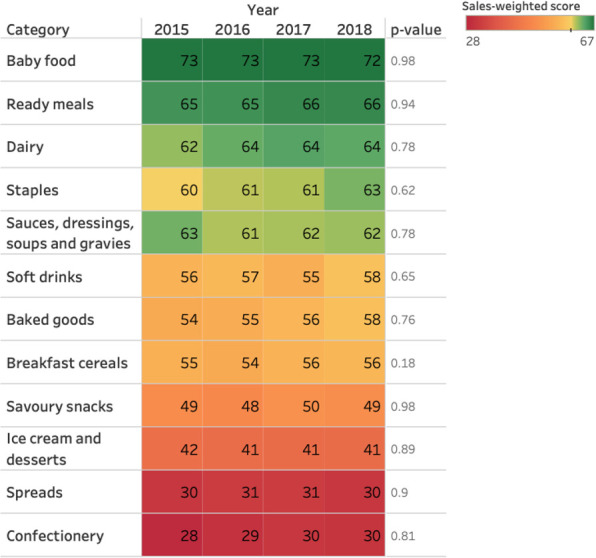
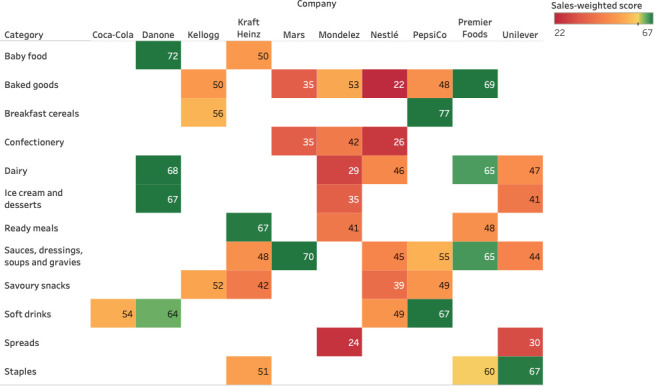
The FSA/Ofcom nutrient profile model was applied to the nutrient composition data for all products manufactured by the top 10 food and beverage companies and weighted by volume sales. The mean nutrient profiling score, on a scale of 1-100 with thresholds for healthy products being 62 for foods and 68 for drinks, was used to rank companies and food categories between 2015 and 2018, and to calculate the proportion of individual products and sales that are considered by the UK Government to be healthy.
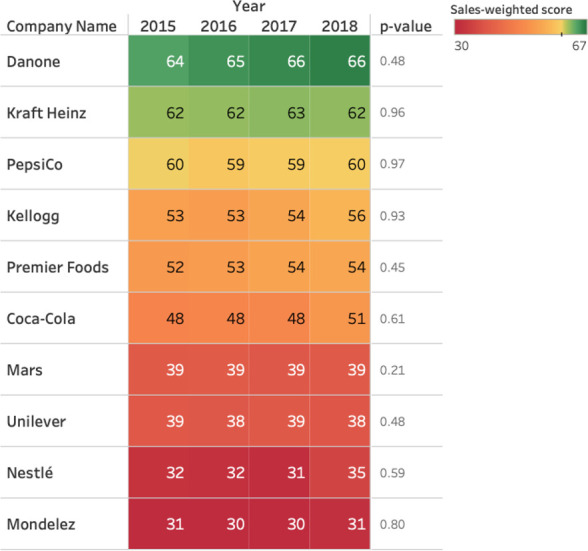
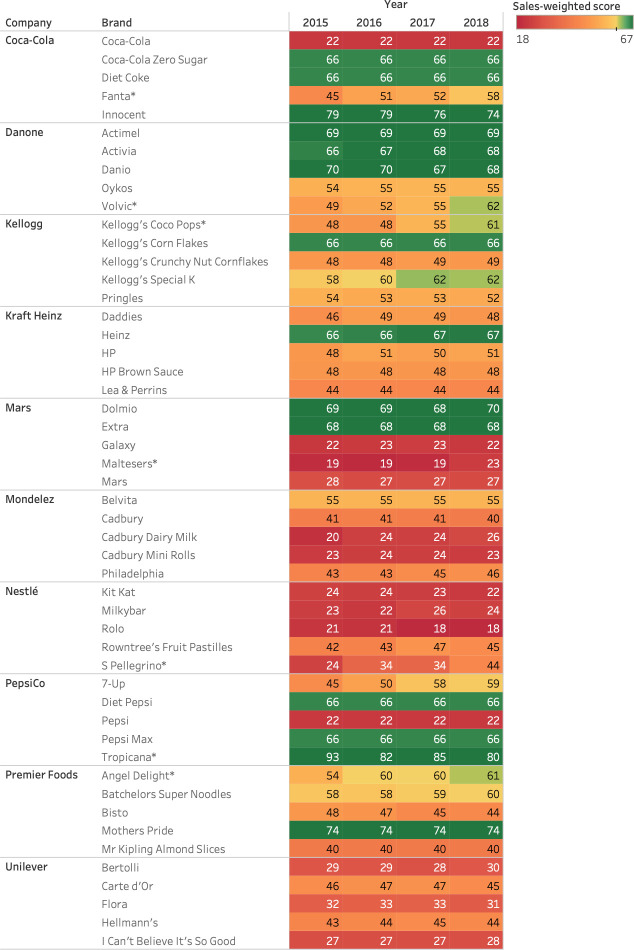
Between 2015 and 2018 there was little change in the sales-weighted nutrient profiling score of the top 10 companies (49 to 51; p = 0.28) or the proportion of products classified as healthy (46% to 48%; p = 0.23). Of the top five brands sold by each of the ten companies, only six brands among ten companies improved their nutrient profiling score by 20% or more. The proportion of total volume sales classified as healthy increased from 44% to 51% (p = 0.07) driven by an increase in the volume sales of bottled water, low/no calorie carbonates and juices, but after removing soft drinks, the proportion of foods classified as healthy decreased from 7% to 6% (p = 33).
The UK voluntary reformulation policies, setting targets for reductions in calories, sugar and salt, do not appear to have led to significant changes in the nutritional quality of foods, though there has been progress in soft drinks where the soft drink industry levy also applies. Further policy action is needed to incentivise companies to make more substantive changes in product composition to support consumers to achieve a healthier diet.
能量、饱和脂肪、游离糖或盐含量高的食物的供应和过度消费是导致不良饮食和健康状况不佳的重要危险因素。在英国,政策旨在通过对关键食品类别的单一营养素进行自愿性配方改革来推动改善。但很少考虑到个别公司的整体进展。本研究评估了英国十大食品和饮料公司销售的品牌和产品的营养成分的最新变化。
应用 FSA/Ofcom 营养成分模型对十大食品和饮料公司生产的所有产品的营养成分数据进行处理,并按销售量加权。使用营养成分评分(范围为 1-100,健康食品的阈值为 62 分用于食品,68 分用于饮料)对公司和食品类别进行排名,以 2015 年至 2018 年之间,并计算英国政府认为健康的个别产品和销售额的比例。
在 2015 年至 2018 年期间,十大公司的销售加权营养成分评分(49 至 51;p = 0.28)或被归类为健康的产品比例(46%至 48%;p = 0.23)几乎没有变化。在十大公司销售的前五大品牌中,只有六个品牌的营养成分评分提高了 20%或更多。被归类为健康的总销售量比例从 44%增加到 51%(p = 0.07),这是由于瓶装水、低/无糖碳酸饮料和果汁的销售量增加所致,但去除软饮料后,被归类为健康的食品比例从 7%下降到 6%(p = 33)。
英国的自愿性配方改革政策设定了减少卡路里、糖和盐的目标,但似乎并没有导致食品营养质量的显著变化,尽管软饮料行业征税也适用于软饮料。需要采取进一步的政策行动,激励公司在产品成分方面做出更实质性的改变,以支持消费者实现更健康的饮食。