Kirby Institute for Infection and Immunity in Society, UNSW Sydney, Level 6, Wallace Wurth Building, Sydney, NSW, 2052, Australia.
Centre for Social Research in Health, UNSW Sydney, Goodsell Building, Sydney, NSW, 2052, Australia.
BMC Public Health. 2021 Aug 4;21(1):1503. doi: 10.1186/s12889-021-11554-6.
Cervical cancer is the fourth most common cancer affecting women worldwide, with 85% of the burden estimated to occur among women in low and middle-income countries (LMICs). Recent developments in cervical cancer screening include a novel self-collection method for the detection of oncogenic HPV strains in the collected samples. The purpose of this review is to synthesise qualitative research on self-collection for HPV-based testing for cervical screening and identify strategies to increase acceptability and feasibility in different settings, to alleviate the burden of disease.
This review includes qualitative studies published between 1986 and 2020. A total of 10 databases were searched between August 2018 and May 2020 to identify qualitative studies focusing on the perspectives and experiences of self-collection for HPV-based cervical screening from the point of view of women, health care workers and other key stakeholders (i.e., policymakers). Two authors independently assessed studies for inclusion, quality, and framework thematic synthesis findings. The Socio-Ecological Model (SEM) was used to synthesize the primary studies.
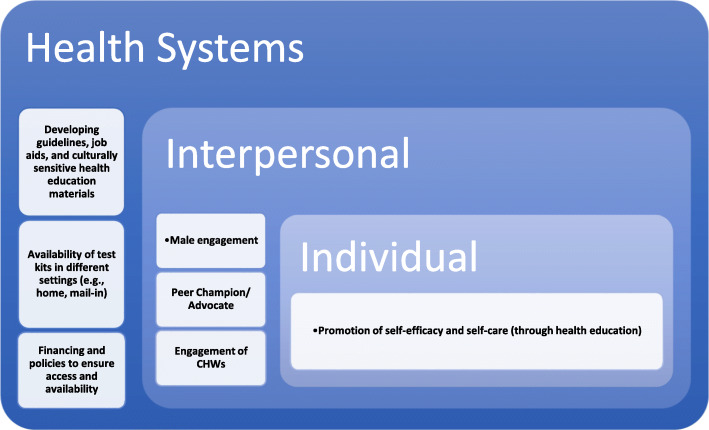
A total of 1889 publications were identified, of which 31 qualitative studies were included. Using an adapted version of SEM, 10 sub-themes were identified and classified under each of the adapted model's constructs: (a) intrapersonal, (b) interpersonal, and (c) health systems/public policy. Some of the themes included under the intrapersonal (or individual) construct include the importance of self-efficacy, and values attributed to self-collection. Under the intrapersonal construct, the findings centre around the use of self-collection and its impact on social relationships. The last construct of health systems focuses on needs to ensure access to self-collection, the need for culturally sensitive programs to improve health literacy, and continuum of care.
This review presents the global qualitative evidence on self-collection for HPV-based testing and details potential strategies to address socio-cultural and structural barriers and facilitators to the use of self-collection. If addressed during the design of an HPV-based cervical cancer screening testing intervention program, these strategies could significantly increase the acceptability and feasibility of the intervention and lead to more effective and sustainable access to cervical screening services for women worldwide.
宫颈癌是全球第四大常见的女性癌症,据估计,85%的负担发生在中低收入国家(LMICs)的女性中。宫颈癌筛查的最新进展包括一种新的自我采集方法,用于检测采集样本中的致癌 HPV 株。本综述的目的是综合分析自我采集用于 HPV 为基础的宫颈癌筛查的定性研究,并确定在不同环境中提高可接受性和可行性的策略,以减轻疾病负担。
本综述包括 1986 年至 2020 年期间发表的定性研究。2018 年 8 月至 2020 年 5 月期间,共检索了 10 个数据库,以确定重点关注女性、卫生保健工作者和其他利益攸关方(即决策者)的自我采集用于 HPV 为基础的宫颈癌筛查的观点和经验的定性研究。两位作者独立评估研究的纳入、质量和框架主题综合分析结果。使用社会生态模型(SEM)综合主要研究结果。
共确定了 1889 篇出版物,其中包括 31 篇定性研究。使用 SEM 的改编版本,确定了 10 个子主题,并将其分类归入每个改编模型的结构:(a)个体内,(b)人际间和(c)卫生系统/公共政策。个体内(或个体)结构下的一些主题包括自我效能感的重要性,以及归因于自我采集的价值观。个体内结构下的研究结果集中在自我采集的使用及其对社会关系的影响上。卫生系统的最后一个结构侧重于确保自我采集的获取、需要制定文化上敏感的方案来提高健康素养以及护理连续性。
本综述介绍了全球关于 HPV 为基础的检测自我采集的定性证据,并详细介绍了潜在的策略,以解决使用自我采集的社会文化和结构性障碍和促进因素。如果在 HPV 为基础的宫颈癌筛查检测干预方案的设计中考虑到这些策略,可以显著提高干预措施的可接受性和可行性,并导致全球范围内更多妇女有效和可持续地获得宫颈癌筛查服务。