School of Medical & Health Sciences, Bangor University, Bangor, UK
School of Psychology, Bangor University, Bangor, UK.
BMJ Open. 2021 Aug 4;11(8):e051983. doi: 10.1136/bmjopen-2021-051983.
This study assessed antimicrobial stewardship (AMS) and infection prevention (IP) interventions targeting healthcare-associated and carbapenem-resistant (CRKP) infections, their key outcomes and the application of behaviour change principles in these interventions.
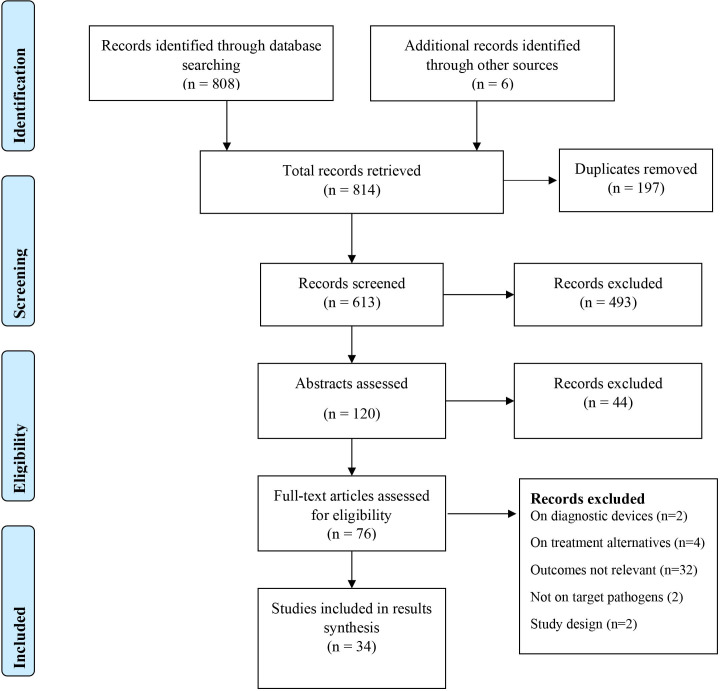
This scoping review was conducted in accordance with Preferred Reporting Items for Systematic Reviews and Meta-analysis Extension for Scoping Reviews (PRISMA-ScR) guidelines while focusing on acute healthcare settings in both low-to-middle income and high-income countries.
The databases searched were MEDLINE, PubMed, Web of Science and CINAHL between 22 April 2020 and 30 September 2020.
The review included peer-reviewed articles published in English language between 2010 and 2019. Studies that focussed on IP and/or AMS interventions primarily targeting or CRKP were included. Studies that assessed effectiveness of diagnostic devices or treatment options were excluded from this review.
An abstraction sheet calibrated for this study was used to extract data on the main study characteristics including the population, intervention and outcomes of interest (antimicrobial use, compliance with IP interventions and risk for and CRKP). A narrative synthesis of the results is provided.
The review included 34 studies. Analysis indicates that interventions targeting and CRKP include Education, Surveillance/Screening, Consultations, Audits, Policies and Protocols, Environmental measures, Bundles, Isolation as well as Notifications or alerts (represented using the ESCAPE-BIN acronym). The identified outcomes include antimicrobial use, resistance rates, risk reduction, adherence to contact precautions, hospital stay and time savings. AMS and IP interventions tend to be more adhoc with limited application of behaviour change principles.
This scoping review identified the AMS and IP interventions targeting and CRKP in healthcare settings and described their key outcomes. The application of behaviour change principles in AMS and IP interventions appears to be limited.
本研究评估了针对医疗保健相关和碳青霉烯类耐药 (CRKP) 感染的抗菌药物管理 (AMS) 和感染预防 (IP) 干预措施,及其主要结果,以及这些干预措施中行为改变原则的应用。
本范围综述是根据系统评价和荟萃分析扩展的首选报告项目 (PRISMA-ScR) 指南进行的,重点是中低收入和高收入国家的急性医疗机构。
2020 年 4 月 22 日至 2020 年 9 月 30 日,在 MEDLINE、PubMed、Web of Science 和 CINAHL 数据库中进行了检索。
本综述纳入了 2010 年至 2019 年期间以英文发表的同行评议文章。纳入的研究主要针对 或 CRKP 的 IP 和/或 AMS 干预措施。本综述排除了评估诊断设备或治疗选择有效性的研究。
使用为本研究校准的摘要表提取数据,内容包括主要研究特征,包括感兴趣的人群、干预措施和结果 (抗菌药物使用、遵守 IP 干预措施以及 或 CRKP 的风险)。提供了结果的叙述性综合。
本综述纳入了 34 项研究。分析表明,针对 或 CRKP 的干预措施包括教育、监测/筛查、咨询、审计、政策和方案、环境措施、捆绑、隔离以及通知或警报 (用 ESCAPE-BIN 缩写表示)。确定的结果包括抗菌药物使用、耐药率、风险降低、接触预防措施的依从性、住院时间和节省时间。AMS 和 IP 干预措施往往更临时,行为改变原则的应用有限。
本范围综述确定了医疗机构中针对 或 CRKP 的 AMS 和 IP 干预措施,并描述了其主要结果。在 AMS 和 IP 干预措施中应用行为改变原则的情况似乎有限。