Ferreira-Valente Alexandra, Fontes Fernando, Pais-Ribeiro José, Jensen Mark P
William James Center for Research, ISPA - Instituto Universitário, Lisbon, Portugal.
Department of Rehabilitation Medicine, University of Washington, Seattle, WA, USA.
J Pain Res. 2021 Jul 28;14:2295-2311. doi: 10.2147/JPR.S308607. eCollection 2021.
Chronic pain is a multidimensional experience that is influenced by biological, psychological, social, and spiritual factors. The Meaning Making Model is a recent cognitive behavioral model that has been developed to understand how psychosocial factors influence adjustment to stressful events, such as having a chronic illness. This qualitative study aims to understand the potential utility of this model for understanding the role of meaning making in adjustment to chronic pain.
Eighteen community-dwelling adults with chronic low back pain or chronic pain due to osteoarthritis participated in four focus groups. Participants were asked open-ended questions about their pain experience, pain-related beliefs, meaning of pain, and the perceived association between pain and their meaning in life and sense of purpose. Data were submitted to thematic analysis and the identified themes were considered in light of the Meaning Making Model.
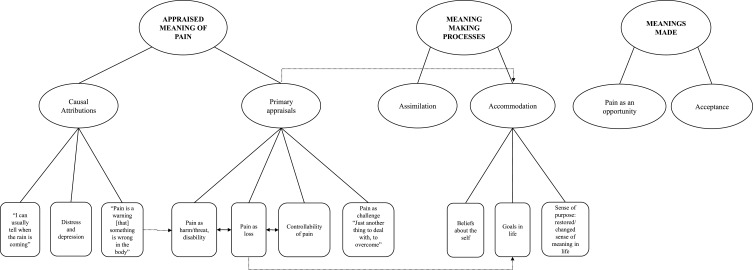
Three overarching themes emerged, each of which included two themes. The first overarching theme - "appraised meaning of pain" - included the themes "causal attributions" and "primary appraisals." The second - "meaning making processes" - included the themes "assimilation" and "accommodation." The third - "meanings made" - included the themes "pain as an opportunity" and "acceptance."
The key themes that emerged as individuals with chronic pain discussed pain and its impact are consistent with those that would be hypothesized as important from the Meaning Making Model, providing preliminary support for the utility of this model in the context of chronic pain. People with chronic pain appear to appraise pain in terms of its cause, controllability, threat, loss, or challenge. When a discrepancy between the appraised meaning of pain and one's global meaning emerged, participants engaged in meaning making processes (accommodation and assimilation), resulting in meanings made, such as a reappraised meaning of pain, perceptions of growth, and acceptance.
慢性疼痛是一种多维度体验,受到生物、心理、社会和精神因素的影响。意义构建模型是最近发展起来的一种认知行为模型,用于理解心理社会因素如何影响对压力事件(如患有慢性疾病)的适应。这项定性研究旨在了解该模型在理解意义构建在慢性疼痛适应中的作用方面的潜在效用。
18名患有慢性下腰痛或骨关节炎所致慢性疼痛的社区居民参加了4个焦点小组。参与者被问及关于他们的疼痛经历、与疼痛相关的信念、疼痛的意义以及疼痛与他们生活意义和目的感之间的感知关联等开放式问题。数据进行了主题分析,并根据意义构建模型对识别出的主题进行了考量。
出现了三个总体主题,每个总体主题又包含两个主题。第一个总体主题——“疼痛的评估意义”——包括“因果归因”和“初级评估”两个主题。第二个——“意义构建过程”——包括“同化”和“顺应”两个主题。第三个——“构建出的意义”——包括“疼痛是一种机遇”和“接纳”两个主题。
慢性疼痛患者在讨论疼痛及其影响时出现的关键主题与意义构建模型假设为重要的主题一致,为该模型在慢性疼痛背景下的效用提供了初步支持。慢性疼痛患者似乎根据疼痛的原因、可控性、威胁、损失或挑战来评估疼痛。当疼痛的评估意义与个人的整体意义之间出现差异时,参与者会进行意义构建过程(顺应和同化),从而产生构建出的意义,如对疼痛的重新评估意义、成长感知和接纳。