Mason Katy, Barnett Joshua, Pappa Sofia
West London NHS Trust, London, UK Lancashire and South Cumbria NHS Foundation Trust.
West London NHS Trust, London, UK.
Ther Adv Psychopharmacol. 2021 Jul 20;11:20451253211029490. doi: 10.1177/20451253211029490. eCollection 2021.
The pragmatic management of psychotic disorders is more complex than that delivered in a controlled trial environment. Therefore, this study aims to evaluate the real-world effectiveness of aripiprazole long-acting injectable (ALAI) and compare it with another commonly used long-acting anti-psychotic, once-monthly paliperidone palmitate (PP1M).
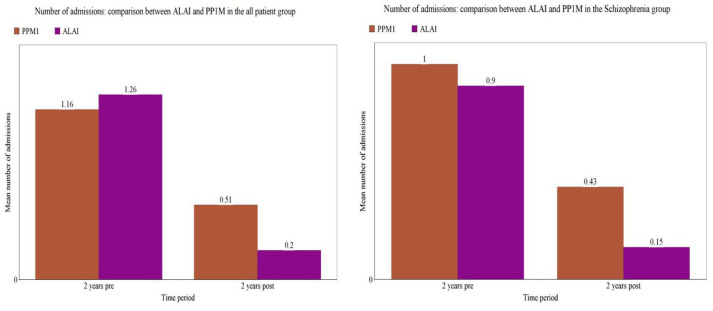
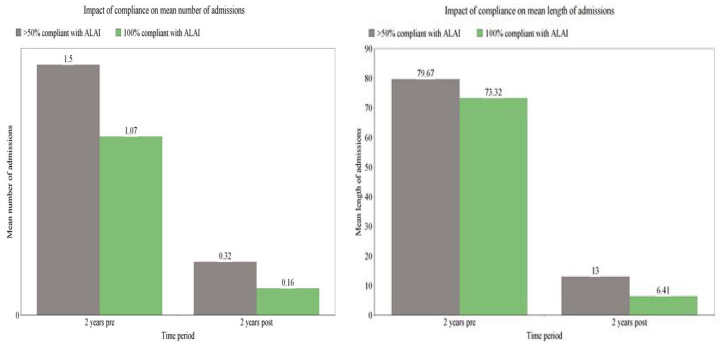
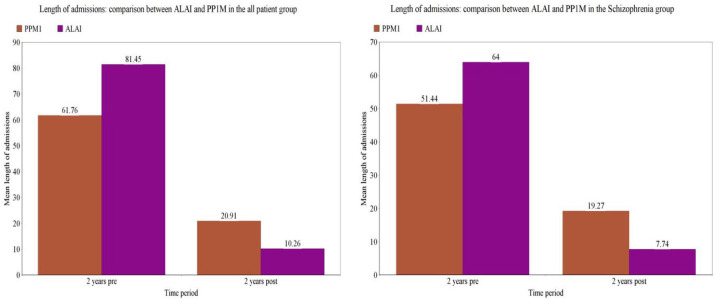
This naturalistic, independent 4-year mirror image study compared the mean number and length of hospital admissions 2 years before and 2 years after treatment initiation with ALAI. Retention rates, discontinuation reasons and level of adherence were also recorded. Furthermore, indirect comparisons were made between treatment outcomes on ALAI and PP1M.
A total of 109 eligible patients with a severe mental illness (65% with schizophrenia and 35% with other diagnosis) commenced on ALAI and 173 patients (69% with schizophrenia and 31% with other diagnoses) initiated on PP1M were included. Of these, 37% on ALAI and 34% on PP1M stopped treatment at 2 years; retention rates were most favourable for the schizophrenia group on PP1M. Patients were more likely to discontinue due to lack of effectiveness on ALAI and due to tolerability issues on PP1M. Those who continued for 2 years on ALAI ( = 69), demonstrated an overall decrease of 84% in the mean number and 88% in the mean length of hospital admissions compared with the 2 years before initiation. Although patients on ALAI appeared to have a significantly higher bed occupancy the 2-year period before initiation than patients on PP1M, the reductions in hospitalizations were comparable across both cohorts after 2 years of treatment.
The introduction of ALAI had a substantial impact on long-term clinical outcomes in this naturalistic cohort; more than half of patients continued treatment and had no admission during 2 years of follow up. There were no significant differences in hospitalisation rates between patients on ALAI and PP1M at 2 years.
精神病性障碍的实际管理比在对照试验环境中实施的管理更为复杂。因此,本研究旨在评估阿立哌唑长效注射剂(ALAI)在现实世界中的有效性,并将其与另一种常用的长效抗精神病药物——每月一次的棕榈酸帕利哌酮(PP1M)进行比较。
这项自然主义的、独立的4年镜像研究比较了开始使用ALAI治疗前2年和治疗后2年的平均住院次数和住院时长。还记录了保留率、停药原因和依从性水平。此外,对ALAI和PP1M的治疗结果进行了间接比较。
共有109例符合条件的严重精神疾病患者(65%为精神分裂症患者,35%为其他诊断患者)开始使用ALAI治疗,173例开始使用PP1M治疗的患者(69%为精神分裂症患者,31%为其他诊断患者)被纳入研究。其中,37%使用ALAI的患者和34%使用PP1M的患者在2年后停止治疗;PP1M治疗组中精神分裂症患者的保留率最为理想。患者因ALAI疗效不佳而停药的可能性更大,因PP1M耐受性问题而停药的可能性更大。那些持续使用ALAI两年的患者(n = 69),与开始治疗前的两年相比,平均住院次数总体减少了84%,平均住院时长减少了88%。尽管开始治疗前两年,使用ALAI的患者的床位占用率似乎明显高于使用PP1M的患者,但治疗两年后,两个队列的住院率下降情况相当。
在这个自然主义队列中,引入ALAI对长期临床结果产生了重大影响;超过一半的患者继续接受治疗,并且在两年的随访期间没有住院。两年时,使用ALAI和PP1M的患者的住院率没有显著差异。