Cardiovascular Research Institute, University of California, San Francisco, San Francisco, CA.
School of Biological Sciences, University of Nebraska-Lincoln, Lincoln, NE.
J Gen Physiol. 2021 Sep 6;153(9). doi: 10.1085/jgp.202112872. Epub 2021 Aug 5.
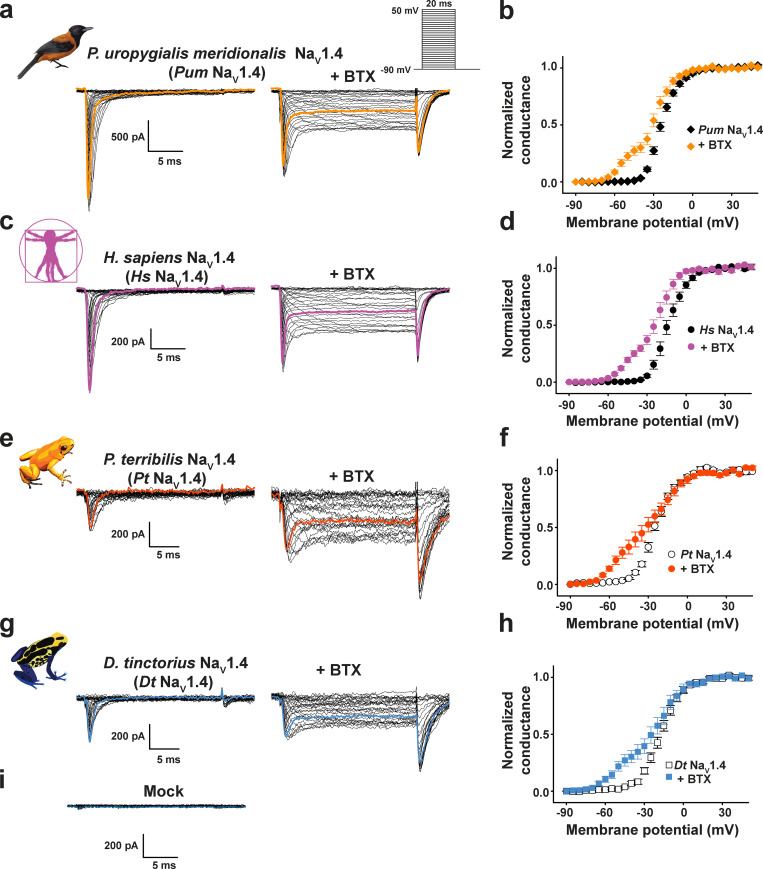
Many poisonous organisms carry small-molecule toxins that alter voltage-gated sodium channel (NaV) function. Among these, batrachotoxin (BTX) from Pitohui poison birds and Phyllobates poison frogs stands out because of its lethality and unusual effects on NaV function. How these toxin-bearing organisms avoid autointoxication remains poorly understood. In poison frogs, a NaV DIVS6 pore-forming helix N-to-T mutation has been proposed as the BTX resistance mechanism. Here, we show that this variant is absent from Pitohui and poison frog NaVs, incurs a strong cost compromising channel function, and fails to produce BTX-resistant channels in poison frog NaVs. We also show that captivity-raised poison frogs are resistant to two NaV-directed toxins, BTX and saxitoxin (STX), even though they bear NaVs sensitive to both. Moreover, we demonstrate that the amphibian STX "toxin sponge" protein saxiphilin is able to protect and rescue NaVs from block by STX. Taken together, our data contradict the hypothesis that BTX autoresistance is rooted in the DIVS6 N→T mutation, challenge the idea that ion channel mutations are a primary driver of toxin resistance, and suggest the possibility that toxin sequestration mechanisms may be key for protecting poisonous species from the action of small-molecule toxins.
许多有毒生物携带小分子毒素,这些毒素会改变电压门控钠离子通道(NaV)的功能。在这些毒素中,来自毒镖蛙和毒蛙的蟾毒和 Phyllobates 尤为突出,因为它们具有致命性和对 NaV 功能的异常影响。这些带毒生物如何避免自身中毒仍知之甚少。在毒蛙中,NaV DIVS6 孔形成螺旋 N 到 T 的突变被提出作为 BTX 抗性机制。在这里,我们表明这种变体不存在于 Pitohui 和毒蛙 NaV 中,会对通道功能造成严重的损害,并且不能在毒蛙 NaV 中产生 BTX 抗性通道。我们还表明,即使它们携带对两者都敏感的 NaV,圈养的毒蛙也能抵抗两种靶向 NaV 的毒素,BTX 和石房蛤毒素(STX)。此外,我们证明了两栖动物 STX“毒素海绵”蛋白 saxiphilin 能够保护和挽救 NaV 免受 STX 的阻断。综上所述,我们的数据与 BTX 自身抗性源于 DIVS6 N→T 突变的假设相矛盾,挑战了离子通道突变是毒素抗性的主要驱动因素的观点,并表明毒素隔离机制可能是保护有毒物种免受小分子毒素作用的关键。