Acibadem Labmed Clinical Laboratories, İstanbul, Turkey.
Department of Medical Biochemistry, AcibademMehmet Ali Aydınlar University, İstanbul, Turkey.
PLoS One. 2021 Aug 5;16(8):e0254073. doi: 10.1371/journal.pone.0254073. eCollection 2021.
Coronavirus disease 2019 (COVID-19) caused by SARS-CoV-2 virus, is a major public health concern spanning from healthy carriers to patients with life-threatening conditions. Although most of COVID-19 patients have mild-to-moderate clinical symptoms, some patients have severe pneumonia leading to death. Therefore, the early prediction of disease prognosis and severity is crucial in COVID-19 patients. The main objective of this study is to evaluate the haemocytometric parameters and identify severity score associated with SARS-CoV-2 infection.
Clinical and laboratory records were retrospectively reviewed from 97 cases of COVID-19 admitted to hospitals in Istanbul, Turkey. The patient groups were subdivided into three major groups: Group 1 (Non-critical): 59 patients, Group 2 (Critical-Survivors): 23 patients and Group 3 (Critical-Non-survivors):15 patients. These data was tested for correlation, including with derived haemocytometric parameters. The blood analyses were performed the Sysmex XN-series automated hematology analyser using standard laboratory protocols. All statistical testing was undertaken using Analyse-it software.
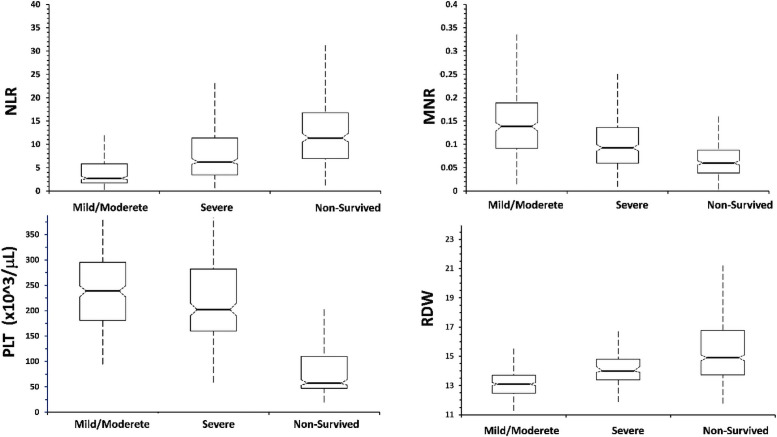
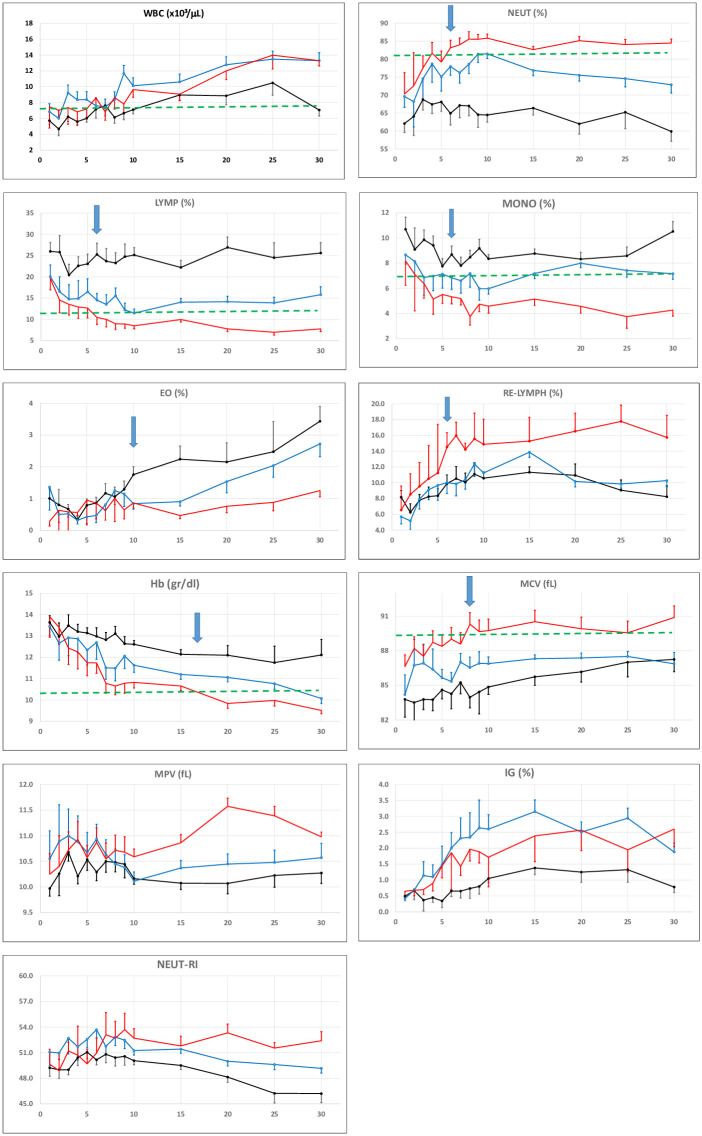
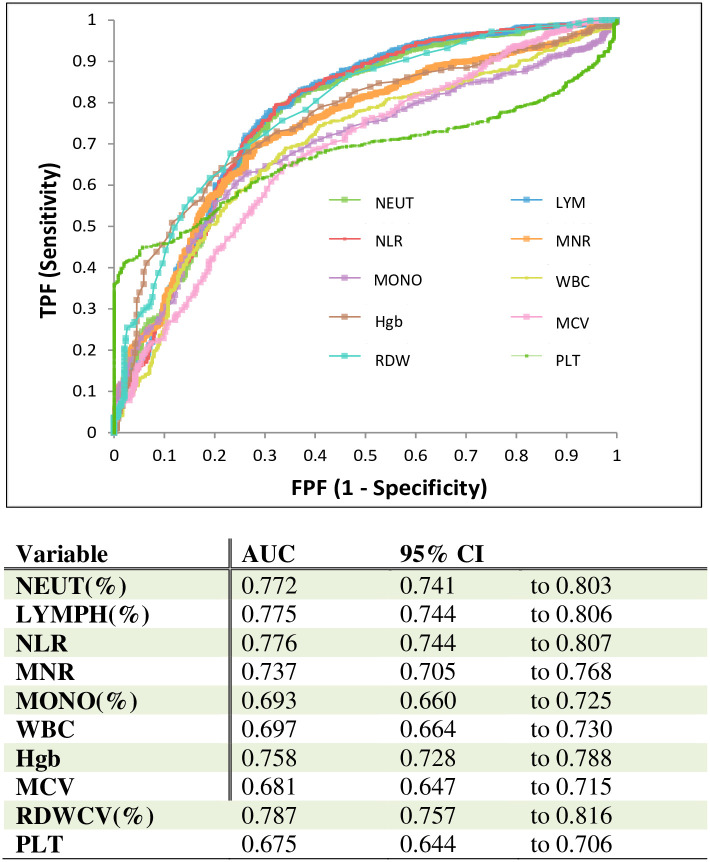
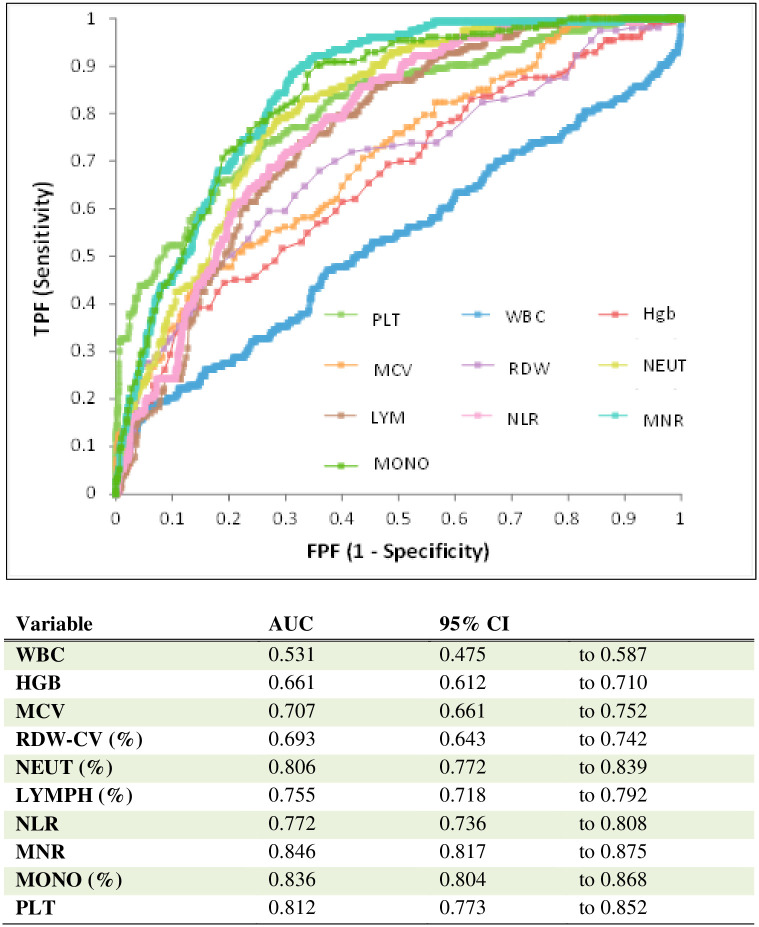
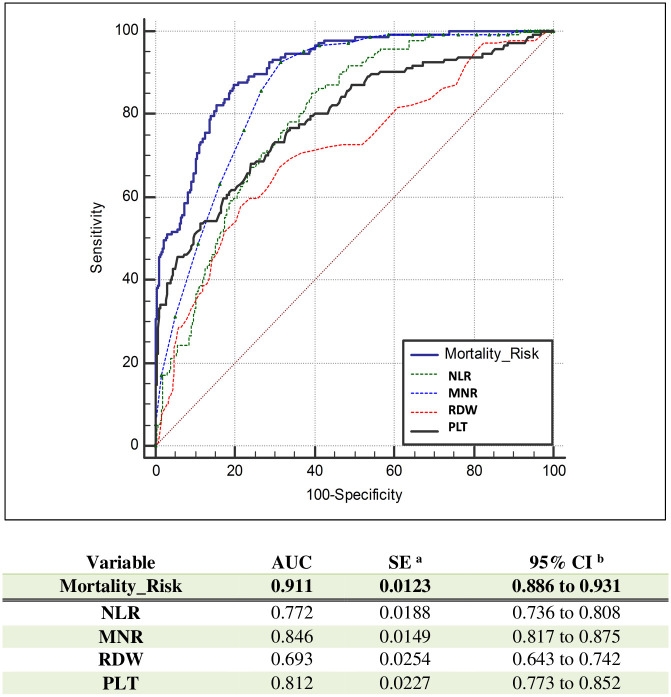
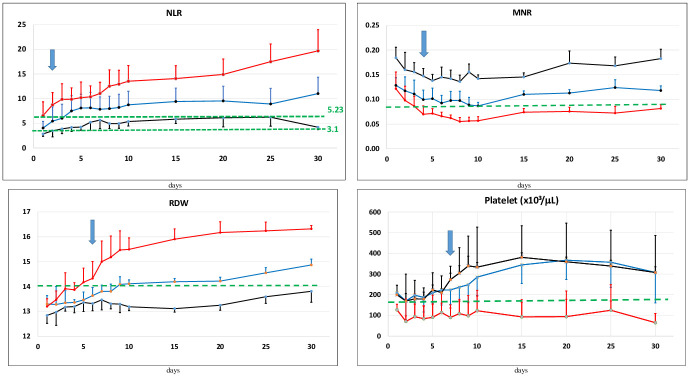
97 patients with COVID-19 disease and 935 sequential complete blood count (CBC-Diff) measurements (days 0-30) were included in the final analyses. Multivariate analysis demonstrated that red cell distribution width (RDW) (>13.7), neutrophil to lymphocyte ratio (NLR) (4.4), Hemoglobin (Hgb) (<11.4 gr/dL) and monocyte to neutrophil ratio (MNR) (0.084) had the highest area under curve (AUC) values, respectively in discrimination critical patients than non-critical patients. In determining Group 3, MNR (<0.095), NLR (>5.2), Plateletcount (PLT) (>142 x103/L) and RDW (>14) were important haemocytometric parameters, and the mortality risk value created by their combination had the highest AUC value (AUC = 0.911, 95% CI, 0886-0.931). Trend analysis of CBC-Diff parameters over 30 days of hospitalization, NLR on day 2, MNR on day 4, RDW on day 6 and PLT on day 7 of admission were found to be the best time related parameters in discrimination non-critical (mild-moderate) patient group from critical (severe and non-survivor) patient group.
NLR is a strong predictor for the prognosis for severe COVID-19 patients when the cut-off chosen was 4.4, the combined mortality risk factor COVID-19 disease generated from RDW-CV, NLR, MNR and PLT is best as a mortality haematocytometric index.
由 SARS-CoV-2 病毒引起的 2019 年冠状病毒病(COVID-19)是一个重大的公共卫生问题,涉及从健康携带者到有生命威胁的患者。尽管大多数 COVID-19 患者的临床症状为轻度至中度,但有些患者患有严重肺炎导致死亡。因此,早期预测疾病预后和严重程度对 COVID-19 患者至关重要。本研究的主要目的是评估与 SARS-CoV-2 感染相关的血液学参数和识别严重程度评分。
回顾性分析了 97 例在土耳其伊斯坦布尔医院住院的 COVID-19 患者的临床和实验室记录。将患者分为三组:第 1 组(非危急组):59 例,第 2 组(危急存活组):23 例,第 3 组(危急非存活组):15 例。测试了这些数据之间的相关性,包括衍生的血液学参数。使用标准实验室方案,使用 Sysmex XN 系列自动化血液学分析仪进行血液分析。所有统计测试均使用 Analyse-it 软件进行。
最终分析包括 97 例 COVID-19 患者和 935 例连续全血细胞计数(CBC-Diff)测量值(第 0-30 天)。多变量分析表明,红细胞分布宽度(RDW)(>13.7),中性粒细胞与淋巴细胞比值(NLR)(4.4),血红蛋白(Hgb)(<11.4gr/dL)和单核细胞与中性粒细胞比值(MNR)(0.084)在区分危急患者与非危急患者方面具有最高的曲线下面积(AUC)值。在确定第 3 组时,MNR(<0.095),NLR(>5.2),血小板计数(PLT)(>142x103/L)和 RDW(>14)是重要的血液学参数,并且由它们的组合创建的死亡率风险值具有最高的 AUC 值(AUC=0.911,95%CI,0.886-0.931)。在住院 30 天期间对 CBC-Diff 参数的趋势分析、入院第 2 天的 NLR、入院第 4 天的 MNR、入院第 6 天的 RDW 和入院第 7 天的 PLT 发现,它们是区分非危急(轻度-中度)患者组和危急(严重和非存活)患者组的最佳时间相关参数。
当选择的截止值为 4.4 时,NLR 是严重 COVID-19 患者预后的有力预测指标,由 RDW-CV、NLR、MNR 和 PLT 生成的 COVID-19 疾病联合死亡风险因素是最佳的死亡率血液学指标。