Laajaj Rachid, De Los Rios Camilo, Sarmiento-Barbieri Ignacio, Aristizabal Danilo, Behrentz Eduardo, Bernal Raquel, Buitrago Giancarlo, Cucunubá Zulma, de la Hoz Fernando, Gaviria Alejandro, Hernández Luis Jorge, León Leonardo, Moyano Diane, Osorio Elkin, Varela Andrea Ramírez, Restrepo Silvia, Rodriguez Rodrigo, Schady Norbert, Vives Martha, Webb Duncan
University of Los Andes, Bogota, Colombia.
Inter-American Development Bank, Washington, D.C., USA.
Nat Commun. 2021 Aug 5;12(1):4726. doi: 10.1038/s41467-021-25038-z.
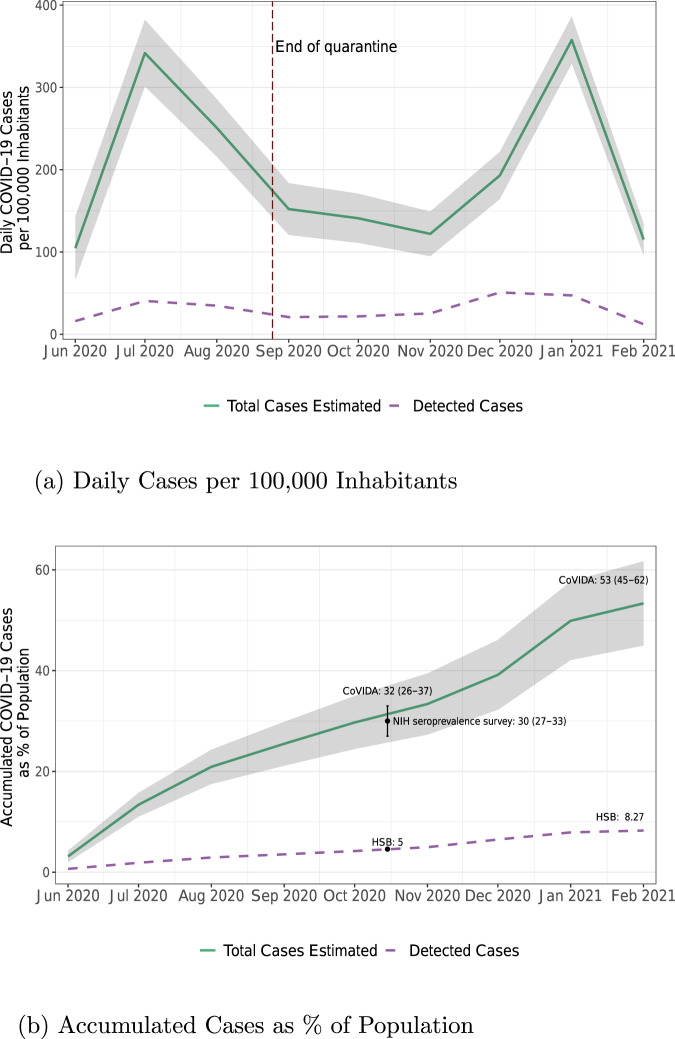
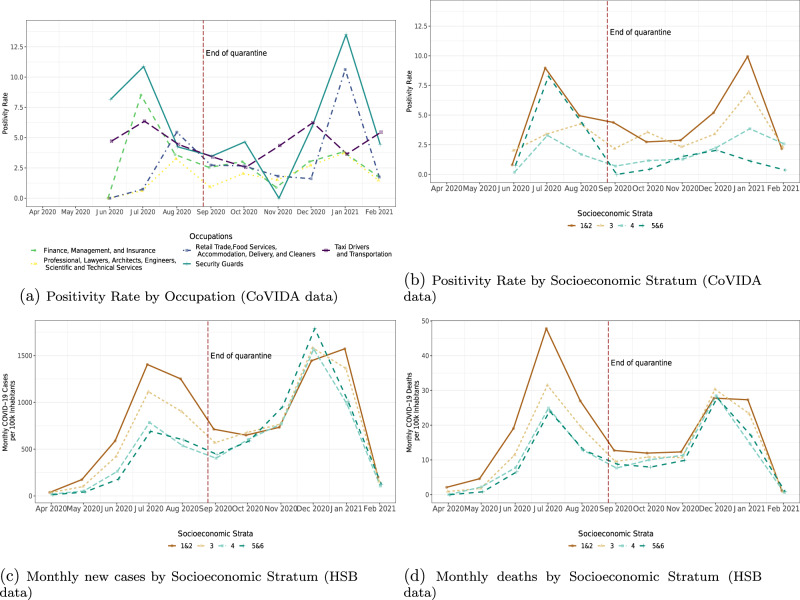
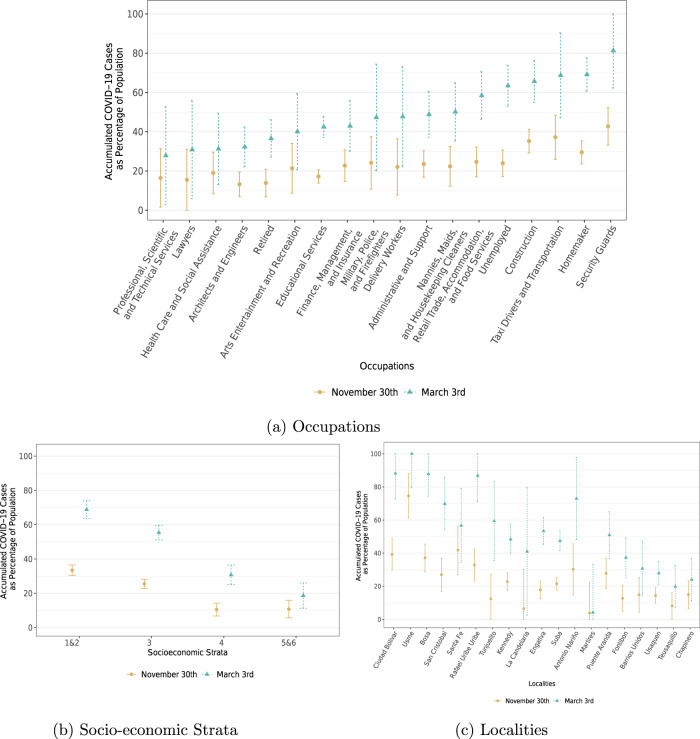
Latin America has been severely affected by the COVID-19 pandemic but estimations of rates of infections are very limited and lack the level of detail required to guide policy decisions. We implemented a COVID-19 sentinel surveillance study with 59,770 RT-PCR tests on mostly asymptomatic individuals and combine this data with administrative records on all detected cases to capture the spread and dynamics of the COVID-19 pandemic in Bogota from June 2020 to early March 2021. We describe various features of the pandemic that appear to be specific to a middle income countries. We find that, by March 2021, slightly more than half of the population in Bogota has been infected, despite only a small fraction of this population being detected. The initial buildup of immunity contributed to the containment of the pandemic in the first and second waves. We also show that the share of the population infected by March 2021 varies widely by occupation, socio-economic stratum, and location. This, in turn, has affected the dynamics of the spread with different groups being infected in the two waves.
拉丁美洲受到了新冠疫情的严重影响,但感染率的估计非常有限,缺乏指导政策决策所需的详细程度。我们开展了一项新冠哨兵监测研究,对大多无症状个体进行了59770次逆转录聚合酶链反应(RT-PCR)检测,并将这些数据与所有确诊病例的行政记录相结合,以掌握2020年6月至2021年3月初波哥大新冠疫情的传播情况和动态。我们描述了这场疫情中似乎是中等收入国家所特有的各种特征。我们发现,到2021年3月时,波哥大略超过一半的人口已被感染,尽管其中只有一小部分人被检测出来。最初的免疫力积累有助于在第一波和第二波疫情中控制疫情。我们还表明,到2021年3月时,不同职业、社会经济阶层和地点的感染人口比例差异很大。这反过来又影响了传播动态,不同群体在两波疫情中受到感染。