Jimenez-Silva Cinthy, Rivero Ricardo, Douglas Jordan, Bouckaert Remco, Villabona-Arenas Ch Julian, Atkins Katherine E, Gastelbondo Bertha, Calderon Alfonso, Guzman Camilo, Echeverri-De la Hoz Daniel, Muñoz Marina, Ballesteros Nathalia, Castañeda Sergio, Patiño Luz H, Ramirez Angie, Luna Nicolas, Paniz-Mondolfi Alberto, Serrano-Coll Hector, Ramirez Juan David, Mattar Salim, Drummond Alexei J
Centre for Computational Evolution, University of Auckland, Auckland, New Zealand.
School of Biological Sciences, University of Auckland, Auckland, New Zealand.
Commun Med (Lond). 2023 Jul 13;3(1):97. doi: 10.1038/s43856-023-00328-3.
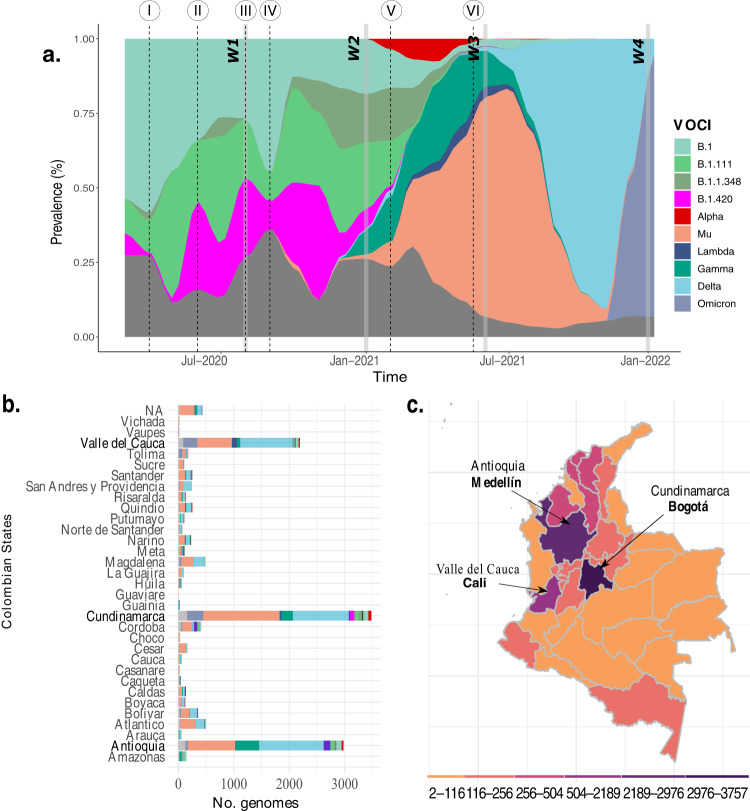
The emergence of highly transmissible SARS-CoV-2 variants has led to surges in cases and the need for global genomic surveillance. While some variants rapidly spread worldwide, other variants only persist nationally. There is a need for more fine-scale analysis to understand transmission dynamics at a country scale. For instance, the Mu variant of interest, also known as lineage B.1.621, was first detected in Colombia and was responsible for a large local wave but only a few sporadic cases elsewhere.
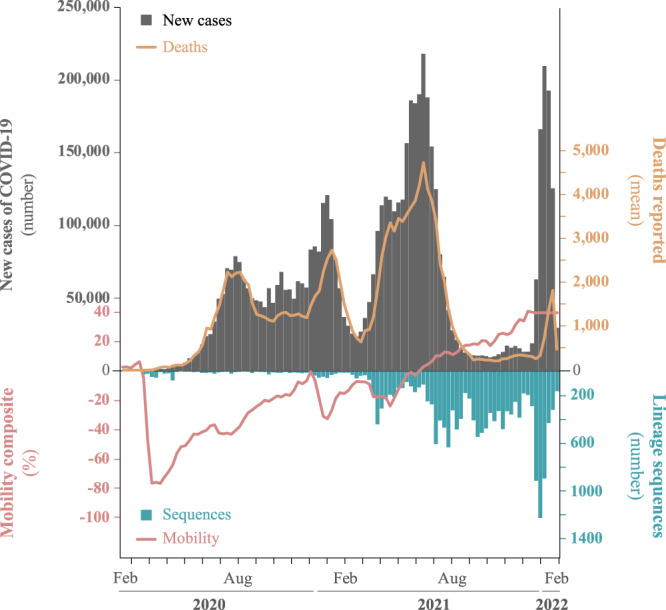
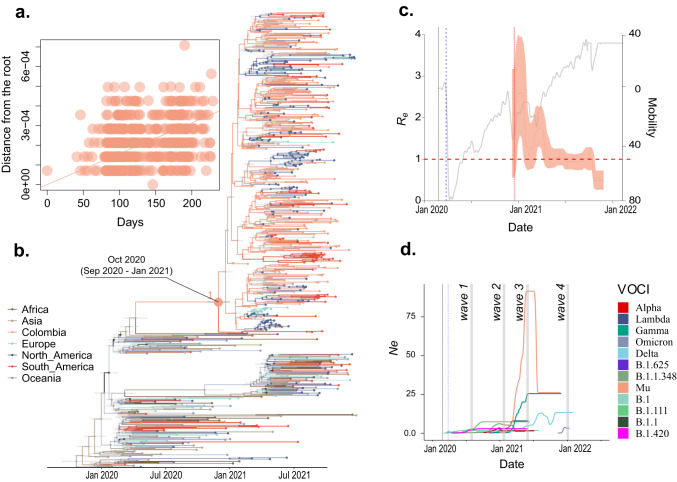
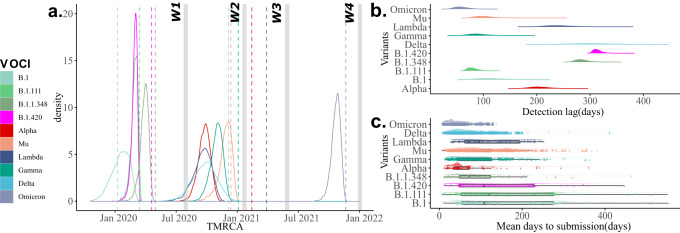
To better understand the epidemiology of SARS-Cov-2 variants in Colombia, we used 14,049 complete SARS-CoV-2 genomes from the 32 states of Colombia. We performed Bayesian phylodynamic analyses to estimate the time of variants' introduction, their respective effective reproductive number, and effective population size, and the impact of disease control measures.
Here, we detect a total of 188 SARS-CoV-2 Pango lineages circulating in Colombia since the pandemic's start. We show that the effective reproduction number oscillated drastically throughout the first two years of the pandemic, with Mu showing the highest transmissibility (Re and growth rate estimation).
Our results reinforce that genomic surveillance programs are essential for countries to make evidence-driven interventions toward the emergence and circulation of novel SARS-CoV-2 variants.
高传播性的严重急性呼吸综合征冠状病毒2(SARS-CoV-2)变异株的出现导致病例激增,因此需要进行全球基因组监测。虽然一些变异株在全球迅速传播,但其他变异株仅在国内持续存在。需要进行更精细的分析,以了解国家层面的传播动态。例如,备受关注的缪变异株,也称为B.1.621谱系,最初在哥伦比亚被检测到,它在当地引发了大规模疫情,但在其他地方仅导致少数散发病例。
为了更好地了解哥伦比亚SARS-CoV-2变异株的流行病学情况,我们使用了来自哥伦比亚32个州的14049个完整的SARS-CoV-2基因组。我们进行了贝叶斯系统发育动力学分析,以估计变异株的引入时间、它们各自的有效繁殖数和有效种群大小,以及疾病控制措施的影响。
在此,我们检测到自疫情开始以来在哥伦比亚共流行的188个SARS-CoV-2潘多谱系。我们表明,在疫情的头两年,有效繁殖数剧烈波动,缪变异株的传播性最高(有效繁殖数和增长率估计)。
我们的结果强化了基因组监测计划对于各国针对新型SARS-CoV-2变异株的出现和传播进行循证干预至关重要。