Department of Cardiology, Peking University International Hospital, Beijing 030001, China.
Third Medical Center, The General Hospital of the People's Liberation Army, Beijing 102206, China.
Cardiovasc Ther. 2021 Jul 12;2021:9956814. doi: 10.1155/2021/9956814. eCollection 2021.
Necrostatin-1 (Nec-1), an inhibitor of necroptosis, has been reported to protect against myocardial ischemia-reperfusion (MI/R) injury. However, the contribution of the potential antinecroptotic effect of Nec-1 on its infarct limitation and cardiac function improvement effects after MI/R has not been investigated.
The present study investigated the effect of Nec-1 on myocardial infarct size, necroptosis, and cardiac functional recovery in rats subjected to myocardial ischemia-reperfusion (MI/R 30 min/12, 24, 48, and 72 h).
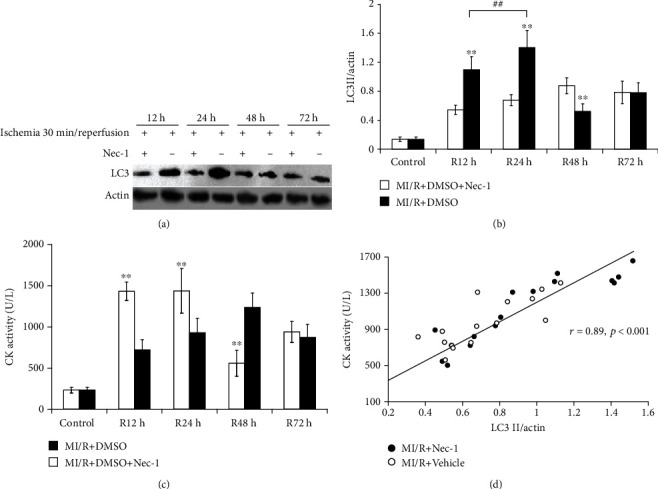
The study showed that Nec-1 might reduce myocardial cell death and maintain myoarchitectonic integrity, consequently inhibiting the reactive fibrosis process in rats in myocardial ischemia/late reperfusion. Moreover, the administration of Nec-1 (0.6 mg/kg) at the onset of reperfusion significantly reduced the release of creatine kinase and downregulation of autophagy within 24 h after reperfusion, and there was a significantly positive correlation between them.
These results suggest that antinecroptosis treatment may improve the clinical outcomes of patients with ischemic heart disease.
坏死抑制剂-1(Nec-1)是一种坏死性细胞凋亡的抑制剂,已被报道可预防心肌缺血再灌注(MI/R)损伤。然而,Nec-1 的潜在抗坏死作用对其在 MI/R 后梗死面积限制和心功能改善的影响尚未得到研究。
本研究探讨了 Nec-1 对大鼠心肌缺血再灌注(MI/R 30min/12、24、48 和 72h)后心肌梗死面积、坏死性细胞凋亡和心功能恢复的影响。
研究表明,Nec-1 可能通过减少心肌细胞死亡和维持肌原纤维结构的完整性,从而抑制心肌缺血/晚期再灌注大鼠的反应性纤维化过程。此外,在再灌注开始时给予 Nec-1(0.6mg/kg)可显著降低再灌注后 24 小时内肌酸激酶的释放和自噬的下调,且二者呈显著正相关。
这些结果表明,抗坏死性细胞凋亡治疗可能改善缺血性心脏病患者的临床转归。