Uchiyama Yasuo, Shibata Masahiro, Koike Masato, Yoshimura Kentaro, Sasaki Mitsuho
Department of Cell Biology and Neuroscience, Osaka University Graduate School of Medicine, 2-2 Yamadaoka, Suita, Osaka 565-0871, Japan.
Histochem Cell Biol. 2008 Apr;129(4):407-20. doi: 10.1007/s00418-008-0406-y. Epub 2008 Mar 5.
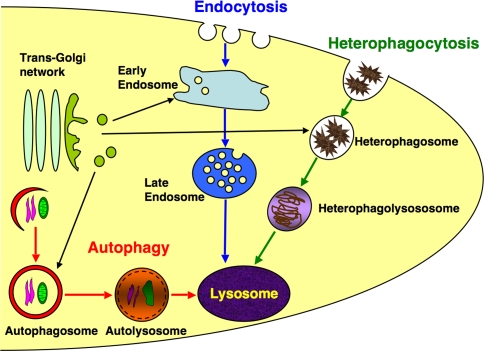
"Autophagy" is a highly conserved pathway for degradation, by which wasted intracellular macromolecules are delivered to lysosomes, where they are degraded into biologically active monomers such as amino acids that are subsequently re-used to maintain cellular metabolic turnover and homeostasis. Recent genetic studies have shown that mice lacking an autophagy-related gene (Atg5 or Atg7) cannot survive longer than 12 h after birth because of nutrient shortage. Moreover, tissue-specific impairment of autophagy in central nervous system tissue causes massive loss of neurons, resulting in neurodegeneration, while impaired autophagy in liver tissue causes accumulation of wasted organelles, leading to hepatomegaly. Although autophagy generally prevents cell death, our recent study using conditional Atg7-deficient mice in CNS tissue has demonstrated the presence of autophagic neuron death in the hippocampus after neonatal hypoxic/ischemic brain injury. Thus, recent genetic studies have shown that autophagy is involved in various cellular functions. In this review, we introduce physiological and pathophysiological roles of autophagy.
“自噬”是一种高度保守的降解途径,通过该途径,细胞内废弃的大分子被输送到溶酶体,在那里它们被降解为具有生物活性的单体,如氨基酸,随后这些氨基酸被重新利用以维持细胞的代谢周转和内环境稳定。最近的遗传学研究表明,缺乏自噬相关基因(Atg5或Atg7)的小鼠出生后存活时间不超过12小时,原因是营养缺乏。此外,中枢神经系统组织中自噬的组织特异性损伤会导致大量神经元丢失,从而导致神经退行性变,而肝组织中自噬受损会导致废弃细胞器的积累,进而导致肝肿大。尽管自噬通常可防止细胞死亡,但我们最近使用中枢神经系统组织中条件性Atg7缺陷小鼠进行的研究表明,新生儿缺氧缺血性脑损伤后海马体中存在自噬性神经元死亡。因此,最近的遗传学研究表明自噬参与多种细胞功能。在本综述中,我们介绍自噬的生理和病理生理作用。