Centre Population et Développement (Ceped), Institut de Recherche pour le Développement (IRD), Université de Paris, Inserm, Paris, France.
Solidarité Thérapeutique et Initiatives pour la Santé (Solthis), Dakar, Senegal.
Front Public Health. 2021 Jul 20;9:653565. doi: 10.3389/fpubh.2021.653565. eCollection 2021.
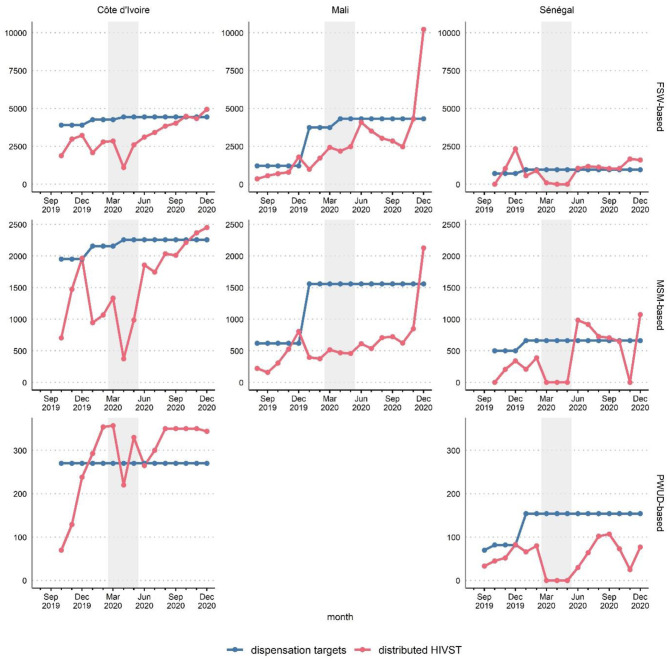
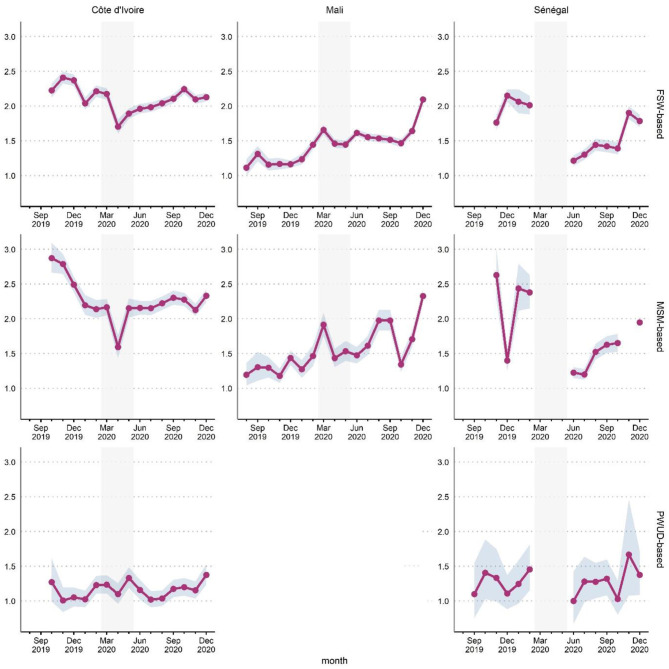
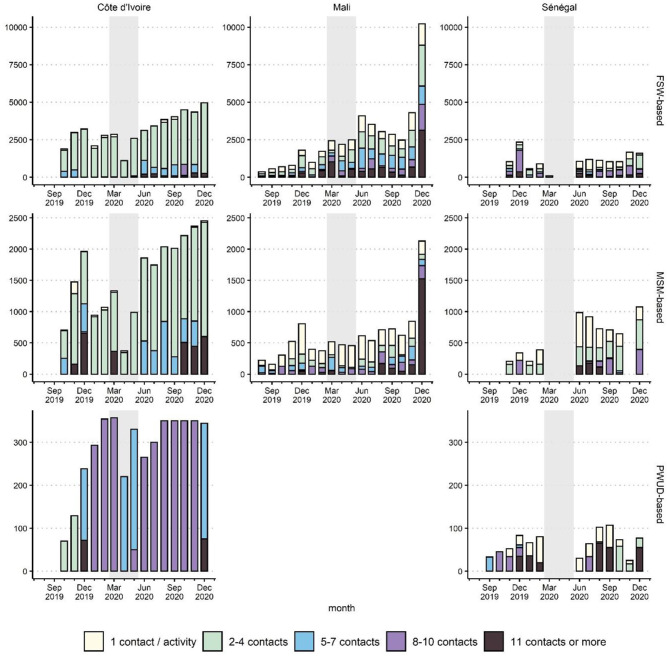
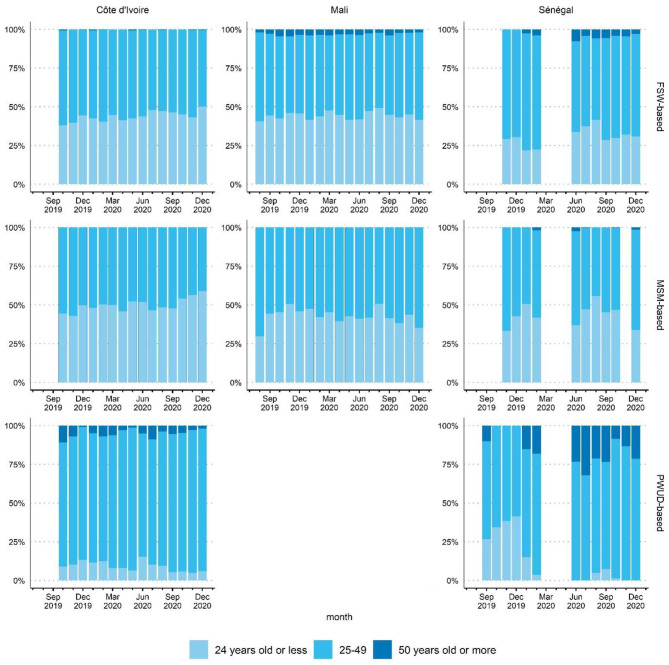
The ATLAS program promotes and implements HIVST in Côte d'Ivoire, Mali, and Senegal. Priority groups include members of key populations-female sex workers (FSW), men having sex with men (MSM), and people who use drugs (PWUD)-and their partners and relatives. HIVST distribution activities, which began in mid-2019, were impacted in early 2020 by the COVID-19 pandemic. This article, focusing only on outreach activities among key populations, analyzes quantitative, and qualitative program data collected during implementation to examine temporal trends in HIVST distribution and their evolution in the context of the COVID-19 health crisis. Specifically, we investigated the impact on, the adaptation of and the disruption of field activities. In all three countries, the pre-COVID-19 period was marked by a gradual increase in HIVST distribution. The period corresponding to the initial emergency response (March-May 2020) witnessed an important disruption of activities: a total suspension in Senegal, a significant decline in Côte d'Ivoire, and a less pronounced decrease in Mali. Secondary distribution was also negatively impacted. Peer educators showed resilience and adapted by relocating from public to private areas, reducing group sizes, moving night activities to the daytime, increasing the use of social networks, integrating hygiene measures, and promoting assisted HIVST as an alternative to conventional rapid testing. From June 2020 onward, with the routine management of the COVID-19 pandemic, a catch-up phenomenon was observed with the resumption of activities in Senegal, the opening of new distribution sites, a rebound in the number of distributed HIVST kits, a resurgence in larger group activities, and a rebound in the average number of distributed HIVST kits per primary contact. Although imperfect, the program data provide useful information to describe changes in the implementation of HIVST outreach activities over time. The impact of the COVID-19 pandemic on HIVST distribution among key populations was visible in the monthly activity reports. Focus groups and individual interviews allowed us to document the adaptations made by peer educators, with variations across countries and populations. These adaptations demonstrate the resilience and learning capacities of peer educators and key populations.
ATLAS 项目在科特迪瓦、马里和塞内加尔推广和实施 HIVST。重点人群包括性工作者(FSW)、男男性行为者(MSM)和吸毒者(PWUD)及其伴侣和亲属。HIVST 分发活动始于 2019 年年中,但在 2020 年初受到 COVID-19 大流行的影响。本文仅关注重点人群的外展活动,分析了在实施过程中收集的定量和定性项目数据,以检查 HIVST 分发的时间趋势及其在 COVID-19 健康危机背景下的演变。具体而言,我们调查了对现场活动的影响、适应和中断。在所有三个国家,COVID-19 之前的时期以 HIVST 分发的逐渐增加为特征。对应于初始紧急响应的时期(2020 年 3 月至 5 月)见证了活动的重要中断:塞内加尔完全暂停,科特迪瓦大幅下降,马里则不太明显。二级分发也受到负面影响。同伴教育者表现出弹性,通过从公共领域转移到私人领域、缩小团体规模、将夜间活动改为白天、增加使用社交网络、整合卫生措施以及推广辅助 HIVST 作为常规快速检测的替代方案来适应。从 2020 年 6 月起,随着 COVID-19 大流行的常规管理,在塞内加尔恢复了活动,开设了新的分发点,分发的 HIVST 试剂盒数量反弹,较大规模的团体活动重新活跃,以及平均每个主要接触者分发的 HIVST 试剂盒数量反弹,出现了追赶现象。尽管不完美,但项目数据提供了有用的信息来描述随时间推移 HIVST 外展活动实施的变化。COVID-19 大流行对重点人群中 HIVST 分发的影响在每月活动报告中可见。焦点小组和个人访谈使我们能够记录同伴教育者所做的适应,各国和人群之间存在差异。这些适应证明了同伴教育者和重点人群的弹性和学习能力。