Rouveau Nicolas, Ky-Zerbo Odette, Boye Sokhna, Fotso Arlette Simo, d'Elbée Marc, Maheu-Giroux Mathieu, Silhol Romain, Kouassi Arsène Kra, Vautier Anthony, Doumenc-Aïdara Clémence, Breton Guillaume, Keita Abdelaye, Ehui Eboi, Ndour Cheikh Tidiane, Boilly Marie-Claude, Terris-Prestholt Fern, Pourette Dolorès, Desclaux Alice, Larmarange Joseph
Ceped (Centre Population & Développement UMR 196), IRD, Université de Paris, Inserm, Paris, France.
Institut de Recherche pour le Développement, Transvihmi (UMI 233 IRD, 1175 INSERM, Montpellier University), Montpellier, France.
BMC Public Health. 2021 Jan 21;21(1):181. doi: 10.1186/s12889-021-10212-1.
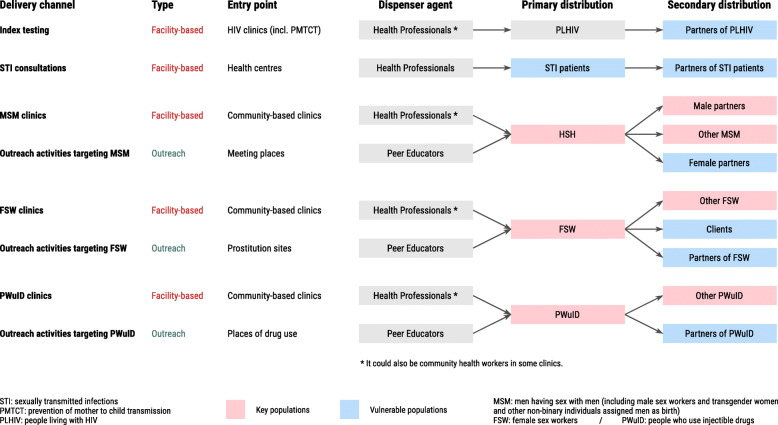
The ATLAS programme aims to promote and implement HIV self-testing (HIVST) in three West African countries: Côte d'Ivoire, Mali, and Senegal. During 2019-2021, in close collaboration with the national AIDS implementing partners and communities, ATLAS plans to distribute 500,000 HIVST kits through eight delivery channels, combining facility-based, community-based strategies, primary and secondary distribution of HIVST. Considering the characteristics of West African HIV epidemics, the targets of the ATLAS programme are hard-to-reach populations: key populations (female sex workers, men who have sex with men, and drug users), their clients or sexual partners, partners of people living with HIV and patients diagnosed with sexually transmitted infections and their partners. The ATLAS programme includes research support implementation to generate evidence for HIVST scale-up in West Africa. The main objective is to describe, analyse and understand the social, health, epidemiological effects and cost-effectiveness of HIVST introduction in Côte d'Ivoire, Mali and Senegal to improve the overall HIV testing strategy (accessibility, efficacy, ethics).
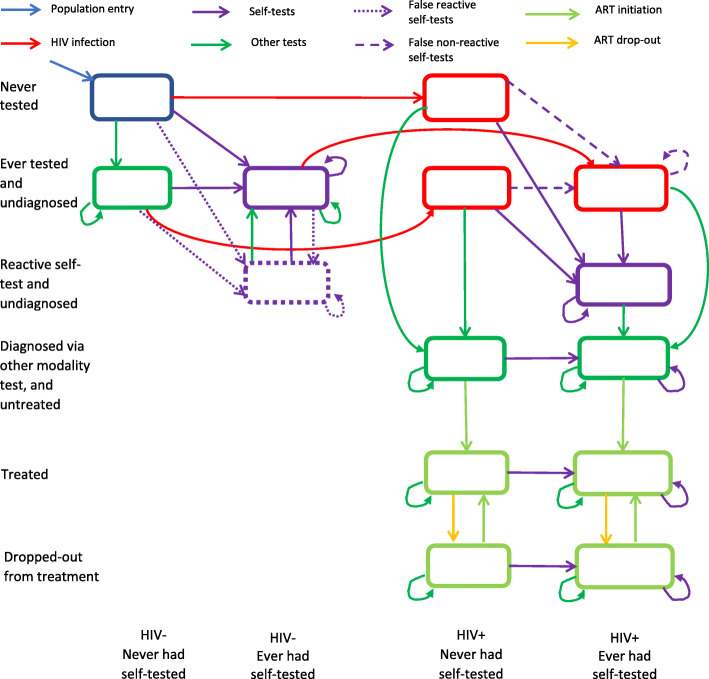
ATLAS research is organised into five multidisciplinary workpackages (WPs): Key Populations WP: qualitative surveys (individual in-depth interviews, focus group discussions) conducted with key actors, key populations, and HIVST users. Index testing WP: ethnographic observation of three HIV care services introducing HIVST for partner testing. Coupons survey WP: an anonymous telephone survey of HIVST users. Cost study WP: incremental economic cost analysis of each delivery model using a top-down costing with programmatic data, complemented by a bottom-up costing of a representative sample of HIVST distribution sites, and a time-motion study for health professionals providing HIVST. Modelling WP: Adaptation, parameterisation and calibration of a dynamic compartmental model that considers the varied populations targeted by the ATLAS programme and the different testing modalities and strategies.
ATLAS is the first comprehensive study on HIV self-testing in West Africa. The ATLAS programme focuses particularly on the secondary distribution of HIVST. This protocol was approved by three national ethic committees and the WHO's Ethical Research Committee.
ATLAS项目旨在在三个西非国家(科特迪瓦、马里和塞内加尔)推广并实施艾滋病毒自我检测(HIVST)。在2019年至2021年期间,ATLAS计划与国家艾滋病实施伙伴及社区密切合作,通过八个配送渠道分发50万个HIVST检测试剂盒,结合基于机构、基于社区的策略,以及HIVST的一级和二级分发。考虑到西非艾滋病毒流行的特点,ATLAS项目的目标人群是难以接触到的人群:重点人群(女性性工作者、男男性行为者和吸毒者)、他们的客户或性伴侣、艾滋病毒感染者的伴侣以及被诊断为性传播感染的患者及其伴侣。ATLAS项目包括研究支持实施,以生成在西非扩大HIVST规模的证据。主要目标是描述、分析和理解在科特迪瓦、马里和塞内加尔引入HIVST的社会、健康、流行病学影响和成本效益,以改进整体艾滋病毒检测策略(可及性、有效性、伦理)。
ATLAS研究分为五个多学科工作包(WP):重点人群工作包:对关键行为者、重点人群和HIVST使用者进行定性调查(个人深度访谈、焦点小组讨论)。索引检测工作包:对三家引入HIVST进行伴侣检测的艾滋病毒护理服务机构进行人种志观察。优惠券调查工作包:对HIVST使用者进行匿名电话调查。成本研究工作包:使用自上而下的成本核算方法,结合项目数据,对每种配送模式进行增量经济成本分析,并辅以对HIVST分发地点代表性样本的自下而上成本核算,以及对提供HIVST的卫生专业人员进行时间动作研究。建模工作包:对一个动态 compartmental模型进行调整、参数化和校准,该模型考虑了ATLAS项目针对的不同人群以及不同的检测方式和策略。
ATLAS是西非第一项关于艾滋病毒自我检测的综合研究。ATLAS项目特别关注HIVST的二级分发。该方案已获得三个国家伦理委员会和世卫组织伦理研究委员会的批准。