Department of Medical, Surgical and Health Sciences, University of Trieste, 34100, Trieste, Italy.
Department of Life Sciences, University of Trieste, 34100, Trieste, Italy.
Neurol Sci. 2022 Mar;43(3):2021-2029. doi: 10.1007/s10072-021-05491-w. Epub 2021 Aug 5.
The purpose of the present study is to compare the effect of the physiotherapy to onabolulinumtoxin-A, and their combination, in relation to cervical and headache parameters in patients with chronic migraine.
This is an observational cohort study conducted by a headache center and a physiotherapy degree course on 30 patients with chronic migraine. The patients were distributed in three groups of treatments for three months: onabolulinumtoxin-A only, physiotherapy only, and onabolulinumtoxin-A plus physiotherapy. The patients were evaluated, before and after each treatment, using the following: the postural assessment software SAPO for the forward head posture; the CROM goniometer for the cervical range of motion; the Migraine Disability Assessment Score for headache parameters.
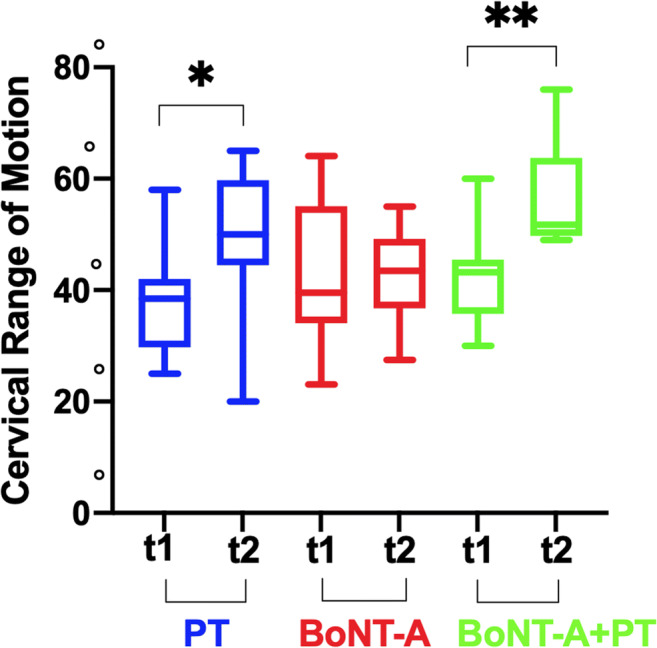
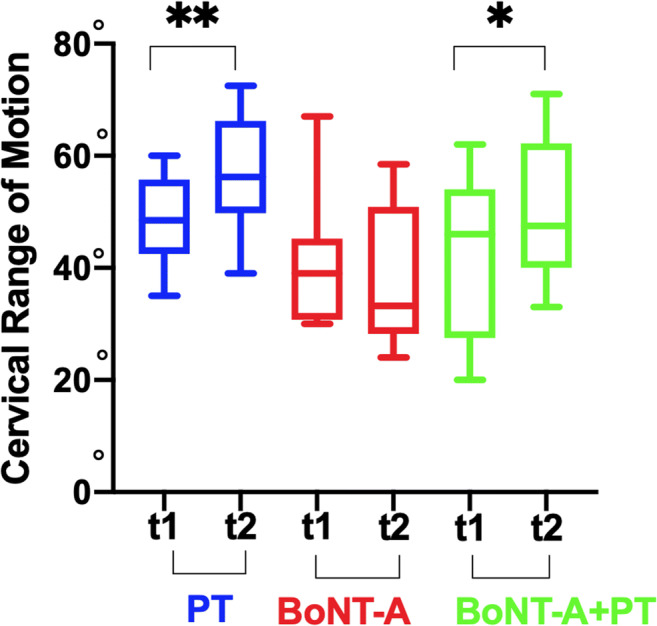
After 3 months of each treatment, the scores obtained for the headache-related disability and the frequency of migraine decreased significantly for all groups, but the pain intensity scores changed significantly only in the onabolulinumtoxin-A (p = 0.01) and in the onabolulinumtoxin-A plus physiotherapy groups (p = 0.007). On the other hand, the forward head posture was reduced significantly in the physiotherapy (p = 0.002) and in the onabolulinumtoxin-A plus physiotherapy groups (p = 0.003). The cervical range of motion increased significantly in certain directions in the physiotherapy group and in the onabolulinumtoxin-A plus physiotherapy groups.
The physiotherapy improved the cervical parameters. The onabolulinumtoxin-A decreased pain intensity. As a consequence, it can be said that the combined treatment was more useful than a mono-therapy alone. From our results, it can be concluded that onabolulinumtoxin-A plus physiotherapy could be a good option in the management of chronic migraine.
本研究的目的是比较物理疗法与肉毒毒素-A 的效果,以及它们在慢性偏头痛患者的颈椎和头痛参数方面的联合效果。
这是一项由头痛中心和物理治疗学位课程进行的观察性队列研究,共纳入 30 名慢性偏头痛患者。患者被分为三组,分别接受三个月的治疗:仅肉毒毒素-A、仅物理疗法和肉毒毒素-A 加物理疗法。在每次治疗前后,使用以下方法对患者进行评估:前探头姿势评估软件(SAPO)评估前伸头姿势;CROM 测角计评估颈椎活动范围;偏头痛残疾评估量表(MIDAS)评估头痛参数。
在每种治疗后的 3 个月,所有组的头痛相关残疾评分和偏头痛发作频率均显著降低,但只有肉毒毒素-A(p = 0.01)和肉毒毒素-A 加物理疗法组(p = 0.007)的疼痛强度评分显著改变。另一方面,只有物理疗法(p = 0.002)和肉毒毒素-A 加物理疗法组(p = 0.003)的前伸头姿势显著减少。在物理疗法组和肉毒毒素-A 加物理疗法组中,颈椎活动范围在某些方向上显著增加。
物理疗法改善了颈椎参数。肉毒毒素-A 降低了疼痛强度。因此,可以说联合治疗比单一治疗更有效。根据我们的结果,可以得出结论,肉毒毒素-A 加物理疗法可能是慢性偏头痛管理的一个不错选择。