Megy Karyn, Downes Kate, Morel-Kopp Marie-Christine, Bastida José M, Brooks Shannon, Bury Loredana, Leinoe Eva, Gomez Keith, Morgan Neil V, Othman Maha, Ouwehand Willem H, Perez Botero Juliana, Rivera José, Schulze Harald, Trégouët David-Alexandre, Freson Kathleen
Department of Haematology, University of Cambridge, Cambridge Biomedical Campus, Cambridge, UK.
NIHR BioResource, Cambridge University Hospitals, Cambridge Biomedical Campus, Cambridge, UK.
J Thromb Haemost. 2021 Oct;19(10):2612-2617. doi: 10.1111/jth.15459. Epub 2021 Aug 5.
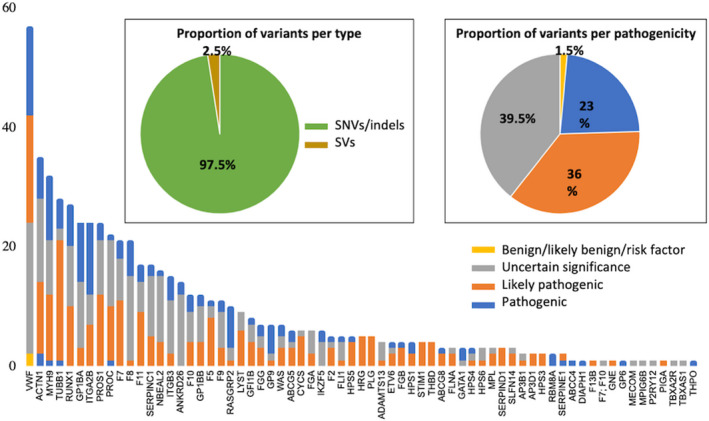
The implementation of high-throughput sequencing (HTS) technologies in research and diagnostic laboratories has linked many new genes to rare bleeding, thrombotic, and platelet disorders (BTPD), and revealed multiple genetic variants linked to those disorders, many of them being of uncertain pathogenicity when considering the accepted evidence (variant consequence, frequency in control datasets, number of reported patients, prediction models, and functional assays). The sequencing effort has also resulted in resources for gathering disease-causing variants associated with specific genes, but for BTPD, such well-curated databases exist only for a few genes. On the other hand, submissions by individuals or diagnostic laboratories to the variant database ClinVar are hampered by the lack of a submission process tailored to capture the specific features of hemostatic diseases. As we move toward the implementation of HTS in the diagnosis of BTPD, the Scientific and Standardization Committee for Genetics in Thrombosis and Haemostasis has developed and tested a REDCap-based interface, aimed at the community, to submit curated genetic variants for diagnostic-grade BTPD genes. Here, we describe the use of the interface and the initial submission of 821 variants from 30 different centers covering 14 countries. This open-access variant resource will be shared with the community to improve variant classification and regular bulk data transfer to ClinVar.
高通量测序(HTS)技术在科研和诊断实验室中的应用,已将许多新基因与罕见出血、血栓形成及血小板疾病(BTPD)联系起来,并揭示了与这些疾病相关的多个基因变异,其中许多变异在考虑现有证据(变异后果、对照数据集中的频率、报告患者数量、预测模型和功能分析)时其致病性尚不确定。测序工作还产生了收集与特定基因相关的致病变异的资源,但对于BTPD而言,此类精心整理的数据库仅针对少数基因存在。另一方面,个人或诊断实验室向变异数据库ClinVar提交数据时,因缺乏适合捕捉止血疾病特定特征的提交流程而受到阻碍。随着我们朝着在BTPD诊断中应用HTS迈进,血栓形成与止血遗传学科学标准化委员会开发并测试了一个基于REDCap的界面,面向社区,用于提交经整理的BTPD诊断级基因的遗传变异。在此,我们描述该界面的使用情况以及来自覆盖14个国家的30个不同中心的821个变异的首次提交。这个开放获取的变异资源将与社区共享,以改善变异分类并定期批量向ClinVar传输数据。