Harvard Medical School, Boston, Massachusetts, USA.
Department of Radiology, Massachusetts General Hospital, Boston, Massachusetts, USA.
Cancer Med. 2021 Sep;10(18):6327-6335. doi: 10.1002/cam4.4183. Epub 2021 Aug 6.
We aimed to investigate the effects of COVID-19 on computed tomography (CT) imaging of cancer.
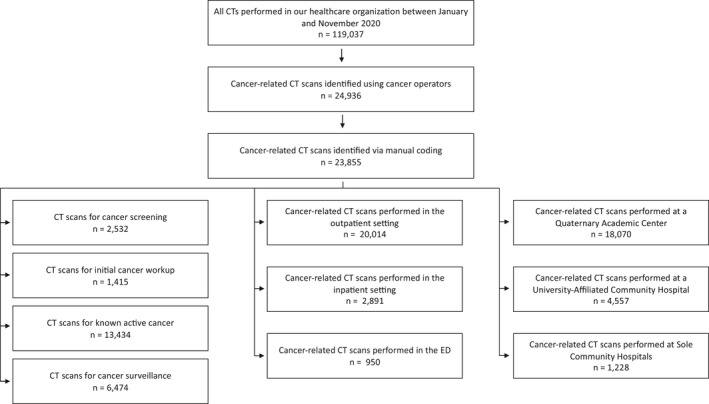
Cancer-related CTs performed at one academic hospital and three affiliated community hospitals in Massachusetts were retrospectively analyzed. Three periods of 2020 were considered as follows: pre-COVID-19 (1/5/20-3/14/20), COVID-19 peak (3/15/20-5/2/20), and post-COVID-19 peak (5/3/20-11/14/20). 15 March 2020 was the day a state of emergency was declared in MA; 3 May 2020 was the day our hospitals resumed to non-urgent imaging. The volumes were assessed by (1) Imaging indication: cancer screening, initial workup, active cancer, and surveillance; (2) Care setting: outpatient and inpatient, ED; (3) Hospital type: quaternary academic center (QAC), university-affiliated community hospital (UACH), and sole community hospitals (SCHs).
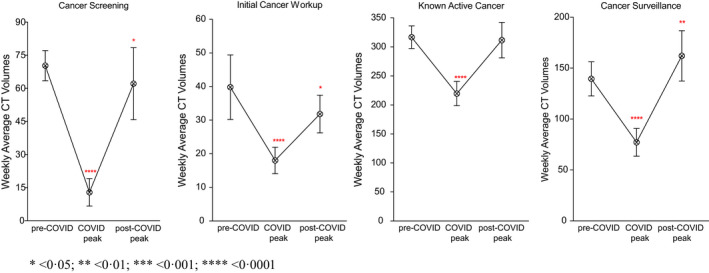
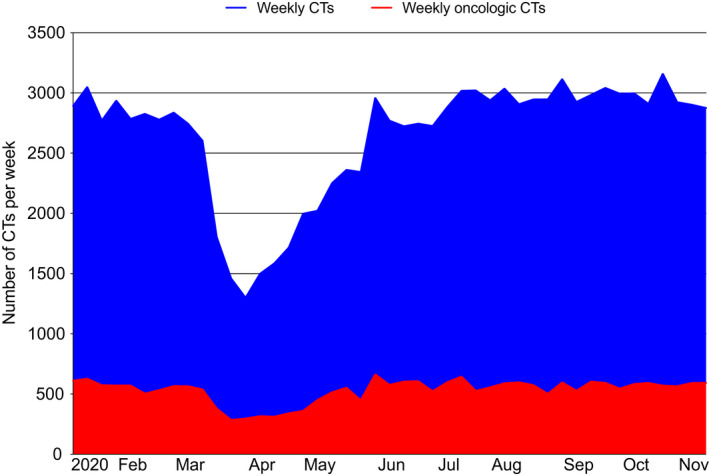
During the COVID-19 peak, a significant drop in CT volumes was observed (-42.2%, p < 0.0001), with cancer screening, initial workup, active cancer, and cancer surveillance declining by 81.7%, 54.8%, 30.7%, and 44.7%, respectively (p < 0.0001). In the post-COVID-19 peak period, cancer screening and initial workup CTs did not recover (-11.7%, p = 0.037; -20.0%, p = 0.031), especially in the outpatient setting. CT volumes for active cancer recovered, but inconsistently across hospital types: the QAC experienced a 9.4% decline (p = 0.022) and the UACH a 41.5% increase (p < 0.001). Outpatient CTs recovered after the COVID-19 peak, but with a shift in utilization away from the QAC (-8.7%, p = 0.020) toward the UACH (+13.3%, p = 0.013). Inpatient and ED-based oncologic CTs increased post-peak (+20.0%, p = 0.004 and +33.2%, p = 0.009, respectively).
Cancer imaging was severely impacted during the COVID-19 pandemic. CTs for cancer screening and initial workup did not recover to pre-COVID-19 levels well into 2020, a finding that suggests more patients with advanced cancers may present in the future. A redistribution of imaging utilization away from the QAC and outpatient settings, toward the community hospitals and inpatient setting/ED was observed.
本研究旨在探究 COVID-19 对癌症计算机断层扫描(CT)影像学的影响。
回顾性分析了在马萨诸塞州的一家学术医院和三家附属医院进行的癌症相关 CT。将 2020 年的三个时期考虑如下:COVID-19 前(1/5/20-3/14/20)、COVID-19 高峰(3/15/20-5/2/20)和 COVID-19 高峰后(5/3/20-11/14/20)。2020 年 3 月 15 日是马萨诸塞州宣布进入紧急状态的日子;2020 年 5 月 3 日,我院恢复非紧急影像检查。通过以下方式评估容量:(1)成像指征:癌症筛查、初始检查、活动性癌症和监测;(2)护理场所:门诊和住院、急诊;(3)医院类型:四级学术中心(QAC)、大学附属社区医院(UACH)和单一社区医院(SCHs)。
在 COVID-19 高峰期间,CT 量显著下降(-42.2%,p<0.0001),癌症筛查、初始检查、活动性癌症和癌症监测分别下降 81.7%、54.8%、30.7%和 44.7%(p<0.0001)。在 COVID-19 高峰后时期,癌症筛查和初始检查 CT 并未恢复(-11.7%,p=0.037;-20.0%,p=0.031),尤其是在门诊环境中。活动性癌症的 CT 量有所恢复,但不同医院类型的恢复情况不一致:QAC 下降 9.4%(p=0.022),UACH 上升 41.5%(p<0.001)。COVID-19 高峰后,门诊 CT 量有所恢复,但 QAC 利用量下降(-8.7%,p=0.020),UACH 利用量增加(+13.3%,p=0.013)。住院和急诊的肿瘤 CT 量在高峰后增加(+20.0%,p=0.004 和 +33.2%,p=0.009)。
癌症影像学在 COVID-19 大流行期间受到严重影响。癌症筛查和初始检查的 CT 量并未恢复到 COVID-19 前水平,这表明未来可能会有更多晚期癌症患者就诊。观察到成像利用从 QAC 和门诊环境向社区医院和住院/急诊环境转移。