Park Kyung-Sun
Department of Laboratory Medicine, Kyung Hee University School of Medicine and Kyung Hee University Medical Center, Seoul 02447, Korea.
Children (Basel). 2021 Jul 16;8(7):601. doi: 10.3390/children8070601.
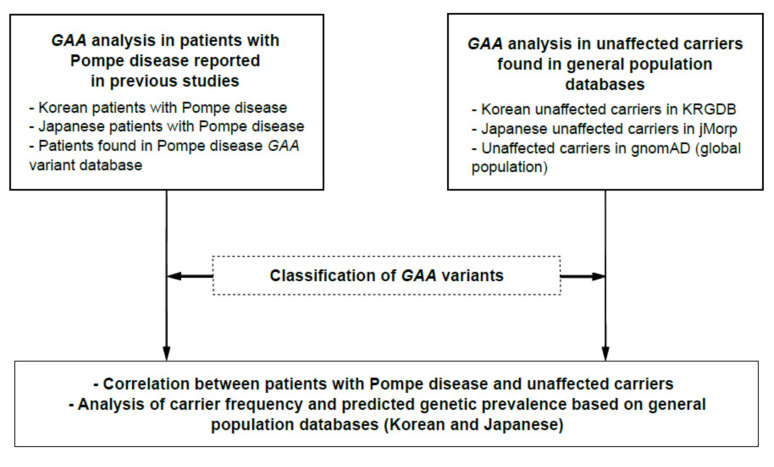
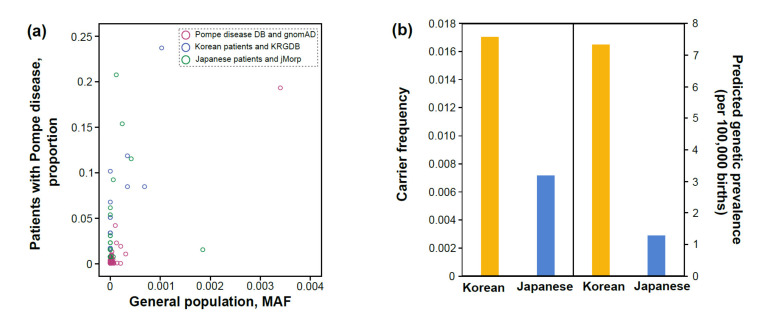
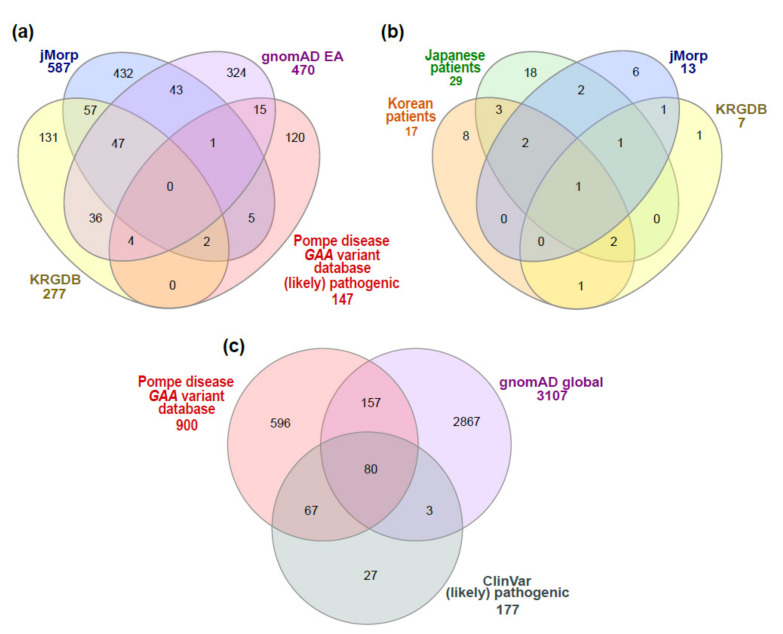
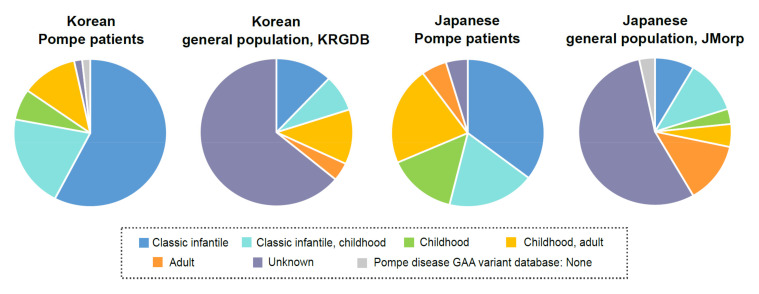
In this study, two different approaches were applied in the analysis of the gene. One was analyzed based on patients with Pompe disease, and the other was analyzed based on genomic data from unaffected carriers in a general population genetic database. For this, variants in Korean and Japanese patients reported in previous studies and in patients reported in the Pompe disease variant database were analyzed as a model. In addition, variants in the Korean Reference Genome Database (KRGDB), the Japanese Multi Omics Reference Panel (jMorp), and the Genome Aggregation Database (gnomAD) were analyzed. Overall, approximately 50% of the pathogenic or likely pathogenic variants (PLPVs) found in unaffected carriers were also found in real patients with Pompe disease (Koreans, 57.1%; Japanese, 46.2%). In addition, there was a moderate positive correlation (Spearman's correlation coefficient of 0.45-0.69) between the proportion of certain PLPVs in patients and the minor allele frequency of their variants in a general population database. Based on the analysis of general population databases, the total carrier frequency for Pompe disease in Koreans and Japanese was estimated to be 1.7% and 0.7%, respectively, and the predicted genetic prevalence was 1:13,657 and 1:78,013, respectively.
在本研究中,采用了两种不同的方法对该基因进行分析。一种是基于庞贝病患者进行分析,另一种是基于一般人群遗传数据库中未受影响携带者的基因组数据进行分析。为此,将先前研究中报道的韩国和日本患者以及庞贝病变异数据库中报道的患者的变异作为模型进行分析。此外,还对韩国参考基因组数据库(KRGDB)、日本多组学参考面板(jMorp)和基因组聚合数据库(gnomAD)中的变异进行了分析。总体而言,在未受影响携带者中发现的约50%的致病或可能致病变异(PLPV)在真正的庞贝病患者中也被发现(韩国人,57.1%;日本人,46.2%)。此外,患者中某些PLPV的比例与其在一般人群数据库中变异的次要等位基因频率之间存在中等程度的正相关(斯皮尔曼相关系数为0.45 - 0.69)。基于对一般人群数据库的分析,韩国人和日本人中庞贝病的总携带者频率估计分别为1.7%和0.7%,预测的遗传患病率分别为1:13,657和1:78,013。