Ruiz-Baca Estela, Pérez-Torres Armando, Romo-Lozano Yolanda, Cervantes-García Daniel, Alba-Fierro Carlos A, Ventura-Juárez Javier, Torriello Conchita
Facultad de Ciencias Químicas, Universidad Juárez del Estado de Durango, Av. Veterinaria S/N, Durango 34120, Mexico.
Facultad de Medicina, Universidad Nacional Autónoma de México, Ciudad de Mexico 04510, Mexico.
Pathogens. 2021 Jul 18;10(7):905. doi: 10.3390/pathogens10070905.
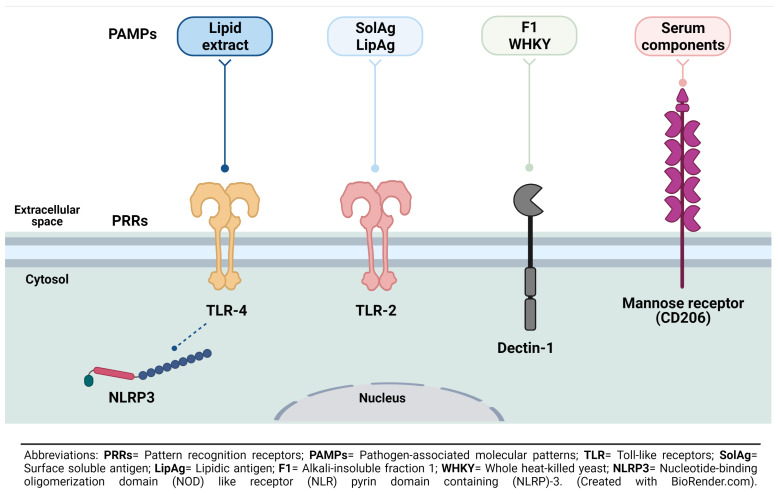
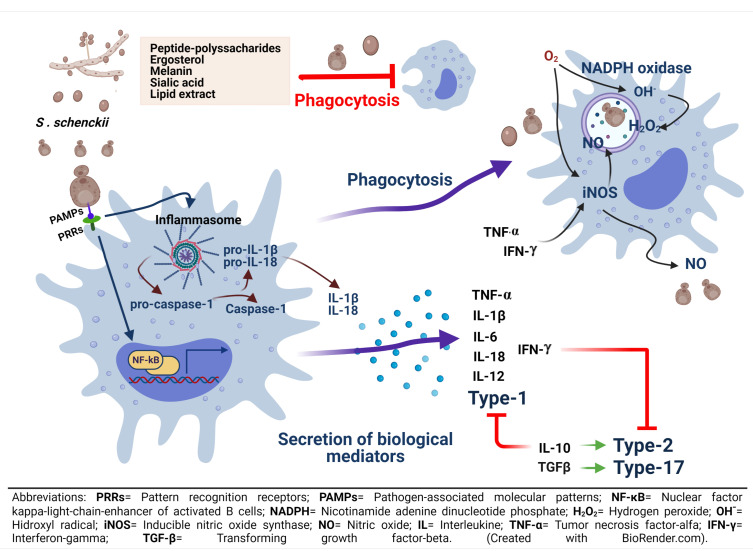
The role of immune cells associated with sporotrichosis caused by is not yet fully clarified. Macrophages through pattern recognition receptors (PRRs) can recognize pathogen-associated molecular patterns (PAMPs) of , engulf it, activate respiratory burst, and secrete pro-inflammatory or anti-inflammatory biological mediators to control infection. It is important to consider that the characteristics associated with and/or the host may influence macrophage polarization (M1/M2), cell recruitment, and the type of immune response (1, 2, and 17). Currently, with the use of new monocyte-macrophage cell lines, it is possible to evaluate different host-pathogen interaction processes, which allows for the proposal of new mechanisms in human sporotrichosis. Therefore, in order to contribute to the understanding of these host-pathogen interactions, the aim of this review is to summarize and discuss the immune responses induced by macrophage- interactions, as well as the PRRs and PAMPs involved during the recognition of that favor the immune evasion by the fungus.
由[病原体名称未给出]引起的孢子丝菌病相关免疫细胞的作用尚未完全阐明。巨噬细胞通过模式识别受体(PRRs)可识别[病原体名称未给出]的病原体相关分子模式(PAMPs),将其吞噬,激活呼吸爆发,并分泌促炎或抗炎生物介质以控制感染。需要考虑的是,与[病原体名称未给出]和/或宿主相关的特征可能会影响巨噬细胞极化(M1/M2)、细胞募集以及免疫反应类型(1型、2型和17型)。目前,利用新的单核细胞-巨噬细胞系,可以评估不同的宿主-病原体相互作用过程,这有助于提出人类孢子丝菌病的新机制。因此,为了有助于理解这些宿主-病原体相互作用,本综述的目的是总结和讨论巨噬细胞与[病原体名称未给出]相互作用诱导的免疫反应,以及在识别[病原体名称未给出]过程中涉及的有利于真菌免疫逃逸的PRRs和PAMPs。