Janczarek Iwona, Kędzierski Witold, Tkaczyk Ewelina, Kaczmarek Beata, Łuszczyński Jarosław, Mucha Karolina
Department of Horse Breeding and Use, Faculty of Animal Sciences and Bioeconomy, University of Life Sciences in Lublin, ul. Akademicka 13, 20-950 Lublin, Poland.
Department of Biochemistry, Faculty of Veterinary Medicine, University of Life Sciences in Lublin, ul. Akademicka 12, 20-033 Lublin, Poland.
Animals (Basel). 2021 Jul 6;11(7):2022. doi: 10.3390/ani11072022.
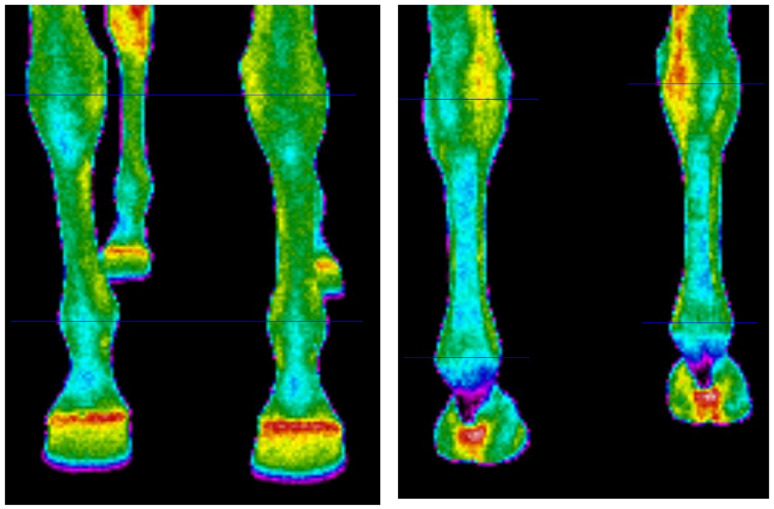
This study aimed to assess the impact of various types of warm-up on the metacarpal and metatarsal surface temperature in jumping sport horses in comparison to leisure horses, which work usually less intensively. Six clinically healthy sport geldings, contestants in showjumping competitions, and six geldings used for leisure riding were included in the study. The experiment was conducted for four consecutive days, during which the horses were warmed up by walking and trotting for various durations. Images were taken with a FLUKE Ti9 thermal imager to determine the resting, post-effort, and recovery temperature of the dorsal and plantar surface of the metacarpus and metatarsus of the four limbs. The obtained data were analysed with SmartView 4.1. software. The increase of measured rectal and surface temperatures was proportional to the warm-up duration. The surface temperature increase in the distal limb parts in jumping sport horses was greater than in horses used for leisure. The plantar surface was also warmer than the dorsal surface of the metacarpal/metatarsal areas, with a forelimb being warmer than a hind limb. Elevated temperatures after warm-up persist for 30 min in the recovery period, especially in jumping sport horses compared to leisure horses. Thus, the warming up effect is achieved earlier and lasts longer in heavily trained horses than in non-performance horses.
本研究旨在评估与通常运动量较小的休闲马相比,各类热身运动对参加跳跃项目的运动马掌骨和跖骨表面温度的影响。研究纳入了6匹临床健康的雄性运动马,即参加场地障碍赛的马匹,以及6匹用于休闲骑乘的雄性马。实验连续进行4天,在此期间,让马通过不同时长的慢步和小跑进行热身。使用FLUKE Ti9热成像仪拍摄图像,以确定四肢掌骨和跖骨背侧及跖侧表面的静息温度、运动后温度和恢复温度。使用SmartView 4.1软件对获得的数据进行分析。测得的直肠温度和表面温度的升高与热身时长成正比。跳跃运动马远端肢体部位的表面温度升高幅度大于休闲用马。掌骨/跖骨区域的跖侧表面也比背侧表面温度高,前肢比后肢温度高。热身运动后体温升高在恢复期持续30分钟,尤其是与休闲马相比,跳跃运动马更为明显。因此,与非运动马相比,高强度训练的马达到热身效果的时间更早且持续时间更长。