Wilk Izabela, Wnuk-Pawlak Elżbieta, Janczarek Iwona, Kaczmarek Beata, Dybczyńska Marta, Przetacznik Monika
Department of Horse Breeding and Use, Faculty of Animal Sciences and Bioeconomy, University of Life Sciences in Lublin, Akademicka 13, 20-950 Lublin, Poland.
Department and Clinic of Animal Internal Diseases, Faculty of Veterinary Medicine, University of Life Sciences in Lublin, Akademicka 13, 20-950 Lublin, Poland.
Animals (Basel). 2020 Feb 21;10(2):340. doi: 10.3390/ani10020340.
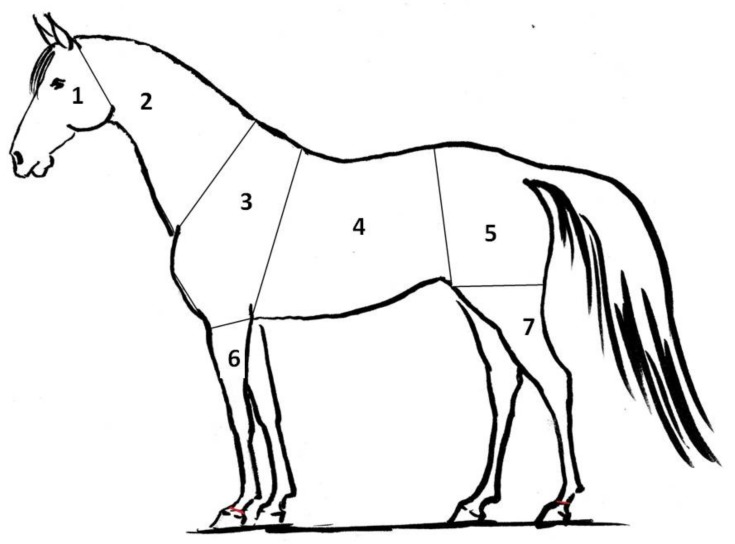
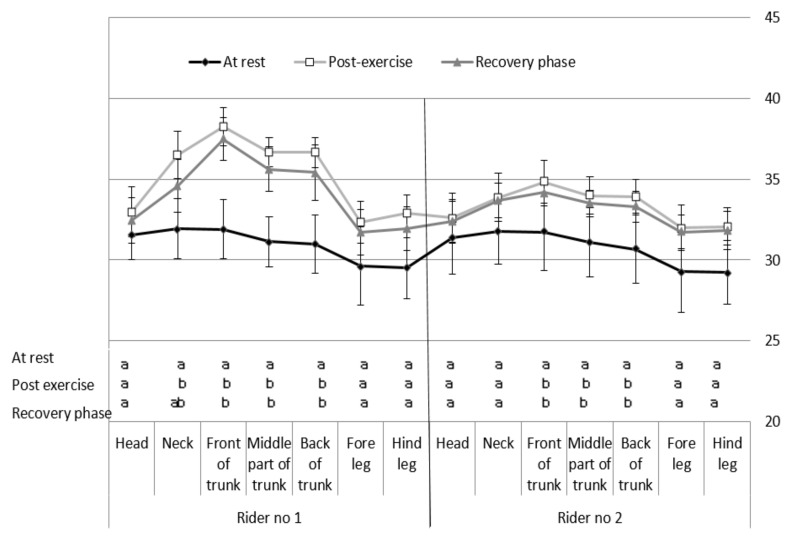
It was assumed that a horse with its rider body weight found in the upper limit may negatively impact the horse's welfare. The objective of this paper was to analyze the differences in body temperature and selected heart rate parameters in horses in response to physical exercise accompanied by various rider's body weight loads. The study was carried out on 12 leisure, 10-15-year-old warmblood geldings. The horses were ridden by two equally qualified riders whose body weights were about 20% and 10% of the average body weight (BW) of the animals (about 470 kg). Each rider rode each of the 12 horses for 13 min walking and 20 min of trotting. Images of the horse at rest, after physical exercise directly after unsaddling, and during the recovery phase (10 min after unsaddling) were taken with an infrared thermography camera. For analysis, the temperatures of selected body parts were measured on the surface of the head, neck, front, middle, and back (croup) parts of the trunk, forelimb, and hind limb. Immediately after the infrared thermography images were taken, the rectal temperature of the horse was measured. The heart rate parameters were measured at rest for 10 min directly before, during, and 10 min following the end of a training session. A multivariate analysis of variance (ANOVA) for repeated measurements was performed. Statistical significance was accepted for < 0.05. A rider BW load on a horse of approximately 20% of the horse's BW led to a substantial increase in the superficial temperatures of the neck, front, middle, and back parts of the trunk in relation to these body parts' average temperatures when the load was about 10% BW. The head and limb average temperatures were not significantly affected by the load of the exercised horse. A horse's load above 20% of his body weight, even with little effort, affects changes in surface temperature and the activity of the autonomic nervous system.
假定一匹马驮着处于体重上限的骑手可能会对马的福利产生负面影响。本文的目的是分析在不同骑手体重负荷下进行体育锻炼时,马的体温和选定心率参数的差异。该研究对12匹10至15岁的休闲温血阉马进行。这些马由两名资质相当的骑手骑乘,他们的体重分别约为这些动物平均体重(BW)(约470千克)的20%和10%。每位骑手骑着12匹马中的每一匹,进行13分钟的步行和20分钟的小跑。在马休息时、卸鞍后立即进行体育锻炼后以及恢复阶段(卸鞍后10分钟),用红外热成像相机拍摄马的图像。为了进行分析,在马的头部、颈部、躯干的前部、中部和后部(臀部)、前肢和后肢表面测量选定身体部位的温度。在拍摄红外热成像图像后,立即测量马的直肠温度。在训练课程开始前10分钟、训练期间以及训练结束后10分钟,测量马在休息时的心率参数。进行了重复测量的多变量方差分析(ANOVA)。当P<0.05时,接受统计学显著性。与体重负荷约为马体重10%时相比,马驮着约为其体重20%的骑手负荷会导致躯干的颈部、前部、中部和后部的表面温度相对于这些身体部位的平均温度大幅升高。头部和四肢的平均温度不受运动马匹负荷的显著影响。马的负荷超过其体重的20%,即使用力很小,也会影响表面温度变化和自主神经系统的活动。