Senent Yaiza, Ajona Daniel, González-Martín Antonio, Pio Ruben, Tavira Beatriz
Translational Oncology Group, Program in Solid Tumors, Cima University of Navarra, 31008 Pamplona, Spain.
Department of Biochemistry and Genetics, School of Sciences, University of Navarra, 31008 Pamplona, Spain.
Cancers (Basel). 2021 Jul 28;13(15):3806. doi: 10.3390/cancers13153806.
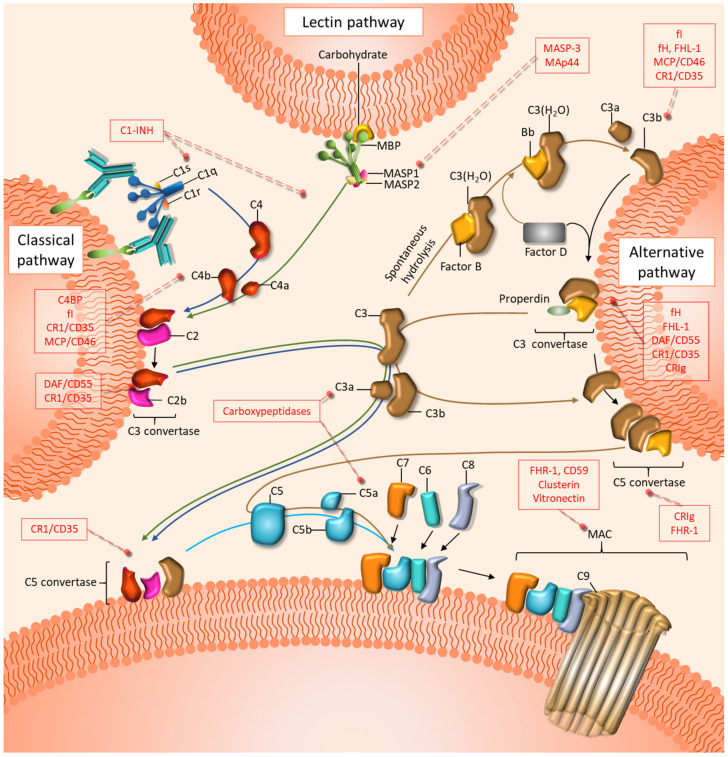
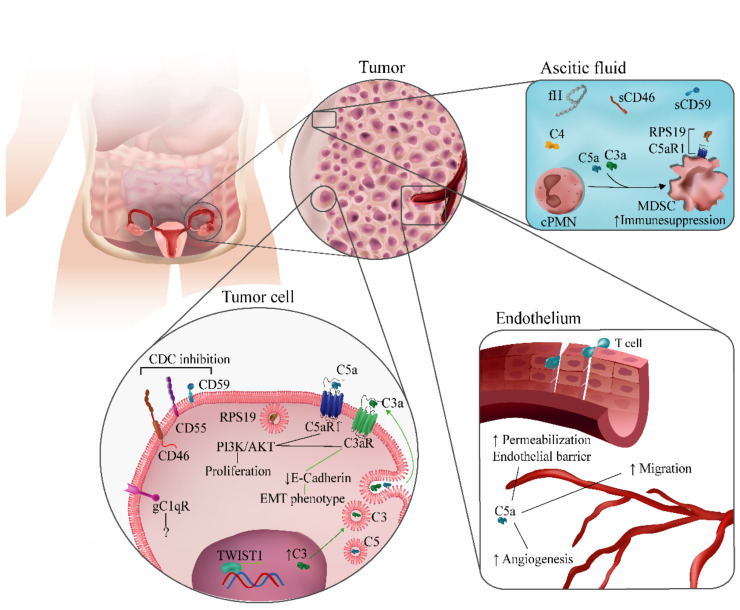
Ovarian cancer is one of the most lethal gynecological cancers. Current therapeutic strategies allow temporary control of the disease, but most patients develop resistance to treatment. Moreover, although successful in a range of solid tumors, immunotherapy has yielded only modest results in ovarian cancer. Emerging evidence underscores the relevance of the components of innate and adaptive immunity in ovarian cancer progression and response to treatment. Particularly, over the last decade, the complement system, a pillar of innate immunity, has emerged as a major regulator of the tumor microenvironment in cancer immunity. Tumor-associated complement activation may support chronic inflammation, promote an immunosuppressive microenvironment, induce angiogenesis, and activate cancer-related signaling pathways. Recent insights suggest an important role of complement effectors, such as C1q or anaphylatoxins C3a and C5a, and their receptors C3aR and C5aR1 in ovarian cancer progression. Nevertheless, the implication of these factors in different clinical contexts is still poorly understood. Detailed knowledge of the interplay between ovarian cancer cells and complement is required to develop new immunotherapy combinations and biomarkers. In this context, we discuss the possibility of targeting complement to overcome some of the hurdles encountered in the treatment of ovarian cancer.
卵巢癌是最致命的妇科癌症之一。目前的治疗策略只能暂时控制病情,但大多数患者会对治疗产生耐药性。此外,尽管免疫疗法在一系列实体瘤中取得了成功,但在卵巢癌中仅取得了有限的效果。新出现的证据强调了先天性和适应性免疫成分在卵巢癌进展和治疗反应中的相关性。特别是在过去十年中,作为先天性免疫支柱的补体系统已成为癌症免疫中肿瘤微环境的主要调节因子。肿瘤相关的补体激活可能支持慢性炎症、促进免疫抑制微环境、诱导血管生成并激活癌症相关信号通路。最近的见解表明补体效应分子,如C1q或过敏毒素C3a和C5a,及其受体C3aR和C5aR1在卵巢癌进展中起重要作用。然而,这些因素在不同临床背景中的意义仍知之甚少。需要详细了解卵巢癌细胞与补体之间的相互作用,以开发新的免疫治疗组合和生物标志物。在此背景下,我们讨论了靶向补体以克服卵巢癌治疗中遇到的一些障碍的可能性。